
Syllabus: Conservation, environmental pollution and degradation, environmental impact assessment.
Context: Madhav Gadgil, a pioneering ecologist and people’s conservationist, passed away in Pune on Wednesday after a brief illness at the age of 83. He shifted the global conservation paradigm by giving primacy to human rights over exclusive wildlife protection, advocating for marginalised forest communities.
Western Ghats
- Overview and Significance
-
-
- The Western Ghats are a UNESCO World Heritage Site and among the world’s eight biodiversity hotspots.
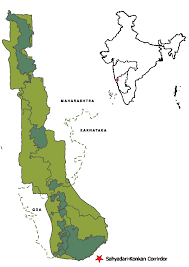
- They extend along the western Deccan Plateau across Gujarat, Maharashtra, Goa, Karnataka, Kerala, Tamil Nadu.
- The region hosts over 7,400 species, with exceptionally high endemism in plants and animals.
- They act as the origin of major peninsular rivers like Godavari, Krishna, and Kaveri.
- By intercepting monsoon winds, the Ghats generate high rainfall and regulate regional climate.
- The terrain includes lateritic plateaus, escarpments, valleys, and peaks like Anai Mudi (2,695 m).
-
- Geological Formation
-
- The Western Ghats are part of the Precambrian Peninsular Shield, older than 600 million years.
- They formed through cratonic uplift and volcanism, not through fold-mountain orogeny.
- Massive Deccan Trap basaltic lava flows created step-like highlands during volcanic eruptions.
- As India drifted from Gondwana, faulting and subsidence along the western edge formed escarpments.
- Over time, monsoon-driven erosion carved deep valleys, leaving residual plateaus and lateritic caps.
- Key Ecological and Governance Issues
-
- Flawed forest governance relies on outdated, inflated data, undermining ecological planning.
- Industrial pollution persists in fragile zones, often with state support and weak accountability.
- Forest Rights Act, 2006 remains poorly implemented, denying Community Forest Rights to tribals.
- Monoculture plantations of eucalyptus and acacia degrade biodiversity and soil health.
- Pesticide-intensive practices reduce pollinators and microbial diversity.
- Anthropogenic forest fires, linked to tendu leaf collection, threaten wildlife habitats.
- Aggregated forest data masks local degradation due to delayed, district-level reporting.
Conservation Committees
- Western Ghats Ecology Expert Panel (2011) under Madhav Gadgil advocated Ecologically Sensitive Areas (ESA) zoning, Community Forest Rights enforcement, and Gram Sabha-led governance.
- Kasturirangan Committee (2013) diluted ESA coverage, prioritising development over participatory conservation.
Way Forward
- Implement Community Forest Rights to empower local stewardship and sustainable livelihoods.
- Strengthen democratic decentralisation through empowered Gram Sabhas.
- Modernise monitoring using real-time, open-access satellite data for transparency.
- Restrict ecologically destructive industries in sensitive zones and wildlife corridors.
- Promote biodiversity-compatible livelihoods like NTFPs, eco-tourism, and agro-forestry.
Conclusion
- The Western Ghats are critical for ecological stability, water security, and climate resilience.
- Sustainable conservation requires community empowerment, scientific data, and just governance.