
Why in News: The International Court of Justice (ICJ) has delivered a landmark advisory opinion stating that states have legal obligations under international law to protect the climate system.
Background
Climate Threat: Climate change is an existential challenge, especially for small island states.
ICJ Role: The International Court of Justice (World Court) issues advisory opinions—not legally binding but authoritative interpretations of international law, influencing state behaviour.
Past Impact: Example – UK’s return of Chagos Islands to Mauritius followed an ICJ advisory opinion.
Request Origin: Small island states pushed the UN General Assembly to seek this opinion on states’ climate obligations.
Core Legal Findings of the ICJ Advisory Opinion
Binding Obligations:
- States must protect the climate system under climate treaties (UNFCCC, Kyoto Protocol, Paris Agreement), scientific consensus, and general/customary international law.
Treaty Interpretation:
- 1.5°C recognised as the binding temperature goal.
- NDCs must reflect the highest possible ambition and be backed by proactive, achievable measures.
Climate Justice (CBDR-RC):
- Action standards vary by historical emissions, development level, and national circumstances.
- Developed nations have a legal duty to provide finance and technology for mitigation and adaptation, assessed on good faith and due diligence.
No ‘Self-Contained Regime’:
- Climate duties also stem from other environmental treaties, Law of the Sea, and customary law, including due diligence, harm prevention, and cooperation.
Human Rights Link:
- Climate action must ensure a just transition and protect vulnerable populations’ rights; treaty withdrawal does not remove obligations.
Accountability:
- Emissions can be scientifically attributed to individual states, enabling responsibility.
Strategic Significance for the Global South
1. Legal Leverage Against Major Emitters
- Advisory opinion strengthens the ability of developing nations to hold high-emission countries accountable for climate inaction.
- Provides a legal foundation for strategic climate litigation at national, regional, and international levels.
2. Strengthened Claims for Climate Justice
- Reinforces the principle of Common But Differentiated Responsibilities and Respective Capabilities (CBDR-RC).
- Recognises historical responsibility, development status, and national circumstances in assessing obligations.
3. Enhanced Access to Climate Finance & Technology
Establishes that developed nations have a legally binding duty to provide:
- Financial resources
- Technology transfer
- Support for both mitigation and adaptation
- Breach can be judged on good faith and due diligence, giving legal weight to funding demands.
4. Protection of Vulnerable Populations
- Links climate obligations to human rights protection, especially for vulnerable communities.
- Ensures that climate action incorporates a just transition without harming socio-economic rights.
5. Resistance to Unfair Burden-Sharing
- Legal basis for opposing disproportionate climate measures that penalise developing economies.
- Empowers Global South to negotiate fairer emission targets and timelines in climate agreements.
6. Political & Diplomatic Influence
- Boosts negotiating power in COP and other climate forums.
- Aligns small island states and large developing economies (like India) in coalitions for stronger climate commitments from the Global North.
Conclusion
- The ICJ’s opinion transforms climate pledges into enforceable legal duties, deepens the link between climate action and human rights, and enhances the negotiating and legal leverage of vulnerable nations in global climate governance.
UPSC Relevance
International Relations (GS-II):
- Role of the International Court of Justice
Environment and Ecology (GS-III)
Mains Practice Question
Q: The recent advisory opinion of the International Court of Justice (ICJ) on climate change has reinforced the legal obligations of states to combat climate change. Discuss the significance of this opinion for international climate governance and India’s role in leveraging it for climate justice.
Prelims Facts
International Court of Justice (ICJ) – Key Points
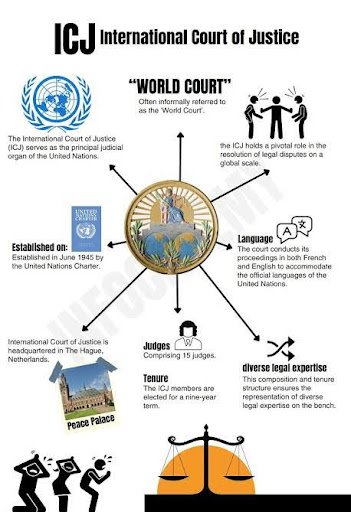
- Also Known As: World Court
- Established: June 1945 by the UN Charter; started functioning April 1946
- Seat: Peace Palace, The Hague, Netherlands
- UN Organs: Only principal UN organ not based in New York
- Official Languages: English and French
- Hearings: Always public
Powers and Functions
Types of Cases:
1. Contentious Cases:
- Disputes between states on issues like territorial sovereignty, maritime boundaries, use of force, humanitarian law, diplomatic relations.
- Judgments are final and binding on the parties, with no appeal.
2. Advisory Opinions:
- Requests from UN bodies or specialized agencies on legal questions.
- Opinions not binding, but authoritative and influential.
Decision Basis: International law including treaties, customs, general principles, judicial decisions, and expert writings.
Composition
Number of Judges: 15 judges, all from different countries
Term: 9 years; one-third elected every 3 years
Election: By majority in both the UN General Assembly and Security Council
Independence: Judges do not represent their countries after election
Judge ad hoc: States without a judge of their nationality on the bench may appoint a judge ad hoc for a specific case