


Director General of Civil Aviation (DGCA)

Context: The DGCA revised passenger refund norms, placing refund responsibility on airlines even for tickets booked through travel agents/portals. The new rules also introduce refund provisions for medical emergencies, allowing passengers to choose between cash refunds or credit shells, while retaining free name change within 24 hours for booking errors.
About DGCA
- Regulatory body in civil aviation primarily dealing with safety issues ensuring air transport security nationwide.
- Attached office of Ministry of Civil Aviation functioning under administrative control for policy implementation.
- Headquarters: New Delhi serving as central hub for civil aviation regulation in India.
Mandate of DGCA
- Responsible for regulation of air transport services to/from/within India and enforcement of civil air regulations.
- Enforces air safety and airworthiness standards ensuring compliance by airlines and aircraft operators comprehensively.
- Coordinates regulatory functions with International Civil Aviation Organisation (ICAO) for global aviation standards alignment.
Functions and Responsibilities of DGCA
- Safety Oversight
- Main function: ensure safety of passengers and crew members on all flights operating in India comprehensively.
- Investigates incidents/accidents within Indian airspace; takes appropriate action to prevent similar incidents in future ensuring accountability.
- Industry Development
- Crucial role in growth and development of Indian aviation industry working closely with airlines and airport operators.
- Plays crucial role in developing new airports, modernizing existing facilities ensuring they meet growing aviation demands effectively.
- Air Traffic Regulation
- Responsible for regulation of air traffic in India; works closely with Airports Authority of India (AAI) ensuring coordination.
- Ensures air traffic managed safely and efficiently across Indian airspace preventing congestion and accidents comprehensively.
- Licensing and Certification
- Issues licenses and certificates to pilots, aircraft maintenance engineers, and other aviation personnel ensuring qualified workforce.
Critical Minerals

Critical minerals
- Critical minerals are essential for modern technologies, low-emission applications, and national security, but their supply is vulnerable due to limited availability and geographical concentration.
- India aims for self-reliance in critical minerals under the National Critical Mineral Mission (NCMM, 2025).
- Applications
- Used in EVs, wind turbines, solar panels, rechargeable batteries, and low-emission technologies.
- Key for electronics, semiconductors, aerospace, defence, medical equipment, and even common products like stainless steel.
- Technological demand and supply dynamics determine their criticality.
- Global and Indian Context
- Top producers: Chile, Indonesia, Congo, China, Australia, South Africa.
- India’s critical minerals (2023): 30 identified, including Lithium, Cobalt, Graphite, REEs, Nickel, Copper, Titanium, etc.
- Legal framework: 24 minerals added to Part D of Schedule I of MMDR Act, 1957, giving the Central Government exclusive auctioning powers.
- A Centre of Excellence for Critical Minerals (CECM) will regularly review the list and advise policy.
National Critical Mineral Mission (NCMM, 2025)
- Objective: Achieve self-reliance across the critical mineral value chain: exploration, mining, processing, recycling, and end-of-life recovery.
- Exploration: Geological Survey of India (GSI) to conduct 1,200 projects (2024–2031) targeting domestic production of at least 15 critical minerals.
- Global acquisition: Indian companies to acquire 50 mining assets worldwide.
- Fast-track approvals: Regulatory simplification for mining projects.
- Recycling and Stockpiling
- Incentive scheme: INR 1,500 crore (~USD 170 million) to recover 400 kilotonnes of recycled minerals.
- National Critical Minerals Stockpile: At least 5 critical minerals to mitigate supply chain risks.
- Research and Development
- Achieve self-sufficiency in processing 5 critical minerals.
- Generate 1,000 patents across the value chain by 2031.
- Set up 4 regional mineral processing parks and 3 Centres of Excellence.
- Governance
- An Empowered Committee on Critical Minerals will coordinate and implement NCMM initiatives.
- CECM and NCMM together ensure strategic oversight, policy guidance, and monitoring.
- Significance for India:
- Reduces import dependence for key minerals like lithium, cobalt, REEs.
- Supports EV, solar, and wind sectors and the net-zero 2070 goal.
- Strengthens industrial growth, energy security, and strategic autonomy.
Large Language Models (LLMs)
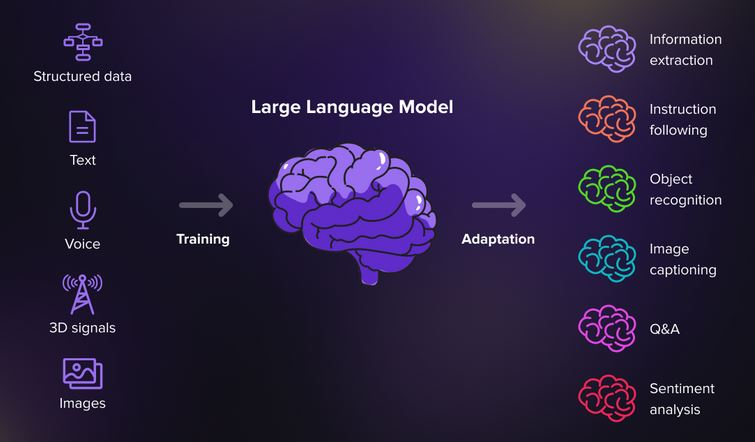
What is an LLM?
- An LLM is a type of Artificial Intelligence (AI) program capable of recognising and generating text, among other tasks.
- It is built on machine learning, specifically a type of neural network called a transformer model, which excels at handling sequences of words and capturing patterns in text.
- LLMs use a type of machine learning called deep learning to understand how characters, words, and sentences function together.
- Deep learning involves probabilistic analysis of unstructured data, enabling the model to recognise distinctions between content without human intervention.
How are LLMs Trained?
- Trained on huge datasets, often thousands or millions of gigabytes of text gathered from the internet.
- The quality of training data significantly impacts how well an LLM learns natural language.
- After initial training, LLMs are further refined through tuning i.e. either fine-tuning or prompt-tuning to perform specific tasks.
What are LLMs Used For?
- Capable of performing various language tasks such as answering questions, summarising text, translating languages, and generating content.
- Businesses use LLM-based applications to:
- Improve employee productivity and efficiency.
- Provide personalised recommendations to customers.
- Accelerate ideation, innovation, and product development.
- LLMs serve as the foundational technology behind popular Generative AI (GenAI) tools such as ChatGPT, Claude, Microsoft Copilot, Gemini, and Meta AI.
Removal of Judges in India
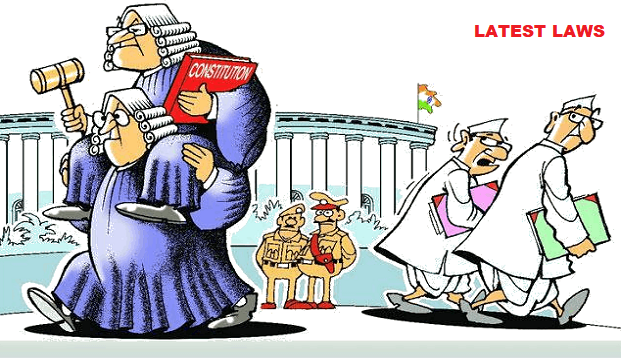
Context: Lok Sabha Speaker has reconstituted the three-member inquiry committee examining grounds for removal of Justice Yashwant Varma, originally constituted in March 2025 following allegations that bundles of burnt cash were discovered at his residence.
Removal of Judges
- Constitutional Provisions (Supreme Court)
- Article 124(4): A Supreme Court judge can be removed only by an order of the President, after both Houses of Parliament pass a removal motion in the same session with a special majority i.e. supported by at least two-thirds of members present and voting.
- The removal is permitted only on grounds of proved misbehaviour or incapacity
- The Supreme Court has clarified that misbehaviour includes wilful misconduct, corruption, lack of integrity, or offences involving moral turpitude.
- Article 124(5): Parliament is empowered to frame a law laying down the detailed procedure for investigating charges which led to the enactment of the Judges (Inquiry) Act, 1968.
- Constitutional Provisions (High Court)
- Article 217(1)(b): A High Court judge can be removed by the President following the same procedure as that for a Supreme Court judge.
- Article 218: The rules applicable to Supreme Court judges also apply to High Court judges.
- Judges (Inquiry) Act, 1968
- Since the Constitution does not lay down a detailed removal procedure, the Judges (Inquiry) Act, 1968 provides a structured process for investigating allegations and reporting to Parliament.
Procedure for Removal
- Step 1: Notice of Motion
- A notice of motion must be signed by:
- At least 50 members in the Rajya Sabha, or
- At least 100 members in the Lok Sabha
- The Chairman of Rajya Sabha or Speaker of Lok Sabha may admit or refuse to admit the motion after due consideration.
- A notice of motion must be signed by:
- Step 2: Constitution of Inquiry Committee
- If the motion is admitted, a three-member Committee is constituted comprising:
- A Judge of the Supreme Court
- A Chief Justice of a High Court
- A Distinguished Jurist
- If the motion is admitted, a three-member Committee is constituted comprising:
- Step 3: Investigation
- The Committee frames specific charges and conducts a detailed investigation
- In cases of alleged physical or mental incapacity (if denied by the judge), a Medical Board is appointed
- After investigation, the Committee submits a report to the Chairman/Speaker with findings on each charge
- Step 4: Parliamentary Action
- The report is laid before the concerned House(s) of Parliament
- If the Committee finds no misbehaviour or incapacity then the motion is dropped
- If misbehaviour or incapacity is proved then the motion proceeds for voting
- If the Motion is Rejected
- The Speaker’s decision is final within the House then no mandatory reasons are required.
- MPs can file a writ petition in the Supreme Court questioning rejection on grounds of arbitrariness or illegality under Article 226/32, though success is limited.
- A fresh motion can be submitted to the Rajya Sabha Chairman with at least 50 signatures.
Note: Till today, no judge has ever been removed from office in India thus making this an extremely rare and carefully regulated process designed to safeguard judicial independence.
Bankim Chandra Chattopadhyay
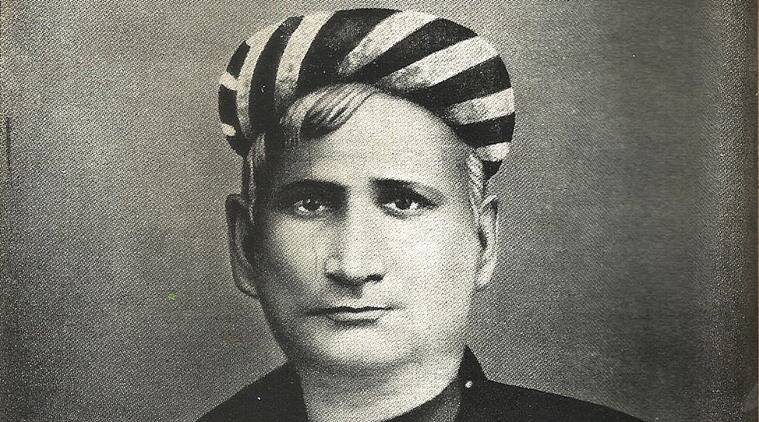
About
- Born on 27th June 1838, Bankim Chandra Chattopadhyay was a renowned novelist, social satirist, journalist, and a prominent face of the Bengal Renaissance.
- He also served as a lawyer and district judge
Notable Works
- Vande Mataram
- Composed Vande Mataram in Sanskrit.
- The first two verses were adopted as India’s National Song.
- It served as a powerful source of inspiration during the freedom struggle.
- Vande Mataram is featured in his celebrated novel Anandamath (1882).
- Anandamath (1882)
- Set against the backdrop of the Sanyasi Rebellion (1770–1820).
- The Sanyasis rose in rebellion following the great famine of 1770 in Bengal, which caused acute chaos and misery.
- Considered one of the finest texts in Indian literature.
- Bangadarshan
- Founded the monthly literary magazine Bangadarshan in 1872.
- Through this publication, Bankim is credited with influencing the emergence of a Bengali identity and nationalism.
- Other Notable Works
- Durgeshnandini (1865),
- Kapalkundala (1866),
- Chandrasekhar (1877),
- Krishnakanter Will (1878),
- Anandamath (1882),
- Devichaudhrani (1884),
- Bishabriksha (The Poison Tree),
- Rajmohan’s Wife
Protectionism
Context: Former German Chancellor Angela Merkel, delivering the inaugural Dr. Manmohan Singh Memorial Lecture recalled Dr. Singh’s warnings after the 2008 global financial crisis that difficulties required “cooperation, not confrontation”, making his advocacy against trade protectionism particularly relevant in today’s fractured global economic order.
What is Protectionism?
- Protectionism refers to government policies that restrict international trade to protect domestic industries from foreign competition. The key tools used are:
- Tariffs (Customs Duties)
- A tax or duty placed on imported goods or services
- It is the most common and visible form of protectionism
- Directly increases the price of imported products, making domestic goods more competitive
- Also serves as a source of government revenue
- Example: A 25% tariff on imported steel makes domestically produced steel cheaper for manufacturers
- Quotas (Import Restrictions)
- A limit placed on the quantity or monetary value of a specific good that can be imported over a defined period.
- Unlike tariffs, quotas restrict supply regardless of price.
- By artificially limiting import volumes, quotas ensure domestic producers retain a specific share of the local market.
- Example: Allowing only 5,00,000 foreign cars to be imported annually.
- Subsidies
- Direct or indirect financial assistance provided by the government to domestic producers.
- Lowers production costs for domestic companies, enabling them to sell at lower prices and compete against cheaper imports i.e. without directly taxing foreign goods.
- Example: Tax breaks or cash grants to local farmers or renewable energy companies.
- Non-Tariff Barriers (NTBs)
- Strict Quality Standards: Imposing overly strict health, safety, or environmental standards that foreign companies find difficult or expensive to meet.
- Complex Customs Procedures: Using bureaucratic red tape and lengthy inspection processes to delay entry of foreign goods.
- Local Content Requirements: Mandating that a certain percentage of a product’s components must be sourced domestically.
Central Drugs Standard Control Organization (CDSCO)
Context: The CDSCO has revised testing norms to speed up new drug approvals by allowing companies to begin laboratory testing immediately after filing applications, eliminating waiting periods for detailed scrutiny.
About CDSCO
- Basic Overview
- CDSCO is the National Regulatory Authority (NRA) of India for the medical devices industry
- Operates under the provisions of the Drugs & Cosmetics Rules
- Functions under the Ministry of Health & Family Welfare
- Headquarters: New Delhi
- Headed by the Drugs Controller General of India (DCGI)
- Under the Drugs and Cosmetics Act, CDSCO is responsible for:
- Approval of New Drugs
- Conduct of Clinical Trials
- Laying down standards for Drugs
- Control over the quality of imported Drugs
- Coordination of activities of State Drug Control Organizations
- CDSCO, along with state regulators, is jointly responsible for granting licenses for certain specialized categories of critical drugs, including:
- Blood and Blood Products
- I.V. Fluids
- Vaccines and Sera
New GDP Series
Base Year Revision
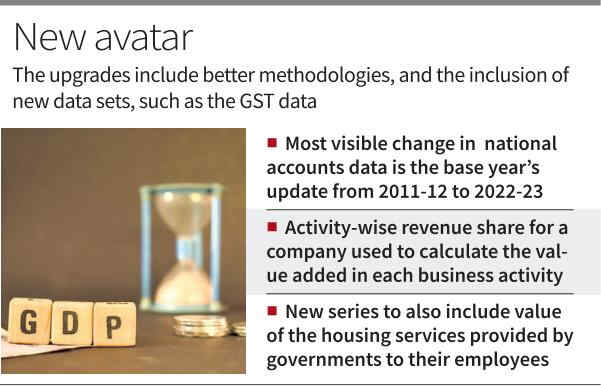
- Base year updated from 2011-12 to 2022-23. This makes GDP and GVA data a more accurate representation of the current economy.
Methodological Changes (Sector Wise)
- Non-Financial Private Corporate Sector
- Earlier: Entire company’s GVA was allocated to the sector where the bulk of activity occurred
- Now: Activity-wise revenue share is used to calculate value added in each business activity, capturing all sectoral activity more accurately
- General Government Sector
- Earlier: Value of housing services provided by government to employees was not included
- Now: Such housing services are included, capturing government output more accurately
- Earlier: Limited coverage of autonomous institutes and local bodies
- Now: Coverage has been enhanced for autonomous institutes and local bodies
- Earlier: Value of housing services provided by government to employees was not included
- Household Sector
- Earlier: Data was extrapolated from older surveys
- Now: ASUSE (Annual Survey of Unincorporated Sector Enterprises) and PLFS (Periodic Labour Force Survey) are used on an annual basis for direct estimation
- Private Final Consumption Expenditure
- Earlier: Less granular measurement
- Now: More granular measurement through enhanced use of Household Consumer Expenditure Surveys and direct estimation based on production data
New Data Sources Introduced
- GST Data
- Earlier: Used only in quarterly accounts and for some sectors in annual data
- Now:
- Used to estimate regional output of private corporations
- Used to determine contribution of private companies to GDP more accurately
- Used to identify active private companies to improve estimation of non-reporting companies
- Banking Sector
- Earlier:Proxy-based approach used for estimating activity of private NBFCs
- Now: Replaced by actual financial data of NBFCs sourced from the Ministry of Corporate Affairs
- Earlier: Limited use of RBI data
- Now: STRBI (Statistical Table Related to Banks in India) published by RBI used to estimate activity of both public and private sector banks
- Earlier:Proxy-based approach used for estimating activity of private NBFCs
- Local Bodies & State Autonomous Bodies
- Earlier: Limited reporting from states — data was largely imputed.
- Now: States have enhanced their reporting from local bodies and state autonomous bodies, enabling direct estimation rather than imputation.
Infrastructure Investment Trust (InvIT)
What is an InvIT?
- InvIT is an investment vehicle, similar to a mutual fund or Real Estate Investment Trust (REIT).
- It enables direct investment from both individual and institutional investors in infrastructure projects.
- Investments can be made directly or through a Special Purpose Vehicle (SPV) / Holding Company by the InvIT.
How Does an InvIT Work?
- A Sponsor (Infrastructure Company or Private Equity Firm) establishes the InvIT and transfers infrastructure assets to it.
- The InvIT Trust holds these assets and issues investment units to investors.
- Investors receive units representing an ownership stake in the underlying infrastructure assets.
- InvITs earn income through tolls, rents, interest, or dividends from their investments.
- The interest, dividend, and rental income are taxable in the hands of the unitholder.
Regulatory Framework
- Regulated by SEBI under the SEBI (Infrastructure Investment Trusts) Regulations, 2014.
- SEBI mandates that InvITs must distribute at least 90% of their income to investors.
- InvITs are recognised as borrowers under the Securitisation and Reconstruction of Financial Assets and Enforcement of Security Interest (SARFAESI) Act, 2002.
