

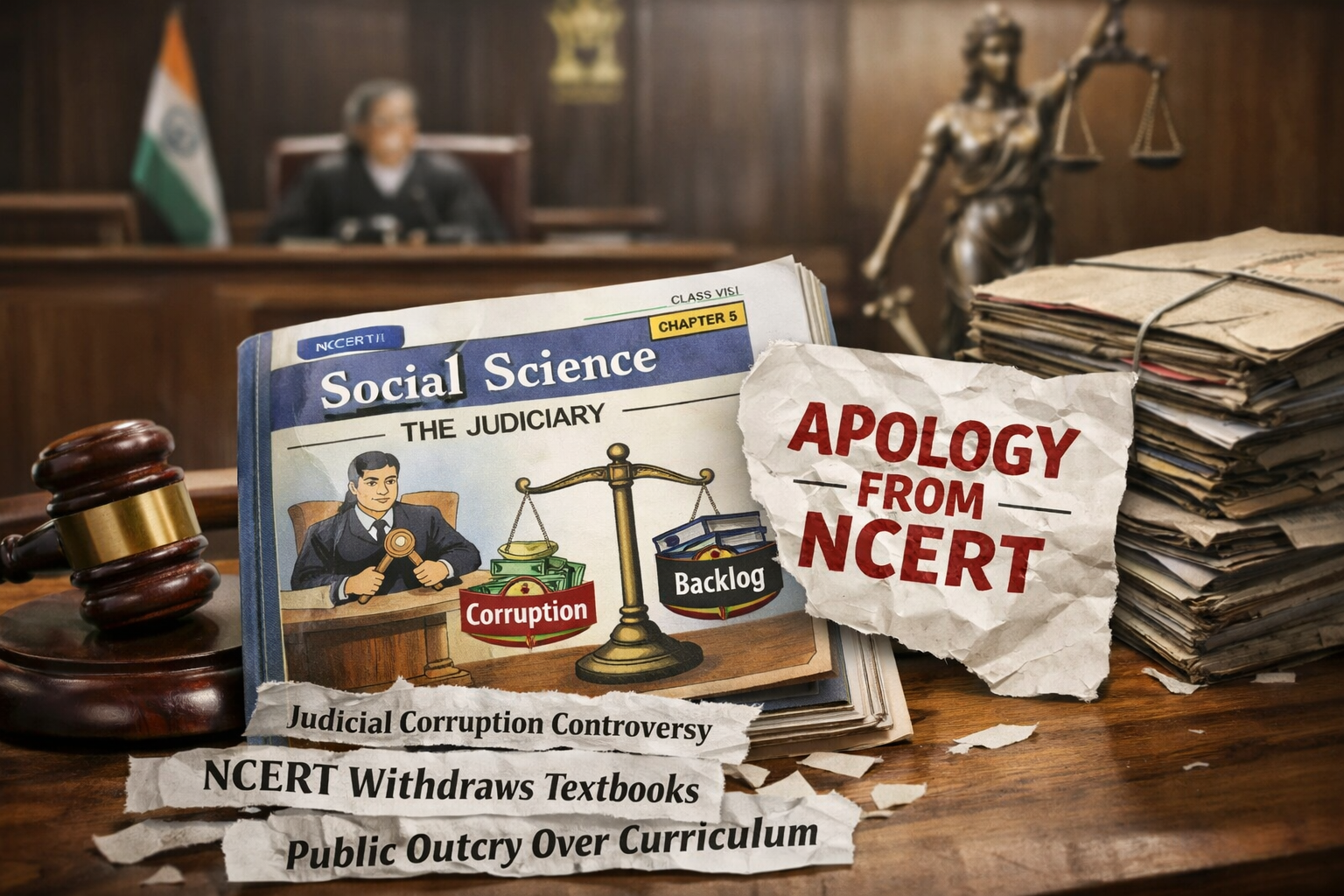
Context
- NCERT’s Class VIII Social Science textbook added a chapter on judiciary including corruption and backlog. The additions triggered controversy, forcing NCERT to issue an apology and reportedly withdraw the textbooks.
- The episode highlights how judicial corruption remains a sensitive but constitutionally important public concern.
Scale of Judicial Corruption in India
- 8,630 complaints were received against sitting judges in the Chief Justice of India’s office over the last 10 years.
- Only a very few complaints led to in-house inquiry committees, revealing a deeply inadequate accountability mechanism.
- Transparency International’s 2007 Global Corruption Report found 77% of Indians surveyed described the judicial system as corrupt.
- Several judges and Chief Justices of the Supreme Court have openly acknowledged corruption within the judiciary.
- In August 2020, the then Attorney General K.K. Venugopal stated he had names of nine corrupt higher judiciary judges.
- He further revealed that seven of these judges admitted corruption after their retirement, with documented extracts.
Forms of Judicial Corruption
- Corruption manifests beyond financial misconduct thus including abuse of discretion, nepotism, and conflict of interest.
- Misuse of authority by judges represents a grave and deep-rooted problem widely recognised by the public.
Why Accountability Mechanisms Are Failing
- The judiciary is not subject to public scrutiny, making it difficult to bring corruption to light.
- Fear of contempt of court prevents public exposure of corrupt practices against individual judges.
- There is no independent mechanism to investigate complaints against higher judiciary judges effectively.
- The only constitutional process is impeachment, which requires signatures of at least 100 Lok Sabha or 50 Rajya Sabha members.
- Impeachment depends on prevailing political will rather than the actual merits of the complaint filed.
- The in-house mechanism created by the judiciary itself is virtually non-functional without external examination or investigation.
- Serious allegations are never reached the stage of formal inquiry, making accountability mechanisms largely ineffective.
Consequences of Unchecked Judicial Corruption
- Lack of accountability further erodes public confidence in judicial integrity and institutional legitimacy.
- When information is suppressed or restricted, public distrust of the judiciary grows significantly stronger.
- Corruption in the judiciary is far more serious than in the executive branch given its constitutional role.
Way Forward
- Public discourse on judicial corruption is essential before any meaningful corrective measures can be implemented.
- Inclusion of judicial accountability in NCERT curriculum aligns with constitutional values of transparency and democratic governance.
- An independent external mechanism for investigating complaints against judges must be urgently established.
- Transparent and merit-based complaint resolution must replace the current self-regulated in-house inquiry system.
