

Changing Nature of Income Mobility in India (2014–2025)
- Downward mobility nearly doubled from 14% in 2015 to 26.8% in 2025 across all Indian households.
- By 2025, more than one in four households are worse-off than their 2014 income position.
- Upward mobility rose gradually from 14.1% to 23.5%, but consistently trailed the rise in downward movement.
- The economy shows growing vulnerability and uneven gains rather than broad-based upward progress.
The Great Gatsby Curve
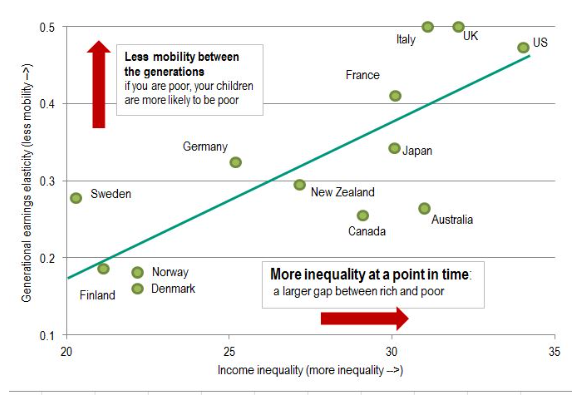
- Rising income inequality makes it harder for poorer households to move upward. Districts with wider income gaps show higher downward mobility among vulnerable families.
- This reflects the Great Gatsby Curve i.e. the more unequal a society, the lower its economic mobility.
- In unequal settings, children born into poverty face limited access to quality education, healthcare, and networks.
- Wealth and opportunities tend to circulate within already privileged groups.
- As inequality rises, aspiration weakens and mobility becomes structurally restricted.
- The data suggest that growth without equity does not guarantee upward progress.
Structural and Spatial Dimensions of Inequality
- Rural households bear the worst impact as nearly 29% are worse-off than their 2014 position by 2025.
- Rural downward mobility saw its sharpest deterioration in the first subperiod (2014–19), persisting thereafter.
- Urban India fares comparatively better, with upward mobility improving at a faster pace than rural areas.
- Economic gains remain heavily concentrated in urban centres, deepening the rural-urban divide.
- Households in more unequal districts are more likely to slip down the income ladder than climb up.
Social Fault Lines in Economic Mobility
- Downward mobility has risen across all social groups since 2014, with OBC and SC households hit hardest.
- By 2025, roughly a quarter or more of OBC and SC households are worse-off than their 2014 position.
- For SC households, the problem is less dramatic descent and more persistent narrowing of pathways upward.
- Caste remains a decisive fault line in income mobility — equal economic ascent remains largely illusory.
- Muslim households show weaker upward mobility compared to Hindus, reflecting entrenched discrimination.
- Education, urban location, and larger household size are associated with better mobility prospects.
Political Economy and Policy Context
- The COVID-19 pandemic caused massive humanitarian and economic disruption, reversing mobility gains significantly.
- Neglect of the informal sector and agriculture contributed to lower upward income mobility across groups.
- Rising downward mobility sits uneasily with political claims of steadily falling inequality and expanding opportunity.
Implications for Inclusive Growth and Social Stability
- An economy where more households slip down than climb up cannot sustain social stability for long.
- When inequality hardens into reduced mobility, frustration replaces aspiration among vulnerable populations.
- Policy must move beyond headline GDP growth toward strengthening health, education, and employment-intensive sectors.
- Policies addressing caste and religious discrimination are central to restoring mobility, not merely matters of welfare.
- Broad-based inclusion requires targeted interventions in rural areas where vulnerability remains persistently high.
