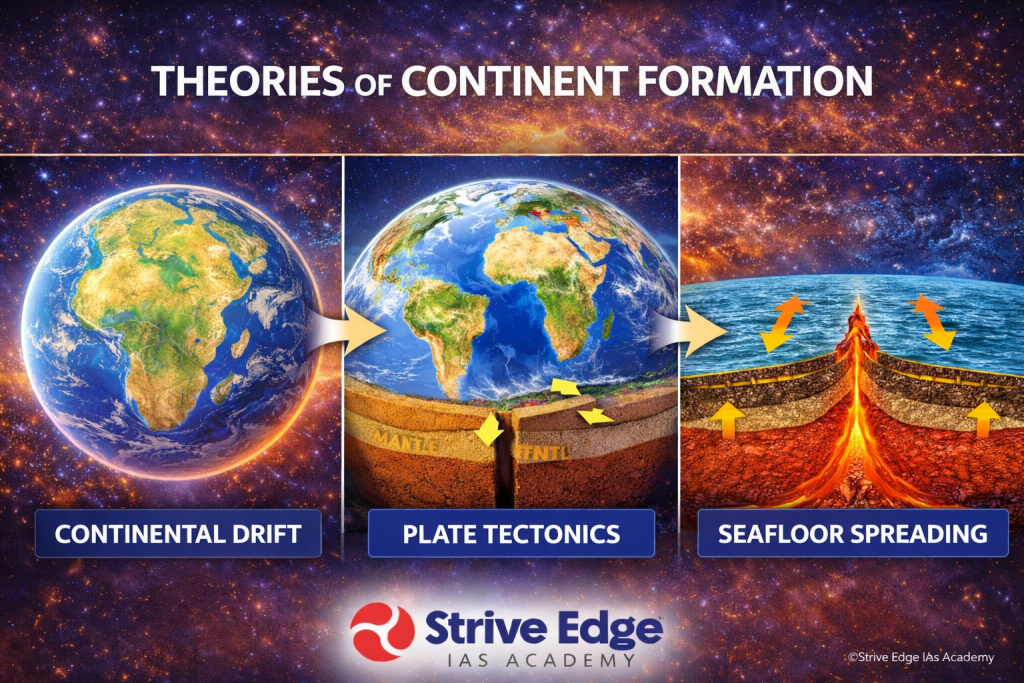
1. CONTINENTAL DRIFT THEORY
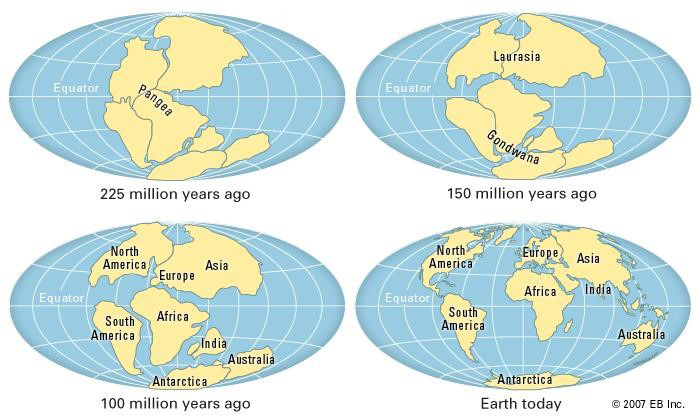
The Continental Drift Theory, proposed in 1912 by German meteorologist Alfred Wegener, sought to explain the present distribution of continents and oceans. It marked a revolutionary shift in geological thinking by suggesting that continents were once united and have since drifted apart over geological time.
- According to Wegener, all the present-day continents were once part of a single supercontinent called Pangaea, meaning “all Earth”.
- This landmass was surrounded by a vast, unified ocean known as Panthalassa.
- He observe that the continent were break-up;
- Pangaea (Initial Split ~200 million years ago) began to rift and divide into two large landmasses:
- Laurasia in the Northern Hemisphere
- Gondwanaland in the Southern Hemisphere
- Over time, Laurasia and Gondwanaland fragmented into smaller continents, these fragments drifted gradually into their current positions, forming the Earth’s modern geography.
- Pangaea (Initial Split ~200 million years ago) began to rift and divide into two large landmasses:
- Wegener’s theory challenged the idea of static continents. Though initially rejected, it laid the foundation for Plate Tectonics and transformed our understanding of Earth’s dynamic crust and the evolution of continents and oceans.
Evidence Supporting the Continental Drift Theory
- Matching of Continents (Jig-Saw Fit) – The coastlines of South America and Africa fit together like puzzle pieces, especially along the Brazilian and Gulf of Guinea coasts. This visual alignment strongly suggests that these continents were once joined.
- Rocks of the Same Age Across Oceans – Radiometric dating reveals that rock formations on opposite sides of oceans (e.g., Eastern South America and Western Africa) are of similar age and composition. Indicates a shared geological history prior to their separation.
- Fossil Distribution
- Identical fossils of land and freshwater organisms are found on continents now separated by vast oceans:
- Example: Mesosaurus, a freshwater reptile, is found in both Southern Africa and Eastern South America.
- Such fossil evidence supports the idea that these landmasses were once connected, allowing species to spread.
- Identical fossils of land and freshwater organisms are found on continents now separated by vast oceans:
- Tillite Evidence (Glacial Deposits)
- Tillite (a rock formed from ancient glacial till) found in the Gondwana sediments has been identified across six southern landmasses: India, Africa, Australia, Antarctica, Madagascar, and Falkland Islands
- The widespread distribution of similar glacial deposits implies these continents were once connected and covered by a common ice sheet.
- Placer Deposits
- Gold-rich placer deposits along the Ghana coast have no local source rocks.
- These deposits match the mineral content of the Brazilian plateau, suggesting they were formed when Africa and South America were joined.
Forces Responsible for the Movement of Continents – Wegener’s View
- Pole-Fleeing (Centrifugal) Force
- The Earth’s rotation on its axis generates a centrifugal force, directed away from the poles toward the equator.
- Wegener believed this force contributed to the breaking of Pangaea and the equatorward drift of continents.
- He termed this force the “pole-fleeing force”, which supposedly pushed landmasses away from the rotational axis.
- Tidal Force
- Wegener also proposed the influence of tidal forces, resulting from the gravitational pull of the Moon and the Sun.
- He used this concept to explain the westward drift of the Americas, attributing it to lunar-solar drag.
- These tidal forces, combined with centrifugal forces, were thought to act as a driving mechanism for continental drift.
Limitations of Wegener’s Explanation
- Though Wegener correctly proposed that continents move, he could not provide a convincing mechanism for how they did so.
- The pole-fleeing force was too weak, and tidal forces could not account for the scale of continental movement.
- As a result, his theory faced strong criticism from the scientific community during his time.
Emergence of Plate Tectonic– Despite its flaws, Wegener’s theory laid the groundwork for the modern Plate Tectonics Theory, which emerged in the 1960s.
Convection Current Theory:
The Convection Current Theory is a pivotal concept in modern plate tectonics, providing the internal mechanism that drives the movement of tectonic plates.
- Proposed by Arthur Holmes in the 1930s, this theory forms the foundation of the Seafloor Spreading Hypothesis and explains various geological phenomena such as mountain building, earthquakes, volcanic activity, and oceanic trench and ridge formation.
- Holmes’ proposal later became a cornerstone in the development of the Plate Tectonics Theory during the 1960s and 1970s.
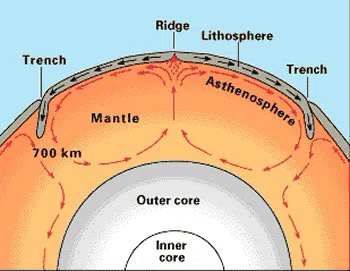
Convection currents are circular patterns of flow within a fluid medium (in this case, the Earth’s mantle), generated due to temperature and density differences.
- The Radioactive decay of elements (U, Th, K) deep in the mantle (Lower mantle is hotter than the upper mantle) generates heat which causes a density difference resulting in Hot, less dense material rises and Cooler, denser material sinks. This creates continuous convection cells—hot material rises, cools, then sinks.
- Tectonic plates (lithosphere) rest on the ductile asthenosphere. Convection currents in the mantle drag these plates.
- The Rising Limb leads to crust formation, ocean ridges at the divergent boundary and the Falling Limb leads to subduction, ocean trenches at the convergent boundary.
Dynamo theory: Generation of Earth’s Magnetic Field and Sustaining it
The Dynamo Theory explains Earth’s magnetic field as aresult of convection currents in the molten, conductive outer core. These flows, driven by heat and composition differences, generate electric currents that, through electromagnetic induction, sustain the geomagnetic field.
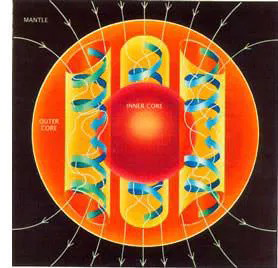
- Earth’s magnetic field is generated in the earth’s outer core.
- Located between 2900 km and 5100 km beneath the surface, the outer core is composed primarily of molten iron and nickel.
- Temperatures range from ~4400°C to 6000°C, yet due to relatively lower pressure than the inner core, the metal remains in a fluid state.
- This dynamic layer becomes the engine room of Earth’s magnetic activity.
- The driving forces behind the dynamo are the sources of heat generated through.
- Latent heat of crystallization as the inner core solidifies
- Radioactive decay of isotopes such as potassium-40, uranium-238, and thorium-232
- Gravitational energy from differentiation and compression
- These heat sources create temperature differentials, setting into motion vast convective currents within the molten core.