


Cauvery River
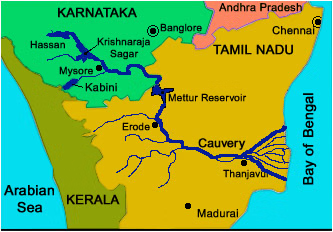
Origin & Course
- Cauvery River originates from Brahmagiri hills in Kodagu district, Karnataka, at 1,341 metres elevation.
- It flows for about 800 km and ultimately drains into the Bay of Bengal.
Geography
- Extent
- The basin covers 81,155 sq km, nearly 2.7% of India’s geographical area.
- It includes Karnataka, Tamil Nadu, Kerala, and Puducherry UT.
- Bounded by Western Ghats in the west and Eastern Ghats in east and south.
- Northern boundary is formed by ridges separating it from Krishna and Pennar basins.
- Flow Characteristics
- The river is perennial nature, with relatively less seasonal variation than other peninsular rivers.
- Upper basin receives southwest monsoon, while lower basin receives northeast monsoon rainfall.
- Tributaries
- Left bank tributaries include Harangi, Hemavati, Shimsha, Arkavati.
- Right bank tributaries include Lakshmana Tirtha, Kabbani, Suvarnavati, Bhavani, Noyil, Amaravati.
Indian Leopard
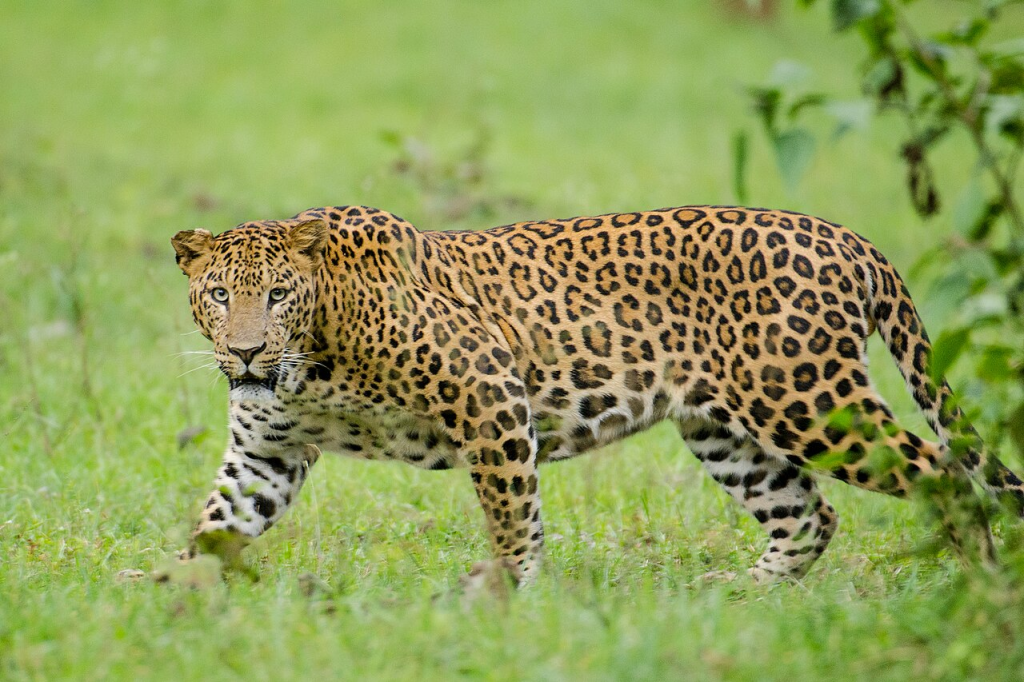
Overview
- The Indian leopard (Panthera pardus fusca) is a highly adaptable big cat, spread across the Indian subcontinent.
- It enjoys the highest legal protection under Schedule I of the Wildlife Protection Act, 1972.
- Globally, it is classified as Vulnerable (IUCN) and listed in CITES Appendix I.
Habitat & Distribution
- Unlike habitat-specialist species, leopards thrive across multiple ecosystems—from dense forests to dry grasslands.
- However, they are notably absent in deserts and Sundarbans mangroves.
- Central India and Eastern Ghats form the core population zone (8,071 individuals).
- Madhya Pradesh leads in numbers, followed by Karnataka and Maharashtra.
- Northeast India shows a sharp population decline, indicating uneven distribution.
Behaviour & Unique Traits
- Known as the most versatile predator, the leopard adapts easily even near human settlements.
- Presence of melanism leads to the iconic Black Panther, a genetic variation, not a separate species.
- Primarily nocturnal in behaviour, it hunts stealthily under cover of darkness.
- Diet is opportunistic, consisting of chital, hog deer, wild boar and other small herbivores.
Threats & Conservation Concerns
- Rapid habitat loss is forcing leopards into human-dominated landscapes, increasing conflict.
- Unlike tigers, leopards co-exist closer to humans, making encounters more frequent.
- Poaching and illegal wildlife trade continue to threaten populations.
- Declining prey base further stresses survival in fragmented habitats.
Global Positioning System (GPS)
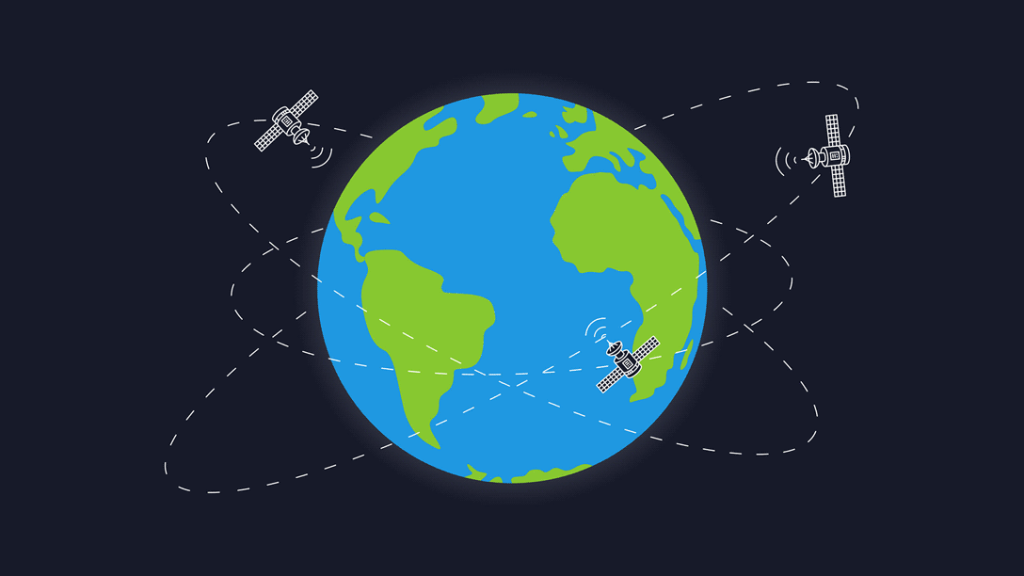
About GPS
- GPS was developed by the U.S. Department of Defence in 1973.
- First satellite was launched in 1978, marking the beginning of space-based navigation.
- The system currently operates through a constellation of 24 satellites.
- These satellites revolve in six orbital planes, ensuring global coverage.
- Each satellite completes two revolutions per day, maintaining continuous positioning support.
Three Core Segments (Backbone of GPS)
- Space Segment
- Comprises 24 satellites placed at about 20,200 km above Earth.
- Ensures that at least four satellites are visible from any point on Earth.
- Control Segment
- Consists of ground stations and antennas that monitor satellite performance.
- Responsible for tracking, corrections, and command transmission.
- User Segment
- Refers to applications across sectors like agriculture, logistics, defence, aviation, and disaster management.
- Represents the practical utility of GPS in everyday and strategic domains.
Working Mechanism
- Each satellite continuously transmits radio signals containing location and time information.
- Signals are sent at L1 and L2 frequencies, enabling precise communication.
- Uses Code Division Multiple Access (CDMA) to separate multiple signals.
- Requires signals from minimum four satellites to determine exact position.
- Location is calculated in four dimensions—latitude, longitude, altitude, and time.
SHANTI Act, 2025 and Nuclear Power
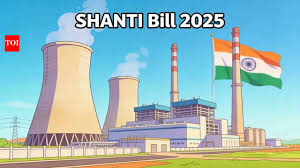
Context: India enacted the SHANTI Act, 2025 to expand nuclear capacity and enable private participation in the sector.
More in News
- The Act aims to increase nuclear capacity from 8.7 GW to 100 GW by 2047.
- It allows private participation and mobilisation of foreign investment in nuclear power.
- Operators are assigned clear liability and safety responsibilities, irrespective of ownership.
- Section 10 mandates strict compliance with safety, security and safeguards norms.
- The law establishes a unified legal framework, separating regulation from operational control.
- Periodic safety reviews are required every 10 years to ensure updated compliance standards.
Key Features of Nuclear Power Sector
- Nuclear power requires lifetime commitment, including waste management and plant decommissioning.
- Financial provisioning must account for radiation risks and compensation liabilities.
- Design integrity must be maintained throughout the entire operational life of the plant.
- Any technological change may affect multiple systems, requiring high regulatory precision.
Technology & Investment Aspects
- Indigenous 700 MW PHWR reactors identified as preferred option for expansion.
- Older 220 MW designs may need upgrades to meet modern safety standards.
- Foreign reactors involve high costs and long validation timelines.
- Investment decisions depend on site selection, cost, government support, and tariff viability.
OCI Cardholders
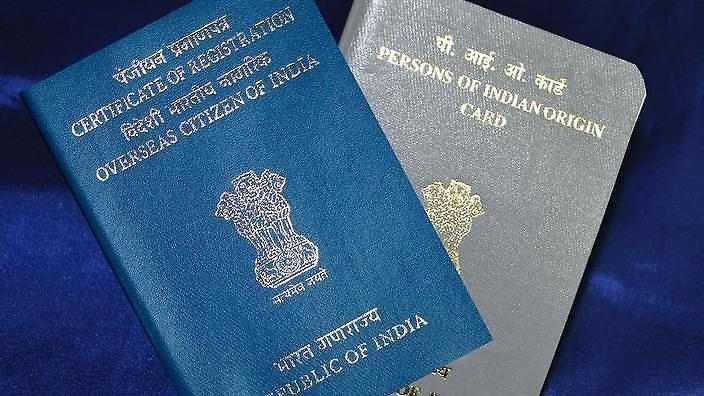
Context: India extended OCI eligibility to sixth generation persons of Indian origin in Sri Lanka, expanding diaspora outreach.
Recent Changes (India–Sri Lanka Angle)
- Earlier eligibility was limited to fourth generation, now extended to fifth and sixth generations.
- Move targets Indian-origin Tamil community, which forms about 7% population in Sri Lanka.
- OCI cards will be issued based on Sri Lankan government-certified documents.
- Initiative aligns with India’s Neighbourhood First policy and regional engagement strategy.
- Linked with broader cooperation including housing projects and $450 million assistance support.
About OCI Scheme
- OCI scheme introduced through amendment of Citizenship Act, 1955 (2005).
- In 2015, PIO and OCI categories merged into a single OCI category.
- As of January 2022, over 40.68 lakh OCI cards have been issued.
- OCI is not dual citizenship, but a form of lifelong residency and travel privilege.
- Eligibility Criteria
- Foreign nationals (except Pakistan and Bangladesh) with Indian ancestry are eligible.
- Includes children, grandchildren, and great-grandchildren of eligible persons.
- Minor children and spouses (marriage ≥2 years) also qualify under conditions.
- Foreign military personnel are not eligible for OCI registration.
Benefits of OCI Cardholders
- Granted lifelong visa with multiple-entry and multi-purpose travel to India.
- Enjoy parity with NRIs in economic, financial, and educational fields.
- Eligible for Indian citizenship after 5 years registration with residence conditions.
- Can invest and participate in schemes like National Pension System (NPS).
Restrictions on OCI
- OCI holders do not enjoy political rights, including voting or contesting elections.
- Not eligible for constitutional posts like President, Vice-President, Judges.
- Cannot be members of Parliament or State Legislatures.
- Restricted from public employment under Article 16, except special cases.
- Require prior approval for research, journalism, restricted area visits.
Fast Breeder Reactor (FBR)
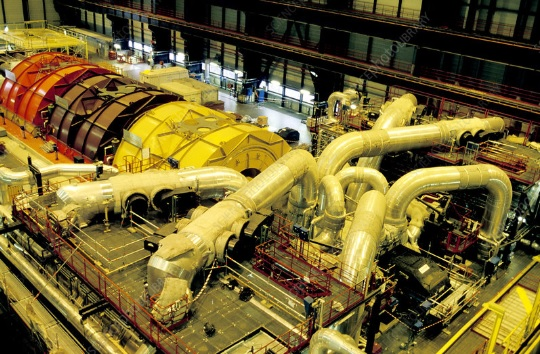
About FBR
- A Fast Breeder Reactor is a nuclear reactor that produces more fuel than consumed during operation.
- It uses fast neutrons to convert non-fissile material into fissile fuel.
- Uranium-238 is converted into Plutonium-239, enhancing fuel efficiency.
- The reactor core is surrounded by a fuel blanket, enabling continuous fuel generation.
Key Features of FBR
- Uses MOX fuel (Uranium-Plutonium mixed oxide) for energy generation.
- Operates with fast neutrons, unlike conventional thermal reactors.
- Ensures higher fuel utilisation through nuclear transmutation process.
- Capable of sustaining long-term energy production with fuel breeding capability.
Prototype Fast Breeder Reactor (PFBR)
- PFBR is India’s first indigenous fast breeder reactor, located at Kalpakkam (Tamil Nadu).
- Operated by BHAVINI under the Department of Atomic Energy (DAE).
- Marks entry into the second stage of India’s nuclear power programme.
- Designed to generate power while simultaneously producing new nuclear fuel.
India’s Three-Stage Nuclear Programme
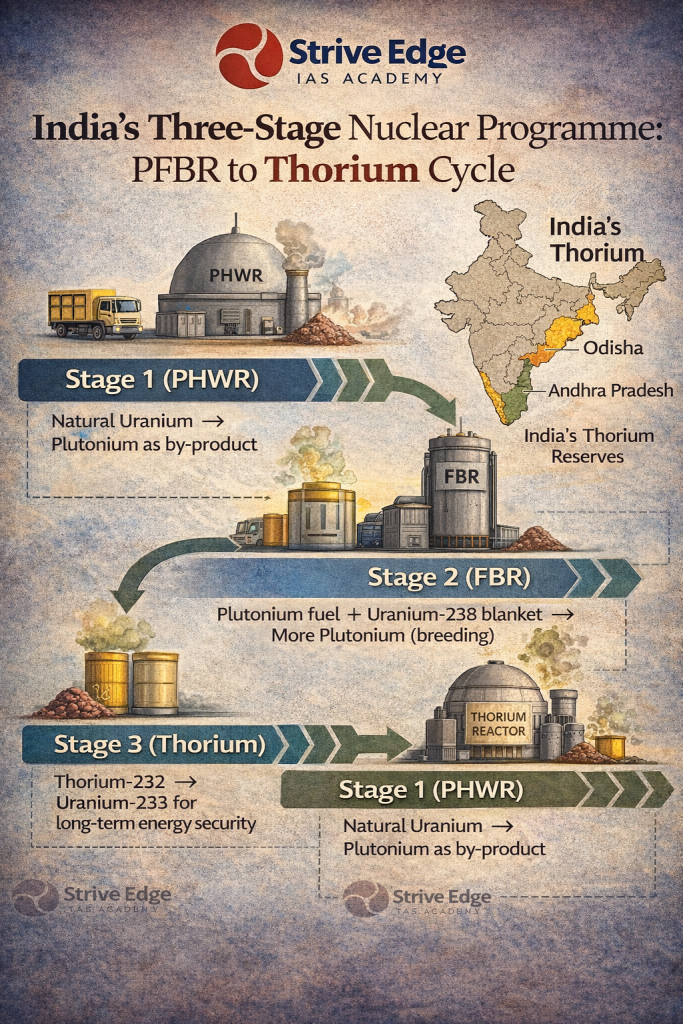
- Conceptualised by Homi J. Bhabha to utilise limited uranium and abundant thorium.
- Stage 1: Uses natural uranium reactors to produce plutonium.
- Stage 2: Uses FBRs to generate Plutonium-239 and breed more fuel.
- Stage 3: Focuses on thorium-based reactors, producing Uranium-233 as fuel.
Thorium & Strategic Significance
- India possesses about 25% global thorium reserves, mainly in coastal sands.
- Found in states like Kerala, Tamil Nadu, Odisha, Andhra Pradesh, and others.
- Thorium-232 is converted into Uranium-233, a future nuclear fuel.
- Ensures long-term energy security and reduces dependence on uranium imports.
