


Context: India is witnessing a gradual rise in female labour force participation, yet women remain underrepresented in leadership and decision-making roles, revealing a deeper structural imbalance.
Trends in Female Labour Force Participation (FLFP)
- Improving participation rates: Female LFPR has increased to about 39.3% (2023), showing steady recovery.
- Global comparison gap: India’s FLFP (~49%) still lags behind countries like Brazil and Vietnam (~53%), indicating untapped potential.
- Economic transition factor: Shift towards a developed economy requires higher female workforce participation, as highlighted in global studies.
- Sectoral contribution: Labour-intensive sectors like manufacturing and textiles have played a key role in increasing participation.
The Leadership Gap: Where Women Are Missing
- Corporate leadership deficit: Women constitute only about 13% of top executives in major companies.
- Entrepreneurship gap: Only around 27% of businesses are women-owned, reflecting limited economic agency.
- Political representation linkage: Low participation in decision-making mirrors broader issues seen in governance and public life.
- Institutional imbalance: Women’s presence in technical institutions like IITs remains low (around 14% faculty representation).
Sectoral and Regional Dimensions
- Urban-rural divide: Participation varies significantly, with rural distress and informal work driving female employment.
- State-level variations: Southern States show relatively higher participation compared to northern regions with restrictive norms.
- Service vs manufacturing imbalance: Growth in services has not adequately translated into quality employment for women.
Structural Barriers to Women’s Economic Participation
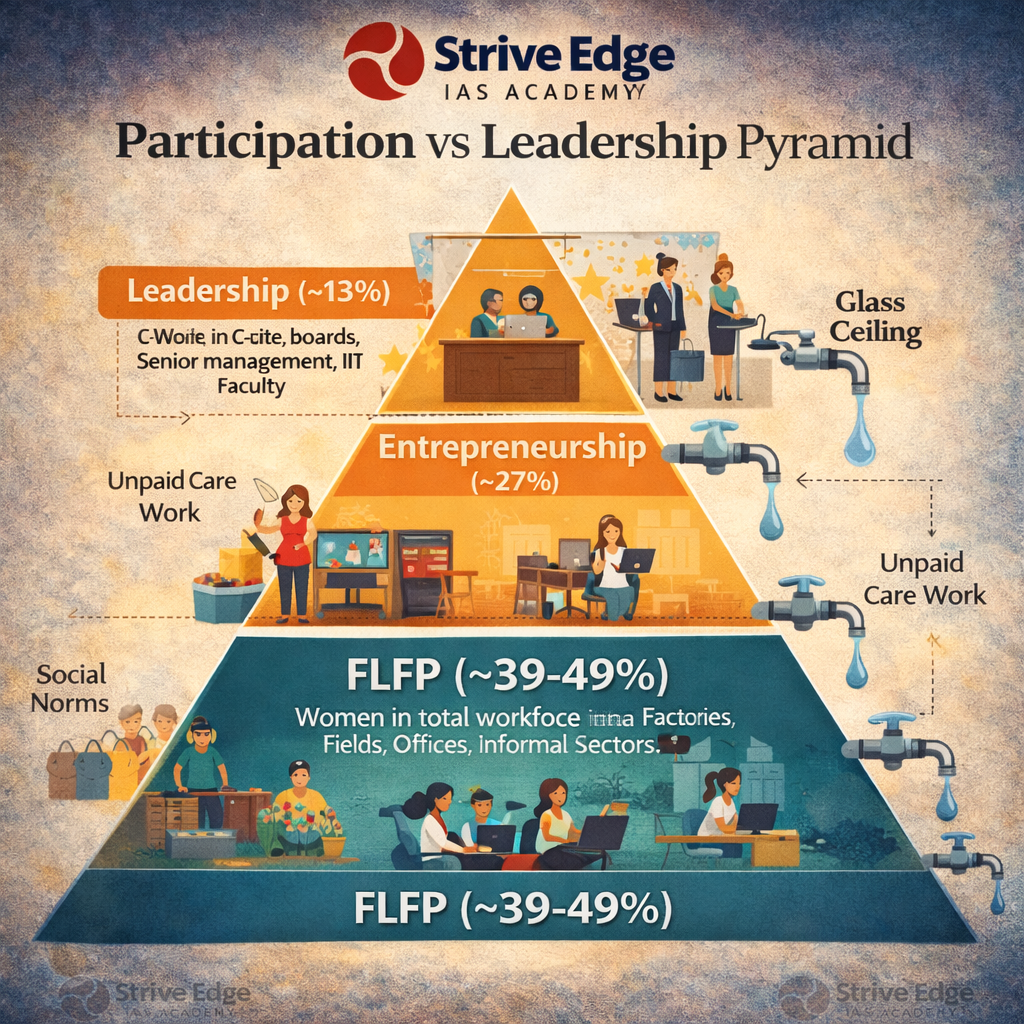
- Social norms and unpaid care work: Women continue to shoulder disproportionate household responsibilities, limiting workforce mobility.
- Workplace barriers: Issues of safety, lack of flexible work, and gender bias restrict career progression.
- Skill and education gaps: Despite higher education enrolment, transition into employment remains weak and discontinuous.
- Glass ceiling effect: Women face invisible barriers in rising to leadership and decision-making roles.
Way Forward
- Promote quality employment: Focus on sectors that generate stable and well-paying jobs for women.
- Strengthen care infrastructure: Expand childcare and support systems to reduce unpaid work burden.
- Encourage leadership pathways: Ensure representation of women in corporate boards and decision-making roles.
- Skill and education alignment: Bridge the gap between education and employment through targeted skilling initiatives.
- Address social norms: Promote gender-sensitive policies and awareness to enable greater workforce inclusion.
Conclusion
- India’s progress lies not just in increasing women’s participation, but in ensuring their meaningful inclusion in positions of power. Bridging the gap between presence and influence is essential for achieving truly inclusive and sustainable economic growth.
