

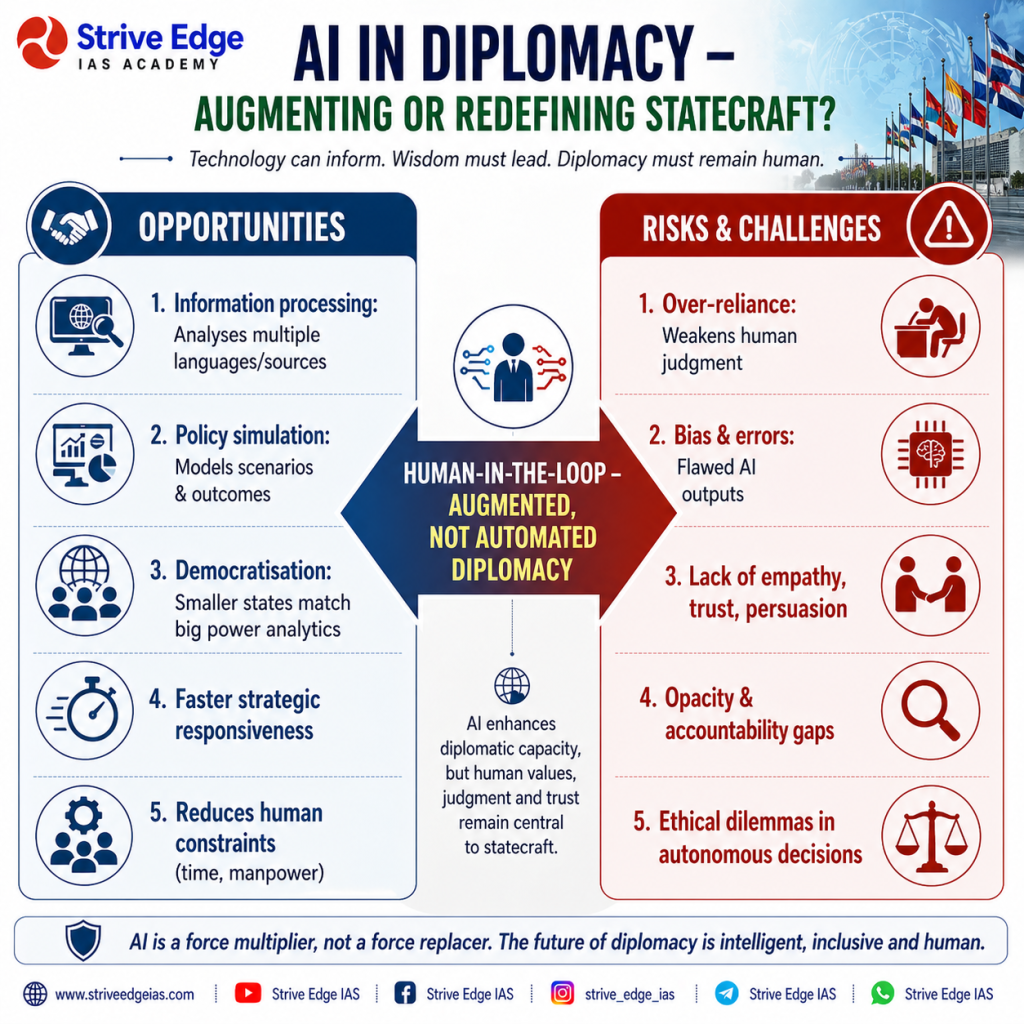
Context: The integration of Artificial Intelligence (AI) into diplomacy, exemplified by experiments such as AI-assisted diplomatic tools, signals a major shift in how foreign policy and national security decision-making are conducted. This transformation raises a deeper question: whether AI will merely assist diplomats or fundamentally redefine the nature of diplomacy itself.
Changing Nature of Diplomacy
- Diplomacy has historically evolved with technology from the telegraph to radio to the internet, each reducing distance and increasing speed of communication.
- AI represents a qualitatively different shift: it does not just transmit information but can interpret, predict, simulate, and generate policy options.
- Unlike earlier tools, AI introduces a new dimension of cognitive augmentation, potentially reshaping decision-making processes.
- Diplomacy is moving from a communication-driven practice to an intelligence-driven system.
Role of AI in Diplomatic and Strategic Functions
- Information Processing: AI can analyse vast datasets across multiple languages, sources, and timeframes, reducing information asymmetry.
- Policy Simulation: AI systems can model negotiation scenarios, crisis responses, and strategic outcomes, aiding anticipatory governance.
- Decision Support: AI can generate drafts, briefs, and policy options, improving efficiency and consistency in diplomatic work.
- Institutional Memory Enhancement: AI reorganises and retrieves historical diplomatic knowledge, strengthening continuity in decision-making.
Opportunities for States in Global Power Dynamics
- Democratisation of Diplomacy: Smaller states and limited-resource governments can leverage AI to match analytical capabilities of larger powers.
- Enhanced Strategic Responsiveness: AI enables quicker adaptation to fast-evolving geopolitical scenarios.
- Reduction of Human Constraints: Traditional limitations of manpower and time can be mitigated through AI-assisted processes.
Risks and Ethical Concerns
- Over-reliance on AI: Excessive dependence may weaken human judgment, intuition, and contextual understanding.
- Loss of Human Dimension: Diplomacy relies on empathy, trust-building, and persuasion, which AI cannot fully replicate.
- Bias and Errors: AI-generated outputs may contain biases or misinterpretations, leading to flawed decisions.
- Opacity and Accountability: Decision-making based on AI systems raises concerns about transparency and responsibility.
- The challenge lies in ensuring that AI augments rather than erodes the human essence of diplomacy.
Impact on National Security Bureaucracy
- Transformation of Bureaucratic Processes: AI is likely to replace slow, hierarchical, paper-based systems with agile, data-driven workflows.
- Cognitive Load Shift: While reducing routine work, AI may increase complexity in decision evaluation and oversight.
- Need for Skill Transition: Diplomats and officials must develop technological literacy alongside traditional diplomatic skills.
- Institutional Adaptation: Bureaucracies must evolve to integrate AI tools while maintaining accountability and ethical standards.
- AI is pushing national security systems towards adaptive, knowledge-driven governance models.
Way Forward
- Human-in-the-Loop Approach: Ensure that AI remains a decision-support tool, not a decision-maker.
- Ethical and Regulatory Frameworks: Develop norms to ensure accountability, transparency, and fairness in AI use.
- Capacity Building: Train diplomats and bureaucrats in AI literacy and interdisciplinary skills.
- Balanced Integration: Combine technological efficiency with human intuition and diplomatic sensibility.
- The objective should be to create a model of “augmented diplomacy” rather than automated diplomacy.
Conclusion
- AI is not merely transforming tools of diplomacy but is reshaping the very nature of statecraft and national security decision-making. The future of diplomacy will depend on how effectively nations balance technological capability with human wisdom, ensuring that progress strengthens rather than undermines trust, dialogue, and global cooperation.
