

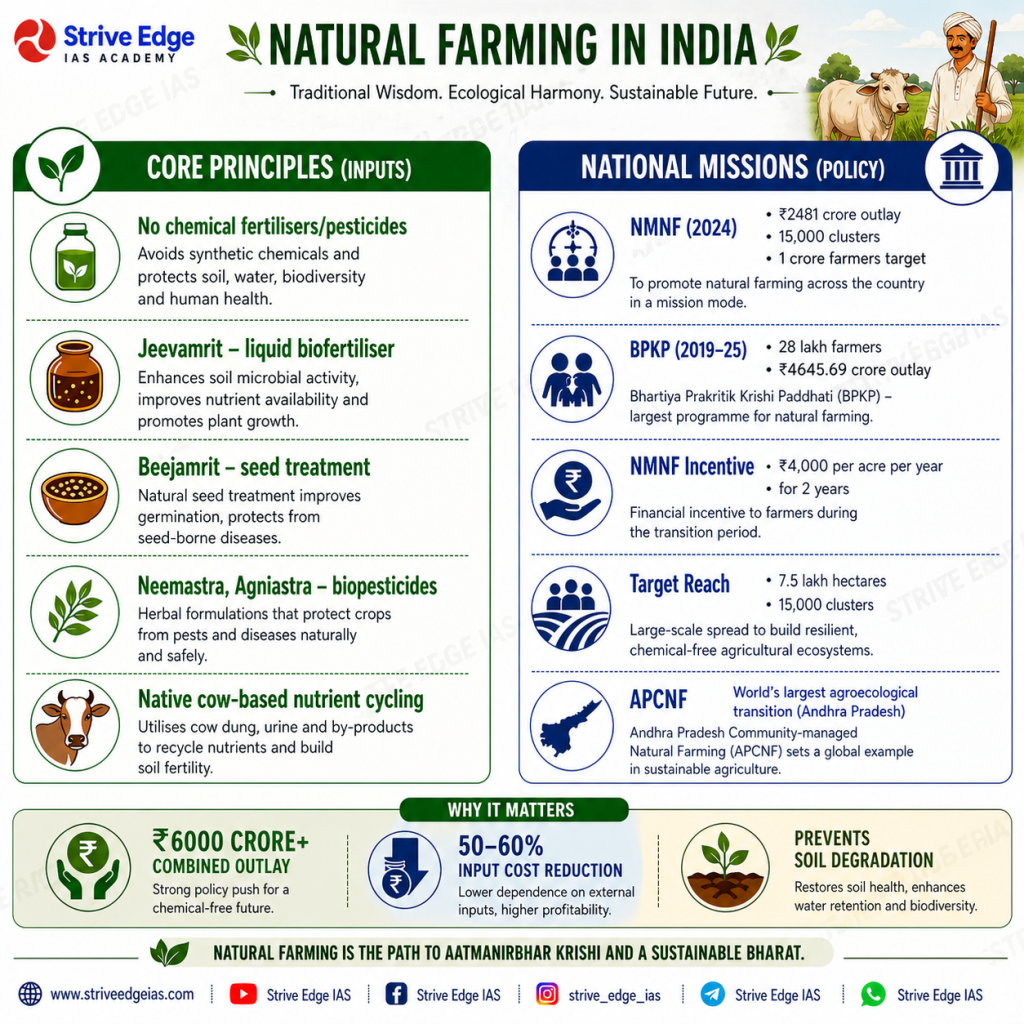
Context: Natural farming has emerged as a key pillar in India’s transition towards sustainable agriculture, addressing concerns of soil degradation, rising input costs, and climate vulnerability. It aligns with India’s broader developmental goals of ecological balance, farmer welfare, and food security, while reducing dependence on chemical-intensive agriculture.
Understanding Natural Farming
- Definition: Natural farming is a chemical-free, agroecological farming system, integrating crops, livestock, trees, and biodiversity into a self-sustaining ecosystem.
- Philosophical Basis: It follows the principle of “working with nature”, minimising external intervention and promoting natural processes.
- Core Features:
- Complete avoidance of chemical fertilisers, pesticides, and growth regulators
- Use of on-farm bio-inputs such as Jeevamrit, Beejamrit, Neemastra, and Agniastra
- Integration of native cow-based inputs for nutrient cycling
- Adoption of mixed cropping, intercropping, agroforestry, and crop rotation
- Emphasis on soil health, mulching, microbial activity, and water efficiency
- Natural farming represents a shift from input-intensive agriculture to ecosystem-based farming systems.
Ecological and Scientific Significance
- Soil Health Restoration: Enhances soil organic carbon, microbial activity, and long-term fertility.
- Biodiversity Conservation: Supports pollinators, beneficial insects, and soil organisms, strengthening ecological balance.
- Climate Resilience: Improves farm resilience against droughts, erratic rainfall, and climate variability.
- Reduced Emissions: Eliminates use of nitrogenous fertilisers, thereby reducing greenhouse gas emissions.
- It contributes to a model of agriculture that is both environmentally sustainable and climate-resilient.
Socio-Economic Benefits for Farmers and Rural Livelihoods
- Reduced Cost of Cultivation: Input costs decline by 50–60%, as farmers rely on locally available resources.
- Income Stability: Diversified cropping systems reduce risk and provide multiple income streams.
- Long-Term Productivity: Soil regeneration leads to sustained or improved yields over time.
- Employment Generation: Creates opportunities in bio-input preparation, seed systems, and local value chains.
- Health and Nutrition: Chemical-free produce ensures food safety and improved nutritional outcomes.
- Women Empowerment: Women play a key role in bio-input preparation, community farming, and self-help groups.
- Natural farming strengthens both economic resilience and social inclusion in rural areas.
Government Initiatives and Policy Support
- National Mission on Natural Farming (NMNF):
- Targets 7.5 lakh hectares across 15,000 clusters
- Aims to benefit 1 crore farmers
- Provides ₹4,000 per acre per year (for 2 years) as incentive
- Bhartiya Prakritik Krishi Paddhati (BPKP):
- Supports 28 lakh farmers across 9.4 lakh hectares.
- Cluster-Based Approach: Promotes community-level adoption and ecosystem development.
Challenges in Mainstreaming Natural Farming
- Knowledge and Skill Gap: Requires ecological understanding and continuous training, which many farmers lack.
- Behavioural Resistance: Farmers accustomed to chemical inputs hesitate to adopt labour-intensive and knowledge-driven practices.
- Regional Variability: Agro-climatic diversity makes uniform implementation difficult.
- Market Constraints: Lack of assured premium pricing and stable markets discourages adoption.
- Infrastructure Gaps: Limited availability of bio-input resource centres and supply chains.
- Policy Coordination Issues: Convergence across schemes and departments remains administratively complex.
- These challenges indicate that scaling natural farming requires systemic transformation, not isolated interventions.
Way Forward
- Cluster-Based Expansion: Develop contiguous natural farming zones to enable peer learning and economies of scale.
- Strengthen Extension Systems: Deploy Krishi Sakhis, KVKs, and community resource persons for capacity building.
- Improve Market Linkages: Develop certification systems and connect farmers to APMCs, FPOs, and niche markets.
- Promote Research and Innovation: Encourage region-specific agroecological practices and scientific validation.
- Enhance Digital Support: Use geo-tagging, mobile advisories, and data systems for monitoring and outreach.
- Ensure Policy Convergence: Integrate natural farming with livestock, rural development, and food processing sectors.
- A holistic approach is essential to transition from pilot success to nationwide adoption.
Conclusion
- Natural farming offers a pathway towards sustainable, low-cost, and climate-resilient agriculture, addressing both ecological and socio-economic challenges. Its success lies in combining traditional wisdom with modern policy support, ensuring that agriculture becomes not only productive but also equitable, resilient, and environmentally responsible.
