

Context
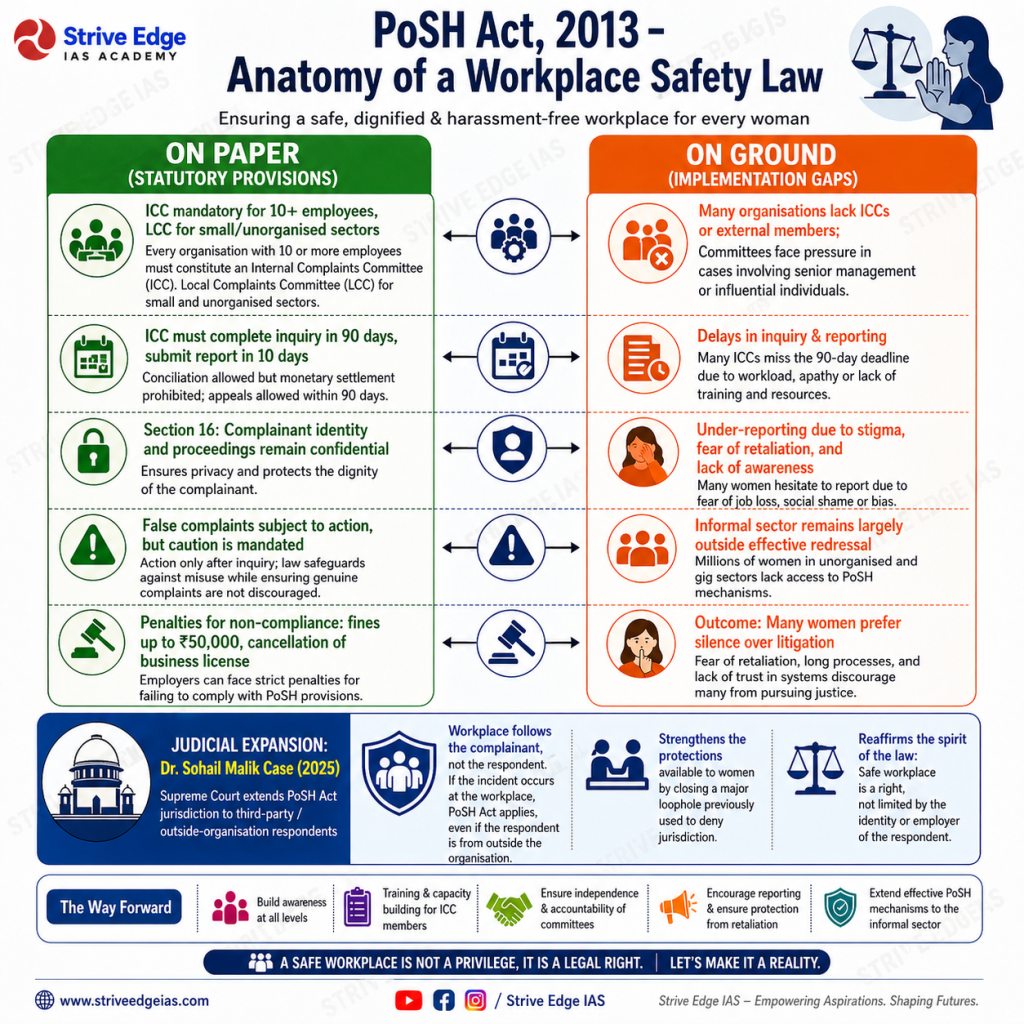
- The Sexual Harassment of Women at Workplace (Prevention, Prohibition and Redressal) Act, 2013 was enacted following the Supreme Court’s landmark Vishaka Guidelines (1997) to address workplace harassment. Despite a strong legal framework, concerns persist regarding implementation gaps, under-reporting, and institutional accountability, especially in evolving workspaces.
About PoSH Act, 2013
- The Act defines sexual harassment broadly to include physical contact, sexual advances, requests for favours, sexually coloured remarks, and other unwelcome conduct.
- It adopts an expansive definition of workplace, covering both organised and unorganised sectors, including transportation and off-site work environments.
- The term aggrieved woman includes all women irrespective of age or employment status, including domestic workers and clients.
- Confidentiality provision (Section 16) ensures that the identity of the complainant and details of proceedings are protected.
- The Act establishes a structured grievance mechanism through:
- Internal Complaints Committee (ICC) in organisations with 10+ employees
- Local Complaints Committee (LCC) at district level for smaller or informal workplaces
- These committees have quasi-judicial powers, including conducting inquiries and recommending action within prescribed timelines.
Institutional Mechanism and Redressal Process
- Complaint Filing: Complaints must be filed within three months, extendable by another three months under valid reasons.
- Conciliation Option: Allowed before inquiry, but monetary settlement is prohibited, ensuring dignity-based resolution.
- Time-bound Inquiry:
- Inquiry to be completed within 90 days
- Report submission within 10 days
- Action and Appeal:
- Employer must act based on ICC/LCC recommendations
- Appeal can be made within 90 days
- Safeguards Against Misuse: Provision exists for action in case of false complaints, though to be applied cautiously.
- These frameworks aim to balance victim protection with procedural fairness.
Issues and Challenges in Implementation
- Institutional Gaps
- Many organisations fail to constitute ICCs properly, or lack external members, weakening the enforcement mechanism.
- Example: Several national sports federations have not constituted ICCs, reflecting systemic gaps.
- Informal Sector Exclusion
- With nearly 80% of women employed in the informal sector, access to PoSH mechanisms remains limited due to unclear employer structures and weak enforcement.
- Procedural Ambiguity
- Lack of clarity in inquiry procedures, evidence standards, and roles of committee members affects consistency and fairness.
- Limited awareness among women regarding complaint mechanisms further restricts utilisation.
- Under-reporting and Social Barriers
- Victims often refrain from reporting due to stigma, fear of retaliation, and career consequences.
- Workplace hierarchies and power imbalances further discourage complaints.
- Evidence and Interpretation Challenges
- Sexual harassment often occurs in private settings, making evidence collection difficult.
- Grey areas exist in distinguishing between miscommunication and harassment, influenced by cultural and social perceptions.
- These challenges highlight that legal provisions alone are insufficient without institutional sensitivity and awareness.
Way Forward
- Standardised Inquiry Framework: Develop clear protocols and training for ICC members to ensure legally robust and sensitive investigations.
- Strengthen Independence of ICCs: Safeguards must be enhanced, especially in cases involving senior management, to ensure impartiality.
- Victim-Centric Approach: Ensure confidentiality, protection from retaliation, and safe working conditions during inquiry.
- Awareness and Sensitisation: Regular programmes to address gender biases and promote workplace dignity.
- Improve Evidence Handling: Adopt structured methods for evaluating digital records, witness testimonies, and documentation.
- Extend Coverage to Informal Sector: Strengthen LCCs and outreach mechanisms to ensure universal access to justice.
Conclusion
- The PoSH Act represents a critical step in ensuring safe, dignified, and equitable workplaces for women, rooted in constitutional values of equality and dignity. However, its true impact depends on effective implementation, institutional accountability, and societal transformation, ensuring that every woman can work without fear or discrimination.
