

Context
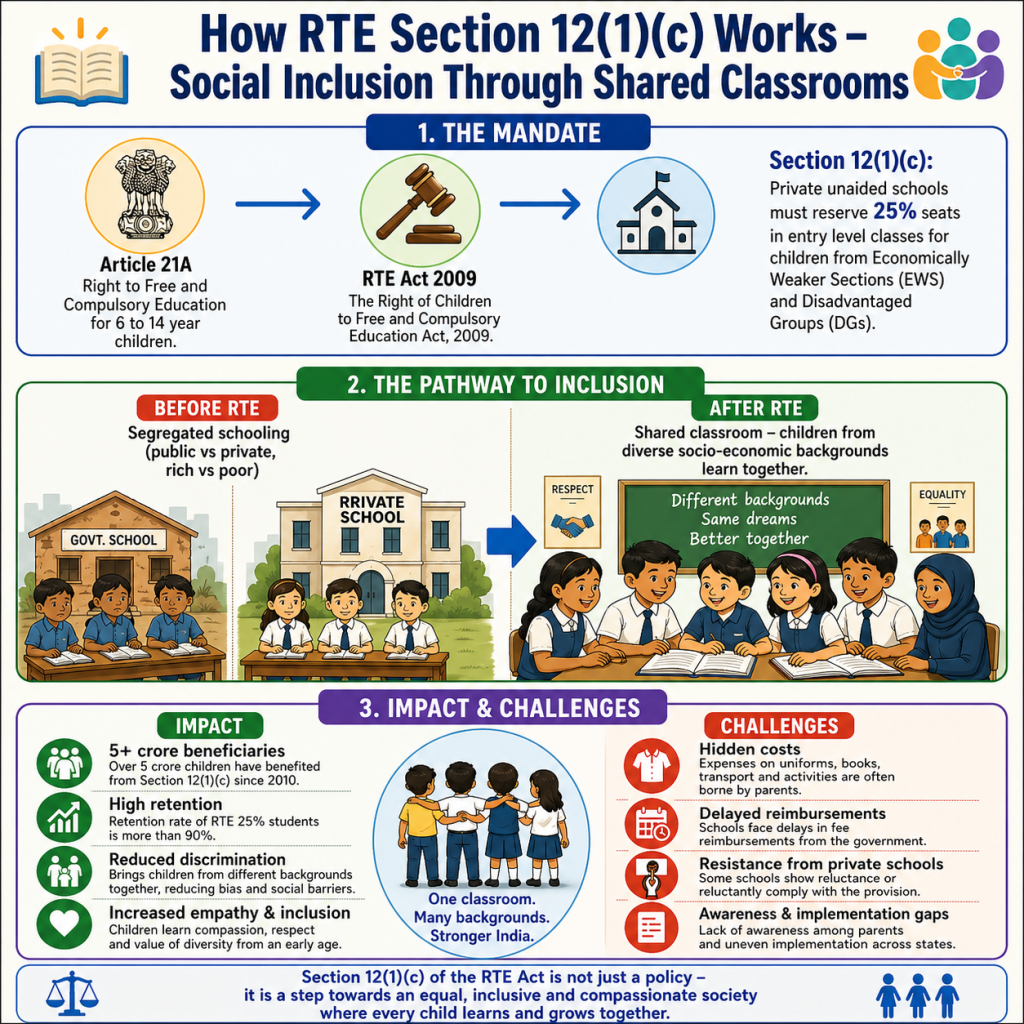
- The Supreme Court (2026) reaffirmed the significance of Section 12(1)(c) of the RTE Act, 2009, emphasising its role in enabling children from diverse socio-economic backgrounds to learn together in shared classrooms.
Core Features of RTE
- The RTE Act, 2009 operationalises the constitutional guarantee of free and compulsory education (Article 21A) for children aged 6–14 years.
- Section 12(1)(c) mandates that private unaided schools reserve 25% seats for children from economically weaker sections (EWS) and disadvantaged groups.
- The provision integrates private schools into the broader educational ecosystem, recognising them as partners in fulfilling constitutional obligations.
- It seeks to create common schooling spaces, rather than reinforcing segregation between public and private education systems.
How RTE Ensures Social Inclusion
- Shared Learning Spaces: The provision enables children from vastly different backgrounds to study together, fostering equality and mutual respect.
- Breaking Social Barriers: It challenges structural divisions of class, caste, and income, ensuring that birth circumstances do not limit opportunity.
- Access to Social Capital: Students gain exposure to peer networks, institutional culture, and aspirational environments, which were earlier inaccessible.
- Transformational Impact: Evidence shows that over 5 million children have benefited, with retention rates exceeding 90%, indicating sustained inclusion.
- Behavioural Outcomes: Research highlights reduced discrimination, increased empathy, and improved pro-social behaviour in mixed classrooms.
- Thus, the RTE framework moves beyond access to create meaningful social integration and long-term mobility.
Shortcomings and Limitations
- Implementation Gaps: Variation across States in transparency, outreach, and monitoring mechanisms affects equitable access.
- Resistance from Private Schools: Some institutions exhibit reluctance towards full inclusion and integration of EWS students.
- Hidden Costs Burden: Families often incur expenses related to uniforms, books, and materials, diluting the promise of free education.
- Administrative Challenges: Delays in reimbursements and grievance redressal mechanisms hinder smooth implementation.
- Misinterpretation of Intent: The provision is often wrongly viewed as promoting private schooling, ignoring its role as a constitutional tool for social inclusion.
Conclusion
- The RTE Act, particularly Section 12(1)(c), represents a deliberate constitutional strategy to transform education into a site of social integration and equality. Its success lies not merely in providing access, but in ensuring that children grow in shared spaces that nurture dignity, aspiration, and equal opportunity.
