


Suwori Festival Assam

Context
- Suwori Festival is an annual tribal celebration held in Boko (Kamrup district) of Assam.
- It is organised at the Sari field, marking a major regional cultural gathering.
Cultural Linkage
- Celebrated on the seventh day of Rongali Bihu, aligning with harvest festivities.
- Reflects strong linkage with agricultural cycle and seasonal transitions.
Participating Communities
- Celebrated collectively by Rabha, Bodo, Garo, and Koch Rajbongshi communities.
- Represents a unique platform for inter-tribal interaction and shared traditions.
Key Features & Activities
- Includes traditional dances like Hana Ghora and vibrant folk performances.
- Showcases indigenous music, rituals, and cultural heritage expressions.
- Community gatherings promote social cohesion and identity preservation.
Significance
- Acts as a symbol of tribal unity in Assam’s diverse socio-cultural landscape.
- Helps preserve and transmit indigenous traditions across generations.
- Reflects cultural synthesis within the broader framework of Bihu celebrations.
Anticipatory Bail
Meaning & Legal Basis
- Anticipatory bail refers to pre-arrest bail granted to a person apprehending arrest.
- It is provided under Section 438 CrPC, applicable in non-bailable offences.
- The application can be filed before the High Court or Sessions Court.
- Once granted, it ensures protection from arrest, subject to court-imposed conditions.
Purpose & Significance
- It acts as a safeguard against false accusations arising from personal or professional enmity.
- Ensures protection of individual liberty before actual arrest occurs.
- Prevents misuse of arrest powers, thereby strengthening procedural fairness.
Transit Anticipatory Bail
- Transit anticipatory bail is sought when arrest is likely in a different State.
- It provides temporary protection to approach the competent court in the concerned State.
- Prevents immediate arrest by police of another State, ensuring legal recourse.
- The procedure remains similar to regular anticipatory bail applications.
- Legal Status of Transit Bail
- It is not codified in law, but recognised through judicial practice.
- Its validity is derived from judicial precedents and evolving legal interpretation.
National Civil Services Day

Background
- National Civil Services Day is observed annually on April 21 across India.
- It honours civil servants as the backbone of administration and governance system.
- First officially celebrated in 2006 at Vigyan Bhawan, New Delhi.
Historical Significance
- The date commemorates April 21, 1947, when Sardar Vallabhbhai Patel addressed civil service probationers.
- He described civil servants as the “Steel Frame of India”, highlighting their central role.
- Emphasised values of integrity, impartiality, and neutrality in public service.
Objectives & Importance
- Recognises outstanding work of civil servants through innovation and efficiency.
- Encourages self-reflection and accountability in administrative functioning.
- Promotes excellence in governance through reforms and transparency.
- Facilitates review of policies and programmes and their effective implementation.
Heatwaves in India

Definition
- A heatwave is defined based on temperature thresholds or deviation from normal conditions.
- Declared when maximum temperature reaches ≥40°C (plains) or ≥30°C (hills).
Criteria (IMD Framework)
- Based on Departure from Normal
- Heatwave: +4.5°C to +6.4°C deviation
- Severe Heatwave: >6.4°C deviation
- Based on Actual Temperature
- Heatwave: ≥45°C maximum temperature
- Severe Heatwave: ≥47°C maximum temperature
- Coastal Conditions
- Heatwave declared when deviation ≥4.5°C and temperature ≥37°C.
Favourable Conditions
- Presence of hot dry air over region.
- Absence of upper atmospheric moisture allows temperature rise.
- Cloudless skies enable maximum solar heating.
- Dominance of anti-cyclonic circulation over area.
Major Causes
- Shifting of Jet Streams (Rossby waves) leading to heat domes.
- Local winds like Loo intensify heat in northern plains.
- Urban Heat Island effect due to rapid urbanisation.
- Long-term driver is global warming.
Mullaperiyar Dam Dispute
Overview
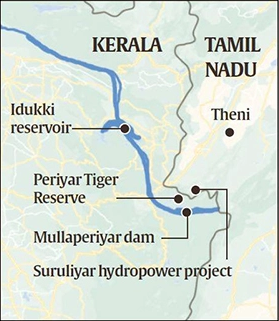
- Mullaperiyar Dam is a masonry gravity dam built on the Periyar River in Kerala.
- Located at Thekkady, Idukki district, at an elevation of 881 metres.
- Constructed at the confluence of Mullayar and Periyar rivers.
- The dam is 53.6 m high and 365.7 m long with 443 MCM capacity.
- It forms an artificial reservoir spread over 8.5 sq km area.
Historical Background
- Construction began in 1887 and was completed in 1895 during British rule.
- Built by the British Royal Engineers under Pennycuick’s leadership.
- Constructed using traditional materials like limestone and surkhi.
- One of the oldest operational dams in India.
Purpose
- Designed to divert water from Periyar basin to Vaigai basin (Tamil Nadu).
- Used for irrigation and hydropower generation in Tamil Nadu.
- Though located in Kerala, it is operated by Tamil Nadu government.
- Governed by a 999-year lease agreement signed during colonial period.
Significance
- Surrounded by Periyar National Park, a biodiversity-rich protected area.
- Supports irrigation, drinking water, and regional agricultural economy.
- Plays a crucial role in inter-basin water transfer system.
Key Issue: Inter-State Dispute
- Ongoing dispute between Kerala and Tamil Nadu over dam safety concerns.
- Kerala demands strengthening or decommissioning due to structural risks.
- Tamil Nadu opposes changes citing water security needs.
Joint Comprehensive Plan of Action (JCPOA)
Background
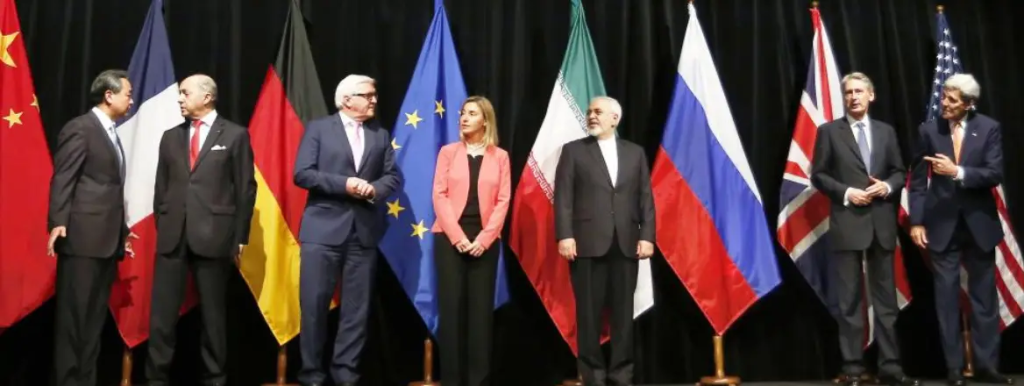
- JCPOA is a nuclear agreement signed in July 2015 between Iran and P5+1 countries.
- Members include U.S., U.K., France, Russia, China, Germany, along with the European Union.
- Aim was to restrict Iran’s nuclear programme in exchange for sanctions relief.
- Intended to prevent nuclear weapons development and reduce West Asia tensions.
Key Provisions of JCPOA
- Iran limited uranium enrichment to 3.67% purity, far below weapons-grade level.
- Restricted use to 5,060 centrifuges at Natanz for a period of 10 years.
- Arak reactor was redesigned to prevent plutonium production for weapons.
- Accepted enhanced monitoring through IAEA inspections under Additional Protocol.
- Ensured that nuclear weapon development would take at least one year breakout time.
Sanctions Relief & Significance
- In return, U.S., EU and UN lifted economic sanctions on Iran.
- Iran regained access to frozen assets and resumed global trade participation.
- Agreement aimed to prevent a potential arms race in the Middle East.
- Reduced risks of conflict involving regional powers like Israel and Saudi Arabia.
Index of Eight Core Industries
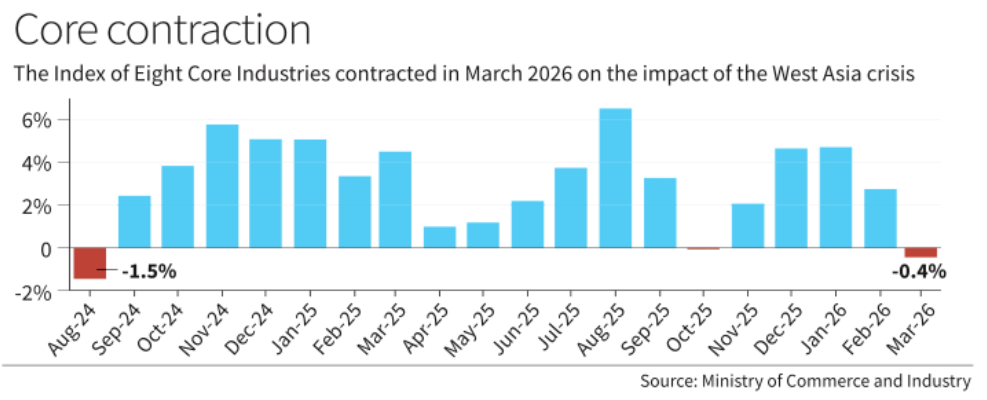
Context: India’s core sector activity contracted by 0.4% in March 2026, reflecting impact of West Asia conflict.
More in News
- Four out of eight core sectors recorded negative growth in March 2026. Annual growth for 2025–26 stood at 2.6%, lowest since COVID-19 period.
- Fertiliser sector declined sharply by 24.6%, due to input shortages.
- Crude oil output fell by 5.7%, marking seventh consecutive contraction.
- Coal output decreased by 4%, indicating supply-side stress.
About Index of Eight Core Industries
- It measures performance of eight key infrastructure sectors of the economy.
- Released by the Ministry of Commerce and Industry.
- These sectors collectively have a significant weight in Index of Industrial Production (IIP).
- Eight Core Sectors
- Coal
- Crude Oil
- Natural Gas
- Refinery Products
- Fertilisers
- Steel
- Cement
- Electricity
Comprehensive Economic Partnership Agreement (CEPA)
Concept & Scope
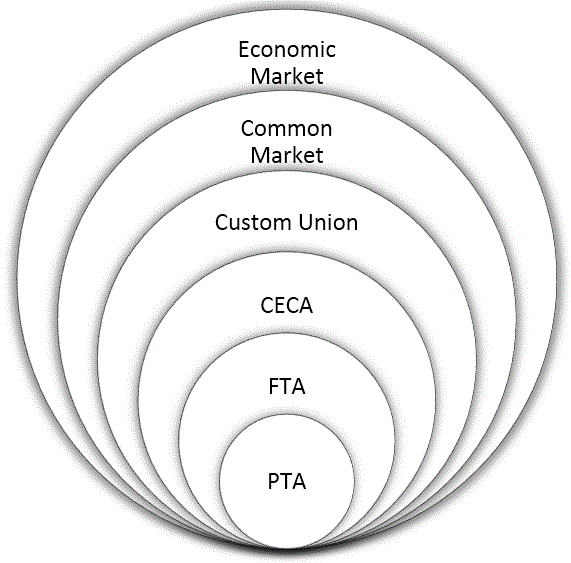
- CEPA is an advanced trade agreement covering trade, services, and investment aspects.
- It goes beyond tariffs to include regulatory frameworks and economic cooperation.
- It represents a more comprehensive arrangement than traditional trade agreements.
Types of Trade Agreements
- Free Trade Agreement (FTA)
- Provides tariff concessions with a negative list approach for excluded items.
- Focuses mainly on goods trade liberalisation.
- Preferential Trade Agreement (PTA)
- Grants reduced tariffs on selected goods through limited tariff concessions.
- Example: India–Afghanistan PTA.
- Comprehensive Economic Partnership Agreement (CEPA)
- Covers goods, services, investment, and regulatory issues.
- Broader in scope compared to FTAs and other agreements.
- Comprehensive Economic Cooperation Agreement (CECA)
- Focuses mainly on tariffs and trade quotas (TQRs).
- Less comprehensive than CEPA.
- Framework Agreement
- Defines broad areas for future cooperation and gradual liberalisation roadmap.
- Example: Agreements with ASEAN and Japan.
GIFT City and IFSCA

Context: GIFT City issued its first licence for a family investment office, boosting private wealth management ecosystem.
More in News
- First permit granted to Poornam Asset Management IFSC Pvt. Ltd. for family office operations.
- Move aims to develop a globally competitive and flexible regulatory ecosystem in GIFT City.
- Reflects increasing shift of Asian wealth from regions like Dubai due to geopolitical tensions.
- Earlier, in-principle approvals were given to entities linked with Azim Premji and Narayana Murthy family offices.
- Final approvals were delayed due to concerns regarding capital flight from India.
About International Financial Services Centres Authority (IFSCA)
- Legal Status & Objective
- Statutory body established under IFSCA Act, 2019 for regulating IFSCs in India.
- Acts as a unified regulator for financial products, services, and institutions.
- Jurisdiction & Role
- Regulates activities in International Financial Services Centres (IFSCs) like GIFT City.
- Aims to build global financial connectivity and support India’s economic interests.
- Composition
- Consists of 9 members, appointed by the Central Government.
- Includes representatives from RBI, SEBI, IRDAI, and PFRDA.
- Also includes members from Ministry of Finance and other appointed experts.
- Members serve a 3-year term, with eligibility for reappointment.
- Headquarters & Significance
- Headquartered at GIFT City, Gandhinagar (Gujarat).
- GIFT IFSC is India’s first IFSC, acting as a global financial hub.
Premature Release From Prison
Context: Delhi High Court examined premature release of a life convict in the Priyadarshini Mattoo case.
More in News
- Sentence Review Board (SRB) rejected premature release plea of Santosh Kumar Singh.
- Court observed need for judicial scrutiny in cases involving heinous crimes.
- Case highlighted conflict between rehabilitation vs gravity of offence.
- Premature release decisions often involve multiple authorities and legal safeguards.
About Premature Release
- It allows a convict to be released before completion of sentence under certain conditions.
- Based on assessment of reform, rehabilitation, and societal risk.
- Commonly applied in cases of life imprisonment.
- Constitutional & Legal Provisions
- Articles 72 and 161 empower President and Governor for clemency powers.
- Include powers of pardon, remission, commutation, and reprieve.
- Under CrPC Sections 432 and 433, governments can remit or commute sentences.
- Section 433A CrPC mandates minimum 14 years imprisonment in certain cases.
- For death sentence cases, Section 475A BNSS sets threshold for remission.
Role of Sentence Review Board (SRB)
- SRB comprises sentence committee, prison authorities, police, and judiciary members.
- Evaluates factors like conduct, nature of crime, and rehabilitation prospects.
- Recommendations are not binding, final decision rests with the government.
Key Considerations
- Nature and gravity of offence committed.
- Conduct and behaviour during imprisonment.
- Age, psychological profile, and rehabilitation potential.
- Impact on victims and broader societal interests.
