

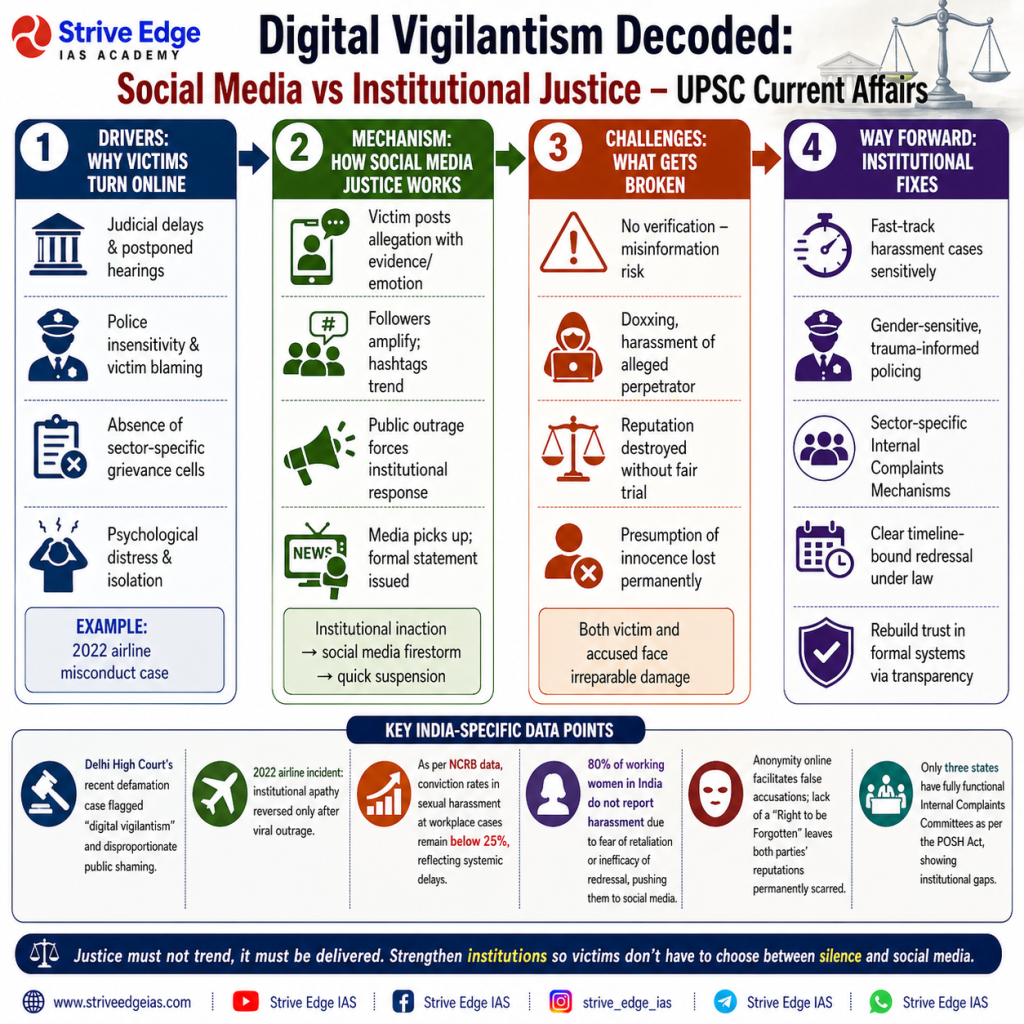
Context: The Delhi High Court raised concerns regarding digital vigilantism in a recent defamation case involving social media amplification. The Court observed that online statements may exceed free expression limits and trigger disproportionate public shaming consequences.
Conceptual Debate on “Digital Vigilantism”
- Traditional vigilantism involves organized citizen action using coercive means to enforce justice outside formal institutions.
- Social media expression lacks structured intent, enforcement capability, and guarantees of justice outcomes.
- Participants in online discourse may face doxxing risks and harassment, indicating absence of security assurances.
- Core Issue
- Social media is increasingly functioning as an alternative accountability mechanism due to declining trust in formal justice systems.
- This reflects a broader institutional crisis where victims seek visibility and validation outside legal redress frameworks.
- Illustrative Example
- In a 2022 airline misconduct case, institutional inaction persisted until public outrage on social media compelled response.
- This demonstrates how digital exposure can catalyse accountability when formal mechanisms fail.
Structural Reasons Behind Social Media Reliance
- Systemic Limitations
- Judicial processes are often prolonged, causing delayed justice and reducing deterrence against harassment-related offences significantly.
- Law enforcement responses frequently involve procedural delays, insensitivity, and victim-blaming tendencies, discouraging formal complaint mechanisms.
- Institutional Gaps
- Many sectors lack effective grievance redressal systems capable of delivering swift responses to harassment allegations transparently.
- Human Dimension
- Victims often experience psychological distress and social isolation, making social media a platform for collective validation.
Challenges of Social Media-Based Justice
- Allegations are often amplified without adequate verification mechanisms, increasing risks of misinformation and reputational harm.
- Anonymity on digital platforms facilitates false claims and exaggerations, undermining the credibility of discourse.
- Public discourse frequently transforms into trial by media, replacing due process with emotional judgments.
- Both victims and accused may suffer irreversible reputational damage without any institutional mechanism for corrective justice.
- Ethical and Legal Tensions
- The issue raises conflict between freedom of expression and the right to reputation.
- Victims’ need for visibility often clashes with the accused’s fair trial rights and presumption of innocence.
- Principles of natural justice and procedural fairness are frequently compromised in emotion-driven environments.
- Comparative Perspective
- In consumer services, social media complaints trigger swift responses due to reputational incentives.
- In contrast, justice systems exhibit institutional delays, pushing individuals towards alternative grievance mechanisms.
Way Forward
- Strengthen grievance redress mechanisms to ensure timely handling of harassment-related complaints sensitively.
- Develop sector-specific accountability frameworks to reduce dependence on social media exposure.
- Ensure a balanced approach protecting victim dignity and accused rights under natural justice principles.
- Rebuild public trust through efficient justice delivery, reducing reliance on digital platforms for accountability.
Conclusion
- The phenomenon termed digital vigilantism reflects institutional inadequacies rather than excessive exercise of free expression. A humane justice system must ensure timely redress without forcing victims into public spectacle or reputational risks.
