

Index of Industrial Production (IIP)
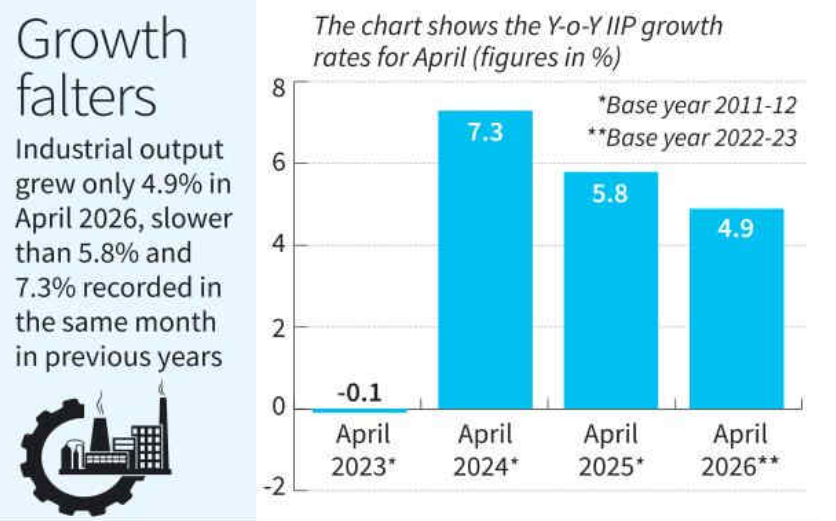
Context: India’s industrial output grew 4.9% in April 2026 under the revised IIP series with 2022-23 as the new base year.
More in News
- The new base year is 2022-23, revised from the earlier 2011-12.
- The new series added water supply, sewerage, waste management, and gas supply to the existing three core sectors.
- Mining and quarrying output declined by over 5.1% while manufacturing grew at 6.2%.
- The new IIP basket consists of 1,042 products mapped to 463 item groups, expanded from 839 items and 407 groups.
- Mining sector now includes classification for fuel minerals, metallic minerals (including rare earth minerals), and non-metallic minerals.
- The electricity index has been newly classified into renewable and non-renewable sources.
About IIP
- IIP measures the quantum of growth in industrial output across key sectors of the Indian economy.
- It covers four sectoral indices: mining, manufacturing, electricity, and water supply and waste management.
- Manufacturing constitutes approximately 75% of the IIP basket.
- Under use-based classification, IIP categories include primary goods, capital goods, intermediate goods, infrastructure goods, consumer durables, and consumer non-durables.
- Base years of major macroeconomic indicators including GDP and IIP were revised to 2022-23 in 2026.
Remittances and India’s External Balance
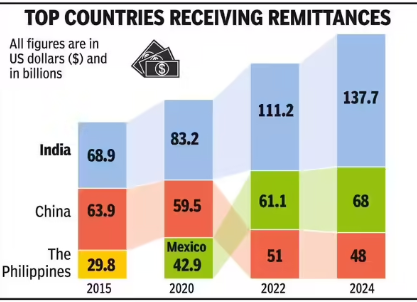
Context: India received $138 billion in remittances in 2024, the highest in the world by a wide margin.
Key Facts about Remittances
- Remittances are recorded in the Current Account under Net Secondary Income (NSI).
- Since mid-2013, remittances have on average financed more than India’s entire trade deficit.
- Net remittances average approximately 3% of India’s GDP, exceeding net FDI and FPI flows.
- Unlike FDI and FPI, remittances do not generate future liability outflows as they are transfers, not claims.
- Remittances are not prone to sudden halts, being driven by diaspora income and family needs.
- They carry low transaction costs compared to other capital flows.
Components of Current Account
- India’s Current Account consists of three main flows: trade deficit, Net Primary Income (NPI), and Net Secondary Income (NSI).
- NPI reflects net investment income flows between Indian residents and foreign counterparts.
- NSI essentially accounts for India’s large net positive remittance flows.
Marine Products Export Development Authority (MPEDA)

Context: India’s seafood exports reached a record $8.46 billion (₹73,890.46 crore) in 2025-26, with the US and China as top importers.
About MPEDA
- MPEDA is a statutory body established by an Act of Parliament in 1972.
- It was formed by converting the Marine Products Export Promotion Council (established in September 1961) on 24th August 1972.
- It functions under the Ministry of Commerce and Industry.
- Headquarters are located in Kochi, Kerala.
- It has trade promotion offices in New Delhi, Tokyo, and New York.
- Key Functions
- It promotes and regulates export of marine products from India.
- It registers fishing vessels, processing plants, storage premises, and exporters of marine products.
- It fixes standards and specifications for marine products meant for export.
- It undertakes conservation and management of offshore and deep-sea fisheries.
- Infrastructure
- MPEDA has set up five Quality Control Laboratories at Kochi, Nellore, Bhimavaram, Bhubaneswar, and Porbandar.
- It operates 18 Regional and Sub-Regional offices across the country.
Emergency Credit Line Guarantee Scheme (ECLGS)
Context: Banks sanctioned ₹35,000 crore in loans under ECLGS to MSMEs impacted by the West Asia conflict.
About ECLGS
- ECLGS was initially launched as part of the Atma Nirbhar Bharat Package in 2020 during the COVID-19 crisis.
- It provides 100% guarantee to Member Lending Institutions (MLIs) against losses from non-repayment.
- It operates under the Department of Financial Services (DFS), Ministry of Finance.
- National Credit Guarantee Trustee Company Ltd (NCGTC) manages and provides guarantees under the scheme.
Key Features of ECLGS 5.0
- It aims to provide credit guarantee coverage to MSMEs and airlines affected by the West Asia Crisis.
- Eligible borrowers include MSMEs, non-MSMEs, and scheduled passenger airlines with standard accounts as of March 31, 2026.
- Guarantee coverage is 100% for MSMEs and 90% for non-MSMEs and airlines.
- Loan tenor is 5 years (including 1-year moratorium) for MSMEs and 7 years (including 2-year moratorium) for airlines.
- The scheme aims to provide additional credit flow of ₹2.55 lakh crore.
Right to Be Forgotten

Context: Delhi High Court held that the “right to be forgotten” flows from the right to privacy under Article 21 of the Constitution.
More in News
- The High Court laid down a framework for de-indexing judicial records from search engines and masking personal identifiers.
- The court directed search engines and legal database platforms to remove specified judgments from name-based search results.
- The court noted India lacks a comprehensive statutory framework explicitly governing the right to be forgotten.
- The ruling came on petitions from acquitted persons, parties to matrimonial disputes, and individuals whose names appeared incidentally in judicial records.
About Right to Be Forgotten
- It allows individuals to request removal of personal data from digital platforms when it is outdated, irrelevant, or harmful.
- It was established by the Court of Justice of the European Union (CJEU) in 2014 in the Google Spain case.
- In the EU, it is enshrined in Article 17 of the General Data Protection Regulation (GDPR).
- In India, the Puttaswamy v. Union of India (2017) case recognised privacy as a fundamental right, implicitly including this right.
- The Digital Personal Data Protection Act, 2023 recognises the right to “erasure” of personal data.
- IT Rules, 2021 obligate intermediaries to remove privacy-violating content within 24 hours of a complaint.
Strength of Supreme Court
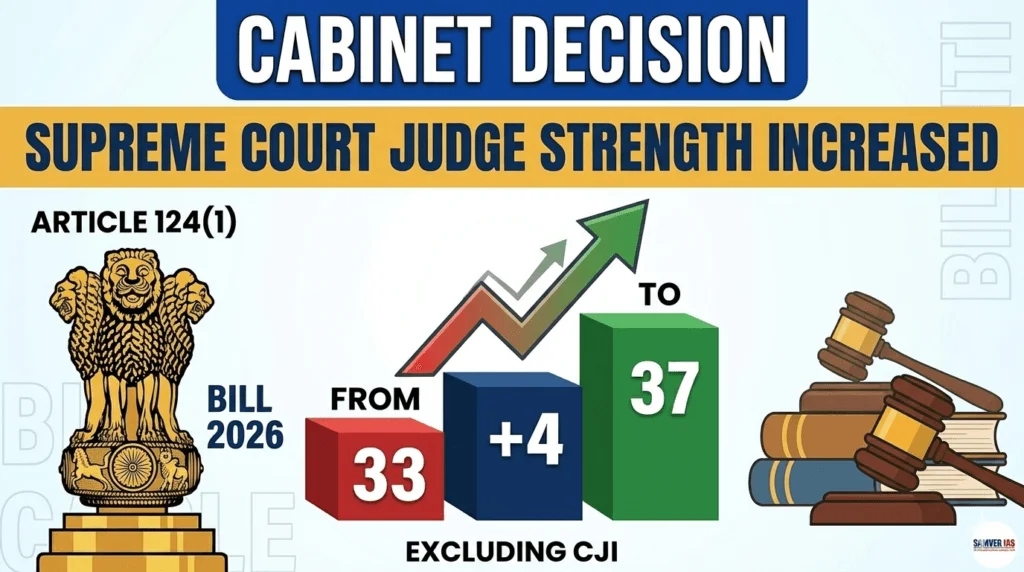
Context: The Centre cleared the appointment of five new judges to the Supreme Court, raising its strength to 37.
More in News
- Appointments were made under Article 124(2) of the Constitution by the President of India.
- The sanctioned strength of the Supreme Court was recently increased from 34 to 38 through the Supreme Court (Number of Judges) Amendment Ordinance, 2026.
Key Constitutional Provisions
- Article 124(2) governs the appointment of Supreme Court judges by the President of India.
- The Supreme Court Collegium recommends judges for appointment to the Supreme Court.
- The sanctioned strength of the Supreme Court is determined by Parliament through legislation.
Fiscal Deficit
Context: The Union Government achieved its fiscal deficit target of 4.4% of GDP for 2025-26, as per data from the Controller General of Accounts.
About Fiscal Deficit
- Fiscal deficit is the difference between the government’s total expenditure and total revenue excluding borrowings.
- It represents the total borrowing requirement of the government in a given year.
- It is calculated as Total Expenditure minus (Revenue Receipts plus Non-debt Capital Receipts).
- Expenditure covers Revenue Expenditure (salaries, interest) and Capital Expenditure (infrastructure investments).
- Revenue includes tax revenue, non-tax revenue (dividends, fees), and Non-debt Capital Receipts (disinvestment, loan recoveries).
Economic Implications
- High fiscal deficit can cause “Crowding Out”, reducing capital available for private investment.
- It can also lead to inflationary pressure and a “Debt Trap” where interest payments consume most revenue.
FRBM Act, 2003
- The Fiscal Responsibility and Budget Management (FRBM) Act, 2003 originally targeted a 3% fiscal deficit by March 2021.
- This target was relaxed due to the COVID-19 pandemic, leading to a post-2021 consolidation path.
- The commitment to bring deficit below 4.5% of GDP by 2025-26 has now been achieved at 4.4%.
Fiscal Deficit vs Revenue Deficit
- Fiscal Deficit measures the government’s total borrowing requirement.
- Revenue Deficit measures the shortfall in the government’s daily operational expenses compared to current income.
