

The Ordinance Question
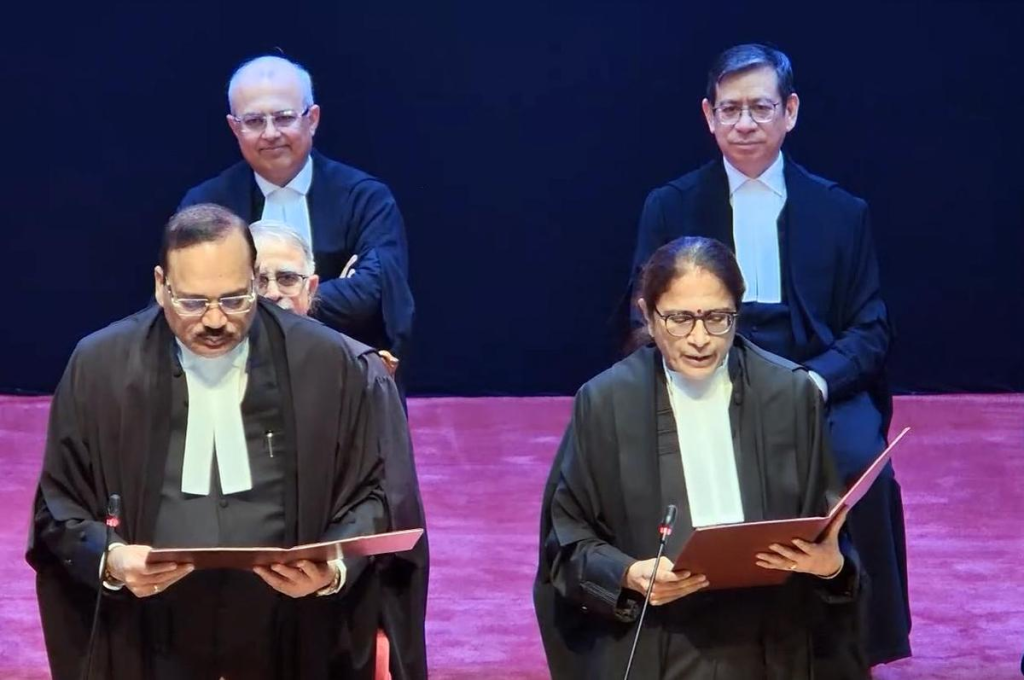
Recent Developments
- The President promulgated an Ordinance for increasing Supreme Court strength from 34 to 38 judges.
- Five judges took oath i.e. four former High Court Chief Justices and one from the bar, but three occupy Ordinance-created posts not yet authorised by Parliament.
- The grievance is not about the judges’ fitness but the manner of their appointment through an executive Ordinance.
Ordinance Power and Its Constitutional Limits
- Under Article 123, the President may promulgate an Ordinance which carries the force of an Act during its life.
- However, an Ordinance can be withdrawn by the President at any time or disapproved by both Houses by resolution.
- It ceases to operate six weeks after Parliament reassembles making it an inherently temporary instrument.
- The Supreme Court itself in D.C. Wadhwa vs State of Bihar (1986) called governance by re-promulgated Ordinance a “fraud on the Constitution”.
- In Krishna Kumar Singh vs State of Bihar (2017), a seven-judge Bench ruled against using Ordinance-making power as a parallel source of legislation.
Judicial Primacy and the NJAC Judgment
- In Supreme Court Advocates-on-Record Association vs Union of India (2015), a Constitution Bench struck down the 99th Amendment and the National Judicial Appointments Commission.
- The Court held that allowing the Law Minister and one eminent person to veto judicial appointments destroyed the judiciary’s primacy in its own appointments.
- Yet the same Collegium that defended judicial primacy has accepted three Ordinance-created seats holding them at the executive’s sufferance.
Constitutional Concerns
- A judge whose tenure depends on an Ordinance holds the post at the executive’s sufferance, thus compromising the security of tenure.
- Article 124(1) leaves the number of judges to what Parliament may prescribe and not what an Ordinance may temporarily permit.
- In matters involving the Union government, judges whose seats the government must regularise may appear to lack the required detachment.
- Whether a judge appointed to an Ordinance-created post can be removed once that post lapses remains an untested constitutional question.
- Their judgments however will hold good under the de facto doctrine affirmed in Gokaraju Rangaraju vs State of Andhra Pradesh (1981).
Institutional Implications
- The court has staked its independence and judges’ security of tenure on the goodwill of the executive and Parliament.
- The U.S. Senate in 1937 warned against a court bound by obligation to the appointing power, a warning equally relevant today.
- The graver danger is not a court that says no to the executive but a court that no longer notices its obligation to remain independent.
- Independence of the judiciary is not only the right to say no to the executive rather it is the instinct to want to.
Reform Measures
- Parliament must pass the Amendment Bill swiftly to replace the Ordinance and remove all constitutional uncertainty.
- The Ordinance route for judicial appointments must be avoided in future as it compromises the appearance of judicial independence.
- The Collegium must insist on statutory authorisation before accepting posts created by temporary executive instruments.
Judicial independence demands that judges hold their seats by law alone and not by the goodwill of any political branch.
