

AI in India’s Judiciary
Context
- India has more than 5 crore pending cases across different courts creating an urgent need for technological intervention.
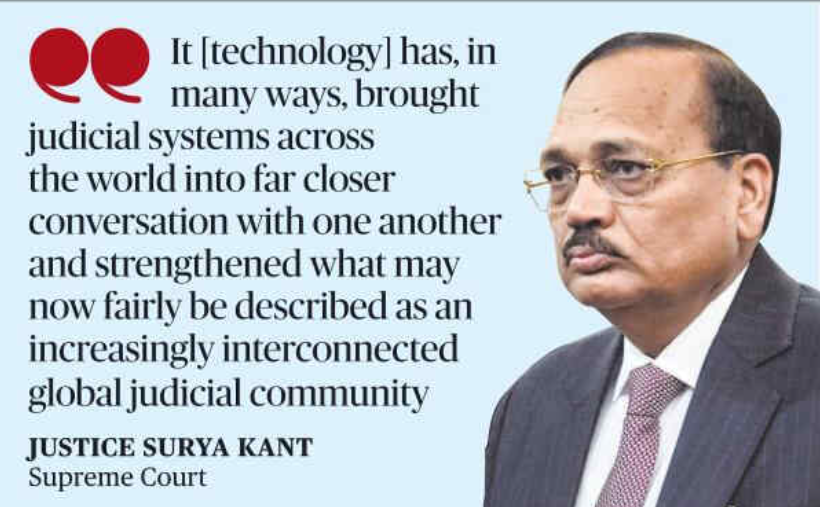
- CJI Surya Kant stated that the SC has consciously approached technology as an aid to human reasoning not as a substitute for judicial thought.
Need for AI in Judiciary
- A large part of judicial delay is caused by administrative bottlenecks rather than complex legal reasoning.
- Key problems include manual recording of proceedings, handwritten depositions, filing defects and difficulty finding relevant precedents.
- Language barriers in understanding judgments further restrict access to justice for ordinary citizens.
Current AI Applications in India’s Judiciary
- TERES: Used by the Supreme Court during Constitution Bench hearings for real-time transcription of oral arguments with human review.
- SUVAS: Supreme Court’s translation platform making thousands of judgments available in regional languages improving access to justice.
- SUPACE and LegRAA: AI tools that scan large volumes of judgments to extract facts and identify relevant precedents for judges.
- Kerala High Court uses AI tools to automatically flag missing annexures and technical defects at the filing stage reducing delays.
- Voice-to-text conversion of witness statements speeds up trial proceedings significantly.
Benefits
- AI reduces case backlog through smart scheduling and better prioritisation of pending matters.
- SUVAS deepens inclusivity by translating judgments into regional languages across a linguistically diverse country.
- Digitised transcripts and structured data enhance transparency and strengthen public confidence in judicial proceedings.
- AI assists judges in handling complex case law by scanning vast volumes of precedents efficiently.
Challenges
- Even a single wrongly transcribed word during real-time proceedings can have serious legal consequences.
- Court records contain highly sensitive personal and commercial information requiring strong data protection and sovereign deployment.
- Unreliable internet connectivity and power cuts pose serious challenges particularly at lower court levels.
- Algorithmic bias as AI trained on biased datasets and may reinforce existing systemic inequalities in justice delivery.
- Specialised legal AI tools remain expensive limiting widespread adoption especially for smaller courts and lawyers.
Way Forward
- AI must remain an assistive tool with final decision-making authority always resting with human judges.
- Clear ethical standards, transparency norms and accountability mechanisms must be established for AI use in courts.
- Continuous training of judges and court staff is essential for responsible and informed use of technology.
- Strong cybersecurity and data protection safeguards must be prioritised before expanding AI deployment across courts.
AI applications must focus on improving efficiency, transparency and accessibility rather than predicting or influencing judicial outcomes.
