

Aircraft Accident Investigation Bureau (AAIB)

About AAIB
- AAIB is a statutory body functioning under the Ministry of Civil Aviation.
- It is responsible for investigating civil aviation accidents and serious incidents.
- It was established in 2012 in accordance with ICAO standards, to provide an investigation function independent of the DGCA.
- Before 2012, accident investigations were handled by the Air Safety Directorate of DGCA.
- The government frames investigation rules under Section 7 of the Aircraft Act, 1934.
Key Functions
- AAIB investigates all accidents and serious incidents involving aircraft with All Up Weight exceeding 2,250 kg and all Turbojet aircraft.
- The investigation aims to prevent future accidents, not to apportion blame or liability.
- An investigation team is deputed to gather perishable evidence, including wreckage samples and black boxes.
- AAIB has immediate and unrestricted access to all relevant evidence from any agency, without requiring prior consent from judicial or government authorities.
- The final investigation report is made public and forwarded to ICAO and all states participating in the investigation.
Ram Air Turbine (RAT)

About RAT
- A Ram Air Turbine is a compact propeller-based emergency power device installed in aircraft as a last-resort backup.
- It deploys automatically upon system failure and can also be activated manually by the pilot.
- RAT comes into action during three critical scenarios: engine shutdown, complete electrical failure, and hydraulic pressure loss.
- A characteristic high-pitched whine accompanies deployment, often the only audible sound when engines have failed.
- ICAO mandates RAT installation on wide-body jets as a non-negotiable safety and certification requirement.
How RAT Works
- During normal flight, RAT remains stored within the aircraft’s fuselage or wing structure, completely out of use.
- Once deployed, the aircraft’s forward motion forces air against the turbine blades, causing them to spin.
- This airflow is called ram air i.e. high-speed wind created naturally by a moving object’s forward motion.
- The spinning turbine powers either an electrical generator or a hydraulic pump to sustain critical systems.
- RAT output is deliberately limited to flight-critical functions such as flight controls and radio communication.
Global Navigation Satellite System (GNSS)
Context: The Defence Ministry signed a ₹449 crore contract with Accord Software and Systems Private Limited, Bengaluru for procurement of 20 enhanced capability GNSS jammers for the Indian Navy.
About GNSS
- GNSS is an umbrella term for any satellite navigation system offering global coverage for positioning, navigation, and timing (PNT) services.
- GPS is only one component of the broader GNSS ecosystem, not synonymous with it.
- GNSS relies on three components: satellite constellations, ground control networks, and special receivers.
- Receivers determine their position using trilateration, requiring signals from at least three satellites for 2D location and four satellites for 3D positioning including altitude.
- GNSS uses high-precision atomic clocks; even a microsecond of error can cause position displacement of several kilometres.
Major GNSS Systems
| System | Country | Satellites | Orbital Altitude |
| GPS | USA | 24 | 20,200 km |
| GLONASS | Russia | 24 | 19,140 km |
| Galileo | Europe | 30 (planned) | 23,222 km |
| BeiDou (BDS) | China | 35 | GEO, IGSO, MEO |
| NavIC (IRNSS) | India | Regional | 20,650 km |
| QZSS | Japan | 4 | Regional |
Applications in India
- India is transitioning from RFID-based FASTag to a GNSS-based toll collection system, where tolls are deducted based on actual distance travelled.
- GNSS supports fleet tracking, aviation safety, maritime navigation, precision farming, and land surveying.
- Banks and power grids use GNSS for synchronising timing across vast distances.
Land Ports
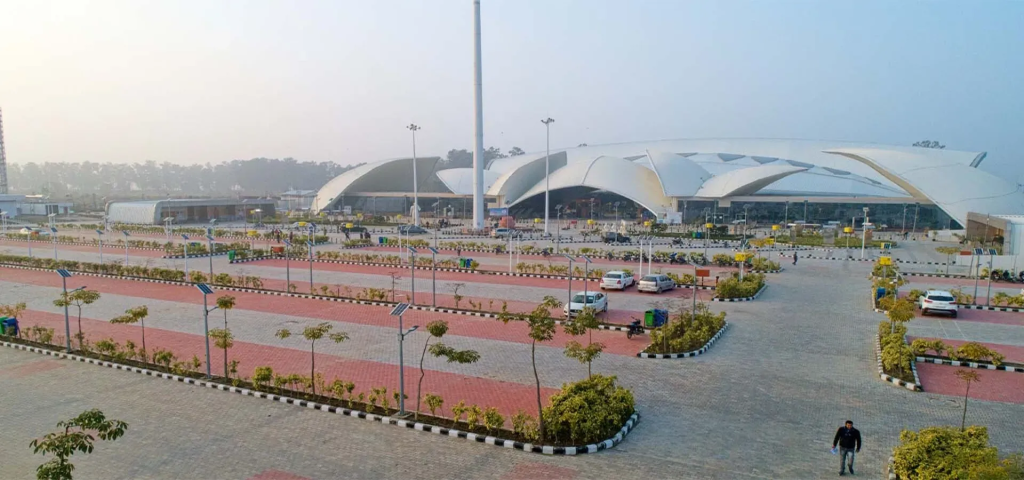
Context: India proposed 74 additional land ports along international borders, including 3 along the China border and 6 along the Pakistan border.
More in News
- Proposed China border land ports are at Namgia (Himachal Pradesh), Gunji (Uttarakhand), and Nathu La (Sikkim).
- Three designated India-China border trade points are
- Lipulekh Pass, Uttarakhand (1992),
- Shipki La Pass, Himachal Pradesh (1995), and
- Nathu La Pass, Sikkim (July 2006)
- Proposed Pakistan border land ports include Teetwal, Adusa, Chakan Da Bagh (J&K), Attari Railway Station, Hussainiwala (Punjab), and Munabao Railway Station (Rajasthan).
- Currently, only one operational land port exists at Attari, Punjab for Pakistan trade.
- Phase II proposes 13 land ports along Nepal, 12 along Bangladesh, 4 along Bhutan, and 2 along Myanmar.
About LPAI and Land Ports
- Land Ports Authority of India (LPAI) was established in 2012 under the LPAI Act, 2010, under the Ministry of Home Affairs.
- A land port is an area on international borders including national and state highways, other roads, and railways, notified under the Customs Act, 1962 or the Foreigners’ Act, 1946.
- LPAI has developed 9 Integrated Check Posts (ICPs) so far, with the total expected to reach 24 by 2030.
About Land Port Management System (LPMS)
- LPMS is a centralised electronic platform developed by LPAI to digitise and unify operations across India’s international land borders.
- It uses a Single Registration Request (SRR) system to reduce repetitive paperwork for stakeholders.
- It integrates with ICEGATE for automatic submission of Shipping Bills and Bills of Entry.
- It incorporates Full Body Truck Scanners, predictive slot booking, and Business Intelligence (BI) analytics dashboards.
- A unified single-window payment gateway covers customs duties, parking, weighbridge, and terminal charges.
Article 142 of the Indian Constitution

Context: The Supreme Court invoked Article 142 to quash a POCSO conviction, noting the victim had later married the accused as an adult.
About Article 142
- Article 142 empowers the Supreme Court to pass any order or decree necessary for complete justice in any case pending before it.
- This power is discretionary and unique to the Supreme Court alone.
- Complete justice means ensuring justice beyond technicalities, filling legislative gaps, and protecting constitutional values, fundamental rights, and social welfare.
- The framers of the Constitution, particularly Dr. B.R. Ambedkar, intentionally vested this extraordinary power only in the Supreme Court.
- The jurisprudence under Article 142 has developed over more than 50 years, with the Court maintaining self-imposed limits.
Significance
- Article 142 elevates the Supreme Court’s role as the guardian of the Constitution, enabling intervention where legislative or executive action falls short.
- It allows the Court to create guidelines and direct government authorities, especially in matters of public interest and constitutional values.
- It strengthens democracy by protecting minority rights and acting as a check on executive and legislative overreach.
Floating Solar Energy in India
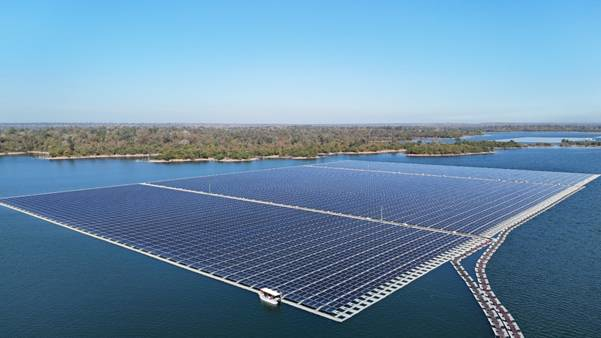
Context: India’s first comprehensive national assessment by the National Institute of Solar Energy (NISE) found that Indian reservoirs can host approximately 102 GW of floating solar capacity.
More in News
- The report titled “Solar PV Potential of India (Floating Solar)” was prepared by NISE, an autonomous institute under the Ministry of New and Renewable Energy (MNRE).
- Floating solar units cost approximately 25% more upfront than ground-mounted installations, as per a 2021 benchmark by the US National Renewable Energy Laboratory.
- Ground-mounted solar systems require 3 to 4 times more area per MW than the panels themselves occupy, making land a major challenge.
- India is pursuing a target of 500 GW non-fossil capacity by 2030, with land acquisition being a key bottleneck.
- State-wise floating solar potential: Maharashtra (16.28 GW), Madhya Pradesh (14.89 GW), Karnataka (13.69 GW), Odisha (12.81 GW), and Telangana (10.72 GW).
- India’s largest floating solar installation is the Omkareshwar Floating Solar Park (278 MW) on the River Narmada in Khandwa district, Madhya Pradesh, with plans to scale to 600 MW.
- Globally, floating solar reached 9.6 GW by 2024, with nearly 90% of installations in Asia.
About Floating Solar
- Floating solar panels are mounted on water bodies, addressing the land acquisition challenge faced by ground-mounted solar.
- Agri-photovoltaics refers to farm beds sheltered by structures on which solar panels are mounted.
