

Armed Forces Special Powers Act (AFSPA), 1958
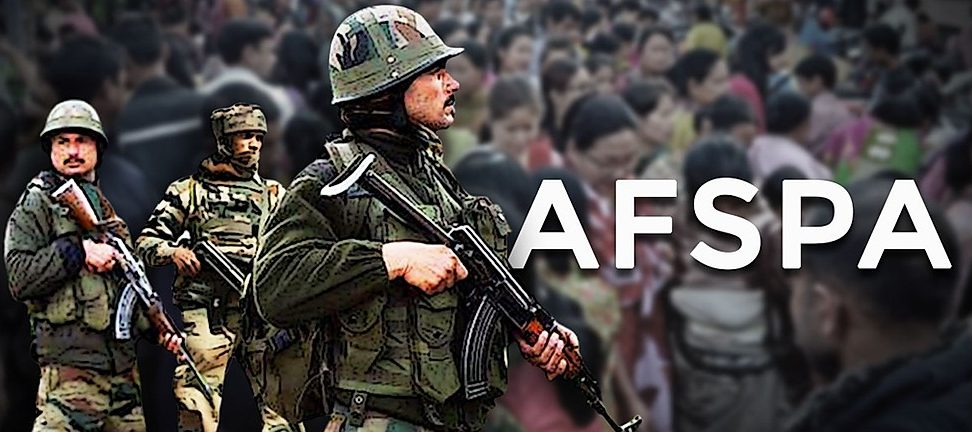
Context: Union Home Minister Amit Shah announced that AFSPA will be withdrawn from almost all Northeast states next year, barring one or two states, describing the shrinking of AFSPA-covered areas as an indicator of growing peace in the region.
About AFSPA
- AFSPA is a special law granting extraordinary powers to the military to maintain law and order in disturbed areas.
- Currently in effect in parts of Nagaland, Assam, Manipur and Arunachal Pradesh and in J&K through the Armed Forces (J&K) Special Powers Act, 1990.
- It was lifted from Tripura in 2015, Meghalaya in 2018 and Mizoram in the 1980s showing that rollback is possible.
Key Provisions
- Section 3 (Disturbed Area Declaration): Governor, Administrator or Central Government can declare any area “disturbed” if armed forces’ aid is considered necessary.
- Section 4 (Special Powers): Armed forces can use force including shooting to kill, arrest and search without warrant, prohibit assembly of 5 or more persons and destroy arms dumps or training camps.
- Section 6 (Immunity): Personnel are protected from prosecution without prior sanction of the Central Government.
- Arrest Procedure: Arrested persons must be handed over to the nearest police with least possible delay.
Landmark Judicial Decisions
- Naga People’s Movement of Human Rights vs Union of India (1997): Supreme Court validated AFSPA constitutionally with safeguards on use of force and immunity.
- Extra-Judicial Execution Victim Families Association vs Union of India (2016): Immunity under Section 6 is not absolute and accountability for excessive force is mandatory.
- Sebastian M. Hongray vs Union of India (1984): Security personnel can be held accountable despite AFSPA immunity in certain cases.
Critical Analysis
- Arguments in Favour:
- National Security: Empowers armed forces to swiftly tackle insurgency in conflict-prone border areas.
- Prevents Legal Paralysis: Officers can act without warrants preventing delays that insurgents could exploit.
- Proven Stabilisation: Contributed to reducing insurgency in states like Mizoram and Tripura over time.
- Arguments Against:
- Fundamental Rights Violation: Shoot-to-kill powers and immunity clash with Articles 14, 21 and 22 of the Constitution.
- Culture of Impunity: The sanction clause effectively shields personnel from prosecution in most cases.
- Prolonged Militarisation: Areas remain under military control for decades without any defined time limit.
- Human Rights Concerns: Numerous allegations of extrajudicial killings, torture and sexual violence have been documented.
- International Law Violation: Continued use contradicts India’s commitments under UDHR, ICCPR and the Convention against Torture.
Committee Recommendations
- Jeevan Reddy Committee (2005): Repeal AFSPA and merge relevant powers into the Unlawful Activities (Prevention) Act, 1967.
- Second ARC (2007): Repeal AFSPA after thorough stakeholder consultations across affected regions.
- Santosh Hegde Committee (2013): Investigate unlawful encounters and prevent misuse of AFSPA powers systematically.
- Justice J.S. Verma Committee (2013): Immediately review AFSPA and try armed forces personnel accused of sexual violence under ordinary criminal law.
Way Forward
- Apply AFSPA only in genuinely disturbed districts and gradually reduce powers as situations improve.
- Amend provisions to ensure arrested persons are presented before magistrates within 24 hours.
- Use CRPF and state police for routine law and order and reserve the army for high-intensity conflicts only.
- Involve civil society, local administration and the army in development activities to rebuild public trust.
Conclusion: AFSPA remains vital for counterinsurgency in genuinely disturbed areas but raises serious concerns about human rights and democratic accountability. A balanced approach that restricts its scope, ensures meaningful oversight and strengthens local governance can protect national security without compromising the constitutional values that make India worth defending.
