

Horticulture Production Estimates 2025-26
Context: The Department of Agriculture and Farmers Welfare released the Second Advance Estimates of Horticultural Crop Area and Production for 2025-26.
Key Highlights
- Total horticulture area is expected to reach 301.51 lakh hectares in 2025-26, an increase of 0.05% over 2024-25.
- Total horticulture production is projected at 3,777.76 lakh tonnes, an increase of 1.90% (70.39 lakh tonnes) over 2024-25.
- Fruits: Production expected to reach 1,214.75 lakh tonnes (up by 3.25%), driven by increased output of Banana, Mango, Papaya, Apple, and Guava.
- Vegetables: Production expected to reach 2,210 lakh tonnes (up by 1.47%), with increases in Potato, Tomato, Okra, Peas, Cauliflower, and Bottlegourd.
- Spices: Area expected to reach 50 lakh hectares; production expected at 126.55 lakh tonnes, with increases in Garlic, Turmeric, Curry Leaf, and Fenugreek.
- Aromatic and Medicinal Plants: Production expected to rise from 9.01 lakh tonnes to 9.76 lakh tonnes.
Oilseeds Kisaan Mitra
About the Initiative
- Oilseeds Kisaan Mitra is India’s first nationwide WhatsApp-based AI advisory service for oilseed farmers, developed by ICAR-Indian Institute of Oilseeds Research (ICAR-IIOR), Hyderabad.
- It was launched in February 2026.
- It is a free, multilingual, 24×7 chatbot accessible through WhatsApp without downloading any additional application.
- Crops Covered: The service provides advisory on groundnut, mustard, sesame, sunflower, soybean, niger, and other oilseed crops.
- The chatbot responds in all Indian languages, removing barriers of distance, language, and cost between research and farmers.
Coal and Lignite Gasification Projects
Context: The Ministry of Coal held a Roadshow on Coal and Lignite Gasification Projects in Hyderabad, showcasing investment opportunities and policy support mechanisms.
India’s Coal Resource Base
- India possesses nearly 400 billion tonnes of coal reserves, the fifth largest in the world.
- India is the world’s second-largest producer and consumer of coal.
- Nearly 70% of India’s electricity generation is dependent on coal.
About the Scheme
- The Union Cabinet approved the Scheme for Promotion of Surface Coal and Lignite Gasification Projects.
- The scheme aims to produce fuels, fertilizers, chemicals, and industrial inputs from domestic coal, reducing import dependence.
- India currently imports methanol, ammonia, fertilizer feedstocks, and critical industrial chemicals, resulting in substantial foreign exchange outflow.
Strategic Significance
- Coal gasification converts domestic coal into syngas, which can produce chemicals, fertilisers, fuels, and hydrogen.
- The initiative aligns with the Atmanirbhar Bharat vision and aims to strengthen India’s energy security and industrial resilience.
Community Seed Bank Management Standard
Context: The Bureau of Indian Standards (BIS) under the Department of Consumer Affairs released IS 20201:2026, a standard for Community Seed Bank (CSB) management to protect indigenous crop varieties.
About the Standard
- IS 20201:2026 is a voluntary certifiable management system standard providing a structured framework for Community Seed Banks across India.
- It was formulated by the Biodiversity Sectional Committee (EED 06) under BIS’s Environment and Ecology Department.
- The standard aligns with SDG 2 (Zero Hunger) and can be downloaded free of cost from the BIS portal.
Significance
- It standardises seed collection, processing, storage, viability testing, documentation, and quality assurance for community seed banks.
- It reinforces the National Food Security and Nutrition Mission (NFSNM), which provides ₹50 lakh one-time assistance for establishing community seed banks.
- It supports statutory protections under the Protection of Plant Varieties and Farmers’ Rights Act, 2001 and the Biological Diversity Act, 2002.
About BIS
- BIS is established under the BIS Act, 2016.
- BIS functions under the Department of Consumer Affairs, Ministry of Consumer Affairs, Food & Public Distribution
- It serves as India’s National Standards Body responsible for standardisation, marking, and quality certification.
India-Nepal Cross-Border Remittance Mechanism
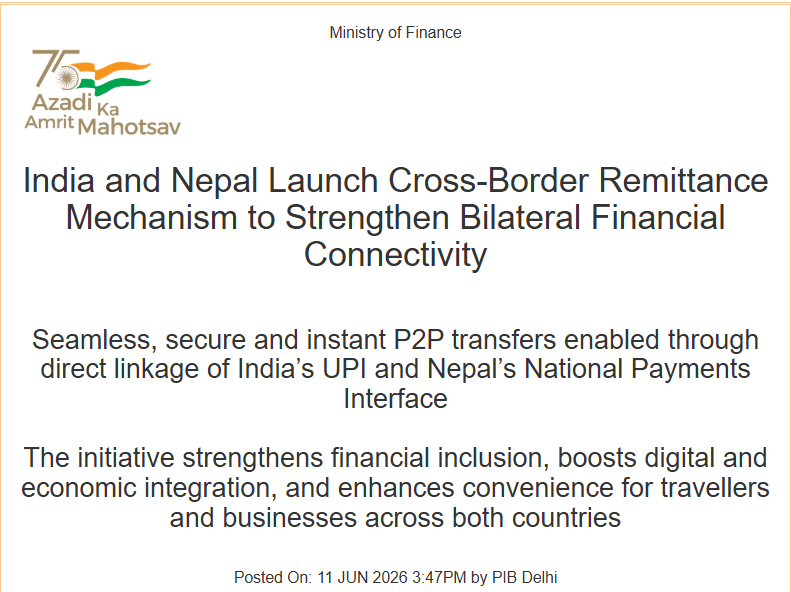
Context: India and Nepal officially launched a peer-to-peer (P2P) cross-border remittance mechanism on June 6, 2026, linking India’s UPI and Nepal’s National Payments Interface (NPI).
Key Facts
- The technical integration was executed through collaboration between NPCI International Payments Limited (NIPL) and Nepal Clearing House Limited (NCHL).
- NPCI International Payments Limited (NIPL) is the international arm of the National Payments Corporation of India (NPCI).
- The system enables real-time, seamless, and secure instant money transfers via mobile banking applications and digital wallets.
- The initiative strengthens financial inclusion and digital economic integration between India and Nepal.
About UPI’s Global Presence
- UPI is currently accepted in nine countries: Singapore, UAE, France, Mauritius, Nepal, Bhutan, Qatar, Sri Lanka, and Cambodia.
SARTHI
Context: The Ministry of Skill Development and Entrepreneurship (MSDE) convened the first meeting of SARTHI at Vigyan Bhavan, New Delhi.
About SARTHI
- SARTHI stands for Strategic Advisory and Reforms Taskforce for Holistic ITI Transformation.
- It has been established as an apex advisory mechanism under the Craftsmen Training Scheme (CTS) for strategic dialogue and policy convergence in vocational education.
- It aims to strengthen Industrial Training Institutes (ITIs) and align vocational training with evolving industry requirements.
About Craftsmen Training Scheme (CTS)
- CTS is one of India’s largest institutional skill development frameworks, operating through a network of 13,888 ITIs across the country.
- These include 3,326 Government ITIs and 10,562 Private ITIs.
Biopharma SHAKTI Scheme
About Scheme
- The scheme aims to develop India into a global biopharmaceutical manufacturing hub for domestic production of biologics and biosimilars.
- It aims to create a network of over 1,000 accredited India Clinical Trials sites.
- It seeks to strengthen CDSCO (Central Drugs Standard Control Organisation) to meet global standards and approval timeframes.
Key Definitions
- Biologics are medicines derived from natural and living sources such as animal cells, plant cells, and microorganisms, including vaccines, blood components, gene therapies, and proteins.
- Biosimilars are highly similar copies of biologics with no clinically meaningful differences from the reference product.
- Biopharmaceuticals are pharmaceutical products produced using biotechnology techniques.
About India’s Bioeconomy
- India’s bioeconomy grew from USD 10 billion (2014) to USD 165.7 billion (2024), targeting USD 300 billion by 2030.
- It contributes 4.25% to India’s national GDP.
- Four key subsectors: BioIndustrial (47%), BioPharma (35%), BioAgri (8%), and Bioresearch (9%).
Key Applications of Biotechnology in Medicine
- Therapeutics: Recombinant insulin, erythropoietin for anaemia, and monoclonal antibodies for cancer.
- Vaccines: DNA-based vaccines like ZyCoV-D for COVID-19 and Hepatitis B vaccines.
- Molecular Diagnostics: PCR and ELISA techniques for rapid disease detection; over 1,000 gene tests identify genetic mutations.
- Gene and Cell Therapy: Treats genetic disorders like cystic fibrosis and cancer through stem cell therapy.
- Tissue Engineering: Lab-grown tissues and organs for transplantation and biocompatible implants.
