

Retail Inflation
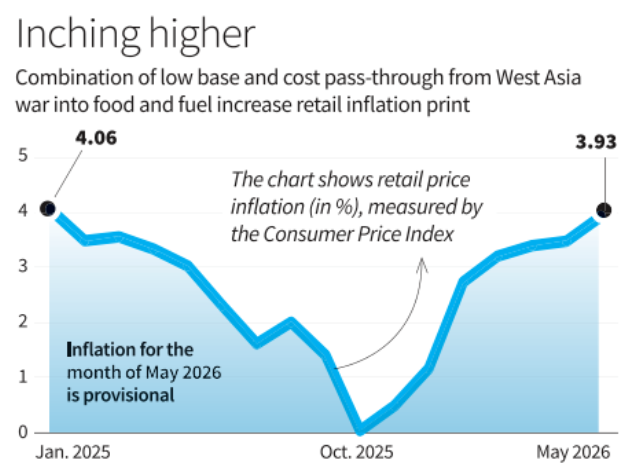
Context: Retail inflation rose to 3.9% in May 2026, driven by rising food prices, marking the highest inflation in 16 months.
More in News
- The Consumer Food Price Index (CFPI) inflation stood at 4.8% in May 2026, up from 4.2% in April.
- Core inflation (excluding food, fuel, and electricity) rose to 3.73%, marking three consecutive months of acceleration.
- Cereal prices entered positive territory for the first time since January 2026, driven mainly by rice price increases.
- The current inflation of 3.9% is just 0.07% short of RBI’s target inflation rate of 4%.
- MoSPI released the CPI with a new base year 2024, replacing the earlier base year 2012.
About CPI
- CPI measures changes in retail prices of selected goods and services purchased by households for consumption.
- Each item in the CPI basket is assigned a specific weight reflecting its relative share of total consumer spending.
- CPI (Rural, Urban, and Combined) has been released by MoSPI since January 2011 with base year 2010.
- CPI (Combined) covering both rural and urban households serves as India’s headline inflation measure.
- CPI is compiled using the Laspeyres Index Formula, based on base year prices, base year weights, and current month prices.
- Weights are derived from the Household Consumer Expenditure Survey (HCES) using the Mixed Modified Reference Period (MMRP) approach.
- Under MMRP, different recall periods (7 days, 30 days, 365 days) are used for different expenditure categories.
Key Changes in CPI 2024 vs CPI 2012
| Feature | CPI 2024 | CPI 2012 |
| Base Year | 2024 | 2012 |
| Total Weighted Items | 358 | 299 |
| Goods | 308 | 259 |
| Services | 50 | 40 |
| Food and Beverages Weight | 36.75% | 45.86% |
| Housing Index | Rural and Urban | Urban only |
New additions in CPI 2024 include rural housing, online streaming services, value-added dairy products, and exercise equipment.- E-commerce prices introduced as an additional market in 12 large towns with population exceeding 25 lakh.
- Overlapping period for linking CPI 2012 and CPI 2024 series is 2025, when both indices were simultaneously available.
Zero FIR
Context: A Zero FIR was registered against TMC leader Mamata Banerjee for allegedly making provocative remarks during election campaigning; the case was later transferred from Netaji Nagar to Hare Street police station.
About Zero FIR
- A Zero FIR can be registered at any police station, regardless of territorial jurisdiction, upon receiving a complaint about a cognisable offence.
- No regular FIR number is assigned at the time of registration of a Zero FIR.
- The concerned police station later registers a fresh FIR and transfers the case to the jurisdiction where the offence occurred.
- Zero FIR was introduced following the recommendation of the Justice Verma Committee, constituted after the 2012 Nirbhaya gangrape case.
- In Lalita Kumari vs Govt. of UP (2014), the Supreme Court held that FIR registration is mandatory when information discloses a cognisable offence.
- In Satvinder Kaur vs State (1999), the Delhi High Court held that a woman has the right to lodge a complaint from any location other than where the incident occurred.
About FIR
- An FIR is a written document prepared by police upon receiving information about a cognisable offence, setting the investigation in motion.
- Section 154(1) of CrPC allows police to register an FIR for cognisable offences.
- Section 166A of IPC, inserted based on the Justice JS Verma Committee’s recommendation, provides punishment of up to two years imprisonment for public servants who fail to record information about a cognisable offence.
Project Kusha and Mission Sudarshan Chakra

Context: Defence Minister described Project Kusha as a “game changer” for India’s security. He also reiterated the government’s commitment to Mission Sudarshan Chakra to establish a multi-layered missile defence shield across the country.
About Project Kusha
- Project Kusha is also referred to as the Extended Range Air Defence System (ERADS) or Precision-guided Long-Range Surface Air Missile system.
- It is being developed by DRDO as a long-range Surface-to-Air Missile (SAM) system to extend beyond India’s current air defence capabilities.
- It is designed to detect, track, and neutralise fighter jets, drones, cruise missiles, stealth aircraft, and UAV swarms.
- It will integrate with India’s Integrated Air Command and Control System (IACCS) for network-centric air defence.
Three Interceptor Variants
| Variant | Range | Primary Targets |
| Kusha-M1 | 150 km | Fighter jets, UAVs, cruise missiles |
| Kusha-M2 | 250 km | Stealth aircraft, high-speed missiles |
| Kusha-M3 | 350 to 400 km | AWACS, refuellers, high-value airborne assets |
About Mission Sudarshan Chakra
- Announced by PM Narendra Modi during his Independence Day address in 2025.
- It aims to establish a multi-layered missile defence shield protecting military assets, critical infrastructure, and civilian establishments.
- It will safeguard strategic, civilian, and religious sites including hospitals, railways, and public places across air, land, and sea.
- Mission to be completed by 2035 and will be entirely researched, developed, and manufactured in India.
- It integrates advanced surveillance, cyber protection, and physical infrastructure safeguards.
