

Water Security for a Viksit Bharat: India’s Integrated Water Mission
Why in News
- India’s integrated water governance has emerged as a central pillar of the Viksit Bharat vision.
- The Jal Jeevan Mission is described as the world’s largest rural drinking water supply programme.
- The Swachh Bharat Mission is considered the most significant rural sanitation movement globally.
Key Initiatives and Their Impact
- Jal Jeevan Mission (JJM):
- When launched, only 3.23 crore rural households (17%) had tap water connections.
- Today, more than 15.8 crore rural households (over 81%) have access to tap water at home.
- The government is moving toward 100% coverage by 2028.
- JJM has helped save more than 5.5 crore person-hours daily previously spent fetching water.
- Saved time is now invested in education, livelihoods, childcare and economic activity.
- Access to safe drinking water has reduced out-of-pocket health expenditure from waterborne diseases.
- Swachh Bharat Mission (SBM):
- SBM-Grameen is estimated to have averted more than 3 lakh diarrhoea deaths between 2014 and October 2019 per WHO assessment.
- Household toilets brought dignity, privacy and safety to millions of rural women across India.
- India has moved beyond open-defecation-free status toward sustainable solid and liquid waste management under SBM-Grameen 2.0.
- Jal Sanchay Jan Bhagidari:
- More than 1.55 crore rainwater harvesting and groundwater recharge structures have been created by May 31, 2026.
- Recent assessments indicate improvement in groundwater recharge and reduction in over-exploited assessment units.
- Namami Gange Programme:
- Created 4,260 MLD of sewage treatment capacity over the past decade.
- Reduced Biochemical Oxygen Demand from 26 TPD in 2017 to 10.75 TPD in 2024.
- Brought down effluent discharge from 349 MLD to 265.56 MLD.
- pH and dissolved oxygen levels in the Ganga now meet bathing criteria at all monitored locations.
Why Water Security Matters: The Challenge
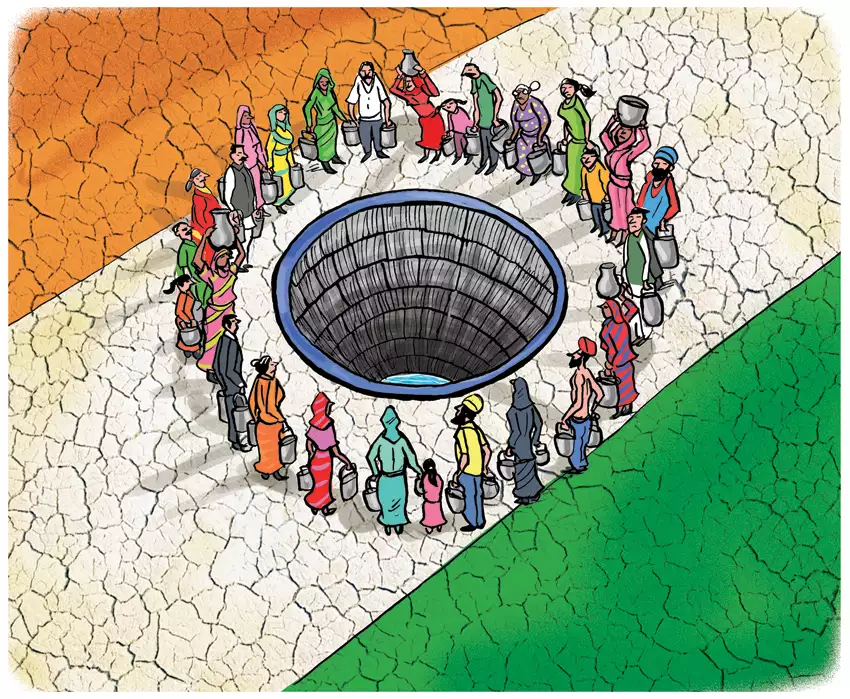
- India is home to nearly 18% of the world’s population but has access to only 4% of global freshwater resources.
- Rapid urbanisation and changing weather patterns will place increasing pressure on water resources.
- India’s water challenges require an integrated ecosystem approach — not isolated interventions.
- Drinking water, sanitation, river conservation, irrigation efficiency, groundwater recharge, wastewater reuse and climate resilience must all be addressed together.
Way Forward
- Water-Use Efficiency: Improve irrigation technology and reduce agricultural water wastage which accounts for over 80% of water use.
- Water Recycling: Promote wastewater recycling and reuse in urban and industrial sectors.
- Strengthened Governance: Strengthen water governance frameworks at local, State and national levels.
- Citizen Participation: Encourage active community ownership of water conservation structures and practices.
- Climate Resilience: Build infrastructure that can withstand erratic rainfall and extreme weather events caused by climate change.
Source: The Hindu
