

WPI to PPI Transition: UPSC Prelims Notes
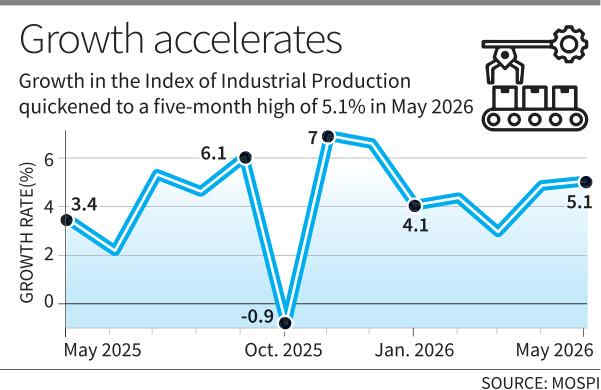
In News: IIP Adopts PPI Over WPI; Output Hits 5-Month High
- Industrial output growth quickened to a five-month high of 5.1% in May. The manufacturing, electricity, capital goods, and consumer goods sectors drove the growth.
- MoSPI decided to discontinue WPI for some value-based outputs in IIP. It adopted the Producer Price Index (PPI) instead, superseding the earlier WPI-based IIP series.
About: Wholesale Price Index (WPI) and 2022-23 Base Year
- WPI basket expanded from 697 to 957 items.
- Solar, Wind, and Nuclear Electricity were added under the ‘Electricity’ Group.
- Crude Petroleum and Natural Gas shifted to ‘Fuel and Power’ group.
- Weights now use Gross Value of Output (GVO), replacing Net Traded Value.
- ‘Targeted Mean Imputation’ replaces the ‘Carry-forward’ approach for missing data.
- WPI will be completely discontinued after a five-year transition window.
About: Producer Price Index (PPI) and Its Three Pillars
- PPI measures average price changes received by domestic producers.
- It tracks inflation from the producer’s or seller’s perspective.
- PPI has three pillars:
- Input PPI: measures prices of raw materials industries purchase.
- Output PPI: measures prices industries receive for final goods.
- Service PPI: covers seven sectors such as Banking, Securities Transaction, Insurance, Pension Fund Management, Railways, Air Passenger, and Telecom.
- PPI measures prices at the first point of sale, called factory-gate prices.
WPI vs PPI: Coverage, Services and Pricing Basis
| Parameter | WPI | PPI |
| Services Included | No | Yes |
| Imports Covered | Yes | No (domestic only) |
| Level | Wholesale | Factory-gate |
| Structure | Single goods-based index | Input PPI and Output PPI |
WPI, Output PPI, and Service PPI use ‘Basic Price’, excluding Net Tax and Trade Margins.- Input PPI uses ‘Purchaser’s Price’ since industries source inputs from the market.
- Both WPI and PPI are published by the Office of Economic Adviser (OEA), DPIIT.
Source: The Hindu
White-Rumped Vulture (Gyps bengalensis): UPSC Prelims Notes

In News: Radio-Tagged White-Rumped Vulture Electrocuted
- A captive-bred, radio-tagged white-rumped vulture was electrocuted at Ebbanad village, overlooking the Sigur plateau, Tamil Nadu.
- The bird was initially released in Tadoba-Andhari Tiger Reserve, Maharashtra in December 2025.
- It later moved to Karnataka, where it showed signs of illness and was treated.
- The bird’s death marked the end of the first attempted reintroduction of a captive-bred bird in this landscape.
About: White-Rumped Vulture (Gyps bengalensis)
- It is a small Old World vulture, native to South and Southeast Asia.
- It is also known as Indian White-backed Vulture or Oriental White-backed Vulture.
- It feeds mostly on carcasses, locating them by soaring high in thermals.
- Found across Pakistan, India, Bangladesh, Nepal, Bhutan, Myanmar, Thailand, Laos, Cambodia, and southern Vietnam.
- It has an unfeathered head and neck, very broad wings, and short tail feathers.
- Its common name derives from the white patch on its lower back and upper tail.
Threat: Diclofenac and the Vulture Population Crash
- In the 1980s, the global population was estimated at several million individuals.
- As of 2021, the global population fell to less than 6,000 mature individuals.
- The main cause of decline is diclofenac, a medicine used for farm animals.
- The drug causes kidney failure in vultures that eat dead animals treated with it.
Status: IUCN Critically Endangered
- The white-rumped vulture is classified as ‘Critically Endangered’ under the IUCN Red List.
Source: The Hindu
RBI Scam Compensation Rules: UPSC Prelims Notes
In News: RBI Changes Rules for Scam Compensation
- RBI issued fresh rules to protect customers from scam transactions and cyberattacks.
- These amend the 2017 circular on “Limiting Liability of Customers in Unauthorised Electronic Banking Transactions.”
- Earlier, banks were liable only if transactions were not authorised by customers.
About: Fraudulent Electronic Banking Transactions (EBTs)
- EBTs are transactions executed by a third-party using fraudulently obtained credentials.
- It also includes transactions where customers grant approval under coercion or duress.
- This covers scams like digital arrests and stolen OTPs.
- Customers who ignore fraud warnings are not eligible for compensation.
Coverage: 85% Compensation up to ₹25,000 (Losses up to ₹50,000)
- For losses up to ₹50,000, victims can claim 85% compensation, capped at ₹25,000.
- This compensation is available only once in a customer’s lifetime.
- Amounts between ₹29,412 and ₹50,000 receive a flat ₹25,000 compensation.
- RBI pays roughly three-fourths of the amount; customer and bank split the rest.
- Scams above ₹50,000 are not covered under this framework.
Condition: Report to 1930 Helpline Within 5 Days
- Customers must report to the cybercrime helpline (1930) within five calendar days.
- This is an increase from the earlier three working days under 2017 rules.
- Once fraud is reported, customers bear no liability for subsequent deductions.
- Complaint settlement timelines are now 45 to 60 days, with 60 days for international transactions.
Source: The Hindu
National Investment and Infrastructure Fund (NIIF): UPSC Notes
In News: Cabinet Clears ₹30,000 Crore for NIIF
- The Union Cabinet approved an additional ₹30,000 crore investment in NIIF. This takes the government’s total commitment in NIIF to ₹60,000 crore.
- It will invest across transportation, energy, digital infrastructure, and urban infrastructure and e-mobility.
About: NIIF, India’s First Sovereign Wealth Fund (2015)
- NIIF is India’s first-ever sovereign wealth fund (SWF), set up in 2015.
- It is anchored by the Government of India as a collaborative investment platform.
- NIIF invests in infrastructure, private equity, and other diversified sectors in India.
- It invests in greenfield, brownfield, and stalled projects.
- NIIF has more than $4.9 billion in assets under management.
Structure: 49% Govt-Owned and SEBI-Registered AIF
- NIIF is 49% owned by the Indian government.
- It is majority-owned by institutional investors and professionally managed.
- The funds are registered as Alternative Investment Funds (AIF) with SEBI.
Four Funds: Master, Private Markets, Strategic and India-Japan Fund
- NIIF Master Fund: Invests in roads, ports, airports, and power; the largest infrastructure fund in India.
- NIIF Private Markets Fund: Invests in funds managed by third-party managers.
- NIIF Strategic Opportunities Fund: Invests in large-scale, strategically important businesses and projects.
- India-Japan Fund: NIIF’s first bilateral fund, focused on environment preservation in India. The India-Japan Fund has a target corpus of $600 million.
Source: The Hindu
