

UPSC MainsGS Paper IIInternational Relations
Makkah Joint Defence Agreement
📰 Saudi Arabia, Pakistan and Türkiye signed a trilateral defence pact in 2026, reshaping West Asian security architecture after the US-Israel-Iran war.
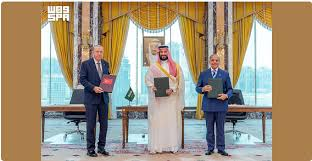
Pact Signatories
Saudi Arabia, Pakistan, Türkiye
Indian Diaspora in Saudi Arabia
~2.4 million workers
India’s Largest Oil Supplier
Saudi Arabia
📜
Makkah Pact: Context and Background
- The Makkah Joint Defence Agreement was signed between Saudi Arabia, Pakistan and Türkiye in 2026.
- It emerged in the aftermath of the US-Israel-Iran war and the Islamabad MoU ceasefire arrangement.
- The pact marks Saudi Arabia’s decisive pivot toward regional self-reliance in security matters.
- It was facilitated by Türkiye’s growing role as a regional power broker between the Gulf and South Asia.
- Pakistan views the pact as a major diplomatic and strategic rehabilitation after the Pahalgam crisis.
🛡️
Key Aspects of the Makkah Pact
Defence and Security Commitments
- The three nations committed to mutual defence cooperation and joint military exercises under the pact.
- Pakistan is expected to provide ground force capabilities that Saudi Arabia lacks domestically.
- Türkiye brings advanced drone technology — including Bayraktar TB2 systems — and defence industrial capacity.
- Saudi Arabia contributes financial resources and strategic depth in the Gulf region.
Strategic Context
- Saudi Arabia has been diversifying away from exclusive US dependence since the 2017 Qatar blockade failure.
- The Islamabad MoU revealed that Oman and Qatar are closer to Iran than Saudi Arabia had assumed.
- Türkiye has been positioning itself as an indispensable mediator between multiple regional blocs simultaneously.
- Pakistan’s inclusion — despite FATF grey-listing history and economic fragility — reflects Saudi Arabia’s limited options.
Nuclear Dimension
- Saudi Arabia has long maintained it would seek nuclear capability if Iran acquires one.
- The Islamabad MoU’s Iran nuclear provisions have made Saudi Arabia’s nuclear ambitions more urgent.
- Pakistan’s de facto status as an Islamic nuclear power makes it a potential strategic deterrent partner.
The pact has alarmed the US, India and Israel, who fear possible nuclear technology transfer between Pakistan and Saudi Arabia under its security umbrella.
⚠️
Challenges Facing the Makkah Pact
- Pakistan’s Fragility: Pakistan’s economic crisis, political instability and IMF dependency make it an unreliable pact partner.
- Türkiye’s NATO Membership: Türkiye’s obligations as a NATO member create inherent contradictions with the Makkah Pact framework.
- Saudi-Iran Normalisation: The 2023 China-brokered Saudi-Iran rapprochement complicates Saudi Arabia’s need for an anti-Iran security umbrella.
- US Pressure: Washington will apply significant diplomatic and financial pressure on Saudi Arabia to abandon the pact.
- Sunni-Shia Fault Line: The pact is implicitly Sunni-centric in a region where sectarian tensions remain dangerous and unresolved.
- Nuclear Proliferation Risk: The international community fears Pakistan facilitating Saudi Arabia’s nuclear ambitions under the pact’s security umbrella.
- Gulf State Division: UAE and Qatar may not align with the Makkah Pact framework, creating Gulf Cooperation Council divisions.
🧭
Way Forward and Implications for India
West Asia Policy Reset
India must urgently revise its West Asia policy, which currently appears tilted toward Israel and the UAE.
Saudi Arabia Engagement
Deepen bilateral engagement with Saudi Arabia to prevent the Makkah Pact from hardening into an anti-India framework.
Pakistan Monitoring
India must closely monitor any nuclear technology transfer between Pakistan and Saudi Arabia under the pact.
Türkiye Dialogue
India must manage Türkiye’s growing role in Kashmir discourse, which could be amplified through the pact.
Energy Security
With Saudi Arabia India’s largest oil supplier, any deterioration in ties has direct energy security implications.
Diaspora Protection
India has approximately 2.4 million workers in Saudi Arabia whose welfare requires stable bilateral relations.
Multilateral Engagement
India should use SCO and Gulf Cooperation Council platforms to express concerns about regional security architecture changes.
The Makkah Pact reflects a fundamental reshaping of West Asian security architecture after the Iran war. Its durability depends on whether Saudi Arabia sees it as a long-term strategic shift or tactical positioning — for India, it is both a geopolitical challenge and a diplomatic opportunity.
📰
Source: The Hindu
