

UPSC Prelims
4 Topics
Prelims Pinpointer
Prelims Pinpointer — August 19, 2026
Today’s high-yield Prelims facts — H1N1 during the monsoon, helicase’s role in DNA replication, PM-CARES’ transparency concerns, and gene-editing for cholesterol with VERVE-102
🤧
H1N1 (Swine Flu)

News Context
- Several Indian states are seeing a rise in H1N1 and influenza cases during the monsoon. Delhi reported 1,344 cases, nearly six times last year’s figure.
- Kerala reported about 7,421 cases and 88 deaths till August 17, mostly among people above 50 years. Experts advise no panic, but high-risk groups should take extra care.
The Virus — Core Facts
- Influenza A (H1N1) is the subtype of influenza A virus that is the most common cause of human influenza — an orthomyxovirus, a single-stranded RNA virus.
- Carries two key surface glycoproteins: Haemagglutinin (HA) (binds virus to host cell) and Neuraminidase (NA) (helps release virus particles from host cells).
- Called “swine flu” because the virus resembles influenza viruses common in pigs; spreads via contact with infected pigs and human-to-human transmission.
- 4 types of Influenza — A, B, C, D. Only Type A has caused pandemics. Type D mainly affects cattle, not known to infect humans.
Pandemic History
- 1918 — Spanish Flu — H1N1 | 1957 — Asian Flu — H2N2 | 1968 — Hong Kong Flu — H3N2 | 2009 — Swine Flu — H1N1.
- WHO declared H1N1 a pandemic in June 2009. The 2009 strain is named A(H1N1)pdm09 and now circulates as a seasonal virus.
Important distractor: Bird flu = H5N1 (NOT H1N1). Unlike temperate countries (winter peak), in tropical/sub-tropical countries the H1N1 peak is during the monsoon.
Source: The Hindu
🧬
Helicase & DNA Replication
News Context
- A recent study in Nature Communications found that cells have a safety mechanism to ensure DNA copying starts at the right time. A chemical signal activates the process by switching on helicase, the enzyme that unwinds DNA for replication.
What Is Helicase — Key Facts
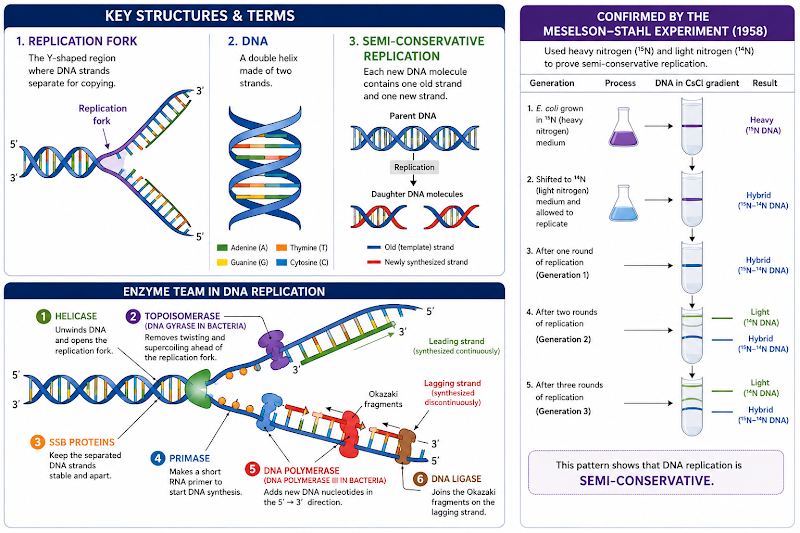
- An enzyme that unwinds the two strands of DNA so it can be copied, using energy from ATP to break hydrogen bonds between A–T and G–C base pairs.
- Importantly, helicase does not break the DNA backbone or phosphodiester bonds; it only separates the two strands.
- Semi-conservative replication: each new DNA molecule contains one old strand and one new strand — confirmed by the Meselson–Stahl experiment (1958).
Enzyme Team in DNA Replication
- Helicase: Unwinds DNA, opens the replication fork.
- Topoisomerase: Removes twisting/supercoiling ahead of the fork (DNA gyrase in bacteria).
- SSB proteins: Keep separated strands stable and apart.
- Primase: Makes a short RNA primer to start synthesis.
- DNA polymerase: Adds nucleotides in the 5′→3′ direction (DNA polymerase III in bacteria).
- DNA ligase: Joins Okazaki fragments on the lagging strand.
Leading vs Lagging Strand
- Leading strand: DNA made continuously toward the replication fork.
- Lagging strand: DNA made in short Okazaki fragments, later joined by DNA ligase.
Exam trap: Helicase breaks hydrogen bonds between bases → Topoisomerase relieves supercoiling in the backbone. Don’t swap these two.
Source: The Hindu
🏛️
PM-CARES Fund
News Context
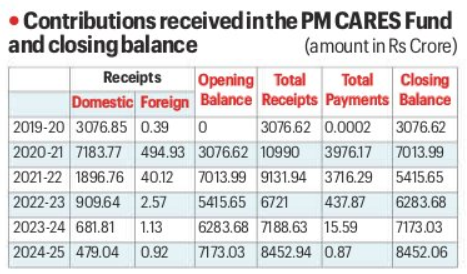
- Audited financial statements of PM-CARES for FY 2023-24 and 2024-25 were released after a two-year delay. Donations dropped sharply, yet the corpus grew ~25.8% (₹6,722 cr → ₹8,453 cr) — driven mainly by interest income, not donations.
- Utilisation collapsed from ₹437.9 cr to just ₹87.5 lakh, reviving concerns over the fund’s transparency and accountability.
Important Facts
- Full form: Prime Minister’s Citizen Assistance and Relief in Emergency Situations Fund.
- Set up: 27 March 2020, during the first wave of COVID-19.
- Legal form: A public charitable trust (registered trust deed) — not created by law or statute.
- Structure: Prime Minister is ex-officio Chairperson; Ministers of Home, Finance, and Defence are ex-officio Trustees. Funded only by voluntary contributions — no budgetary support.
Key Financial / Legal Features
- Donations do not go into the Consolidated Fund of India.
- CAG Audit: Not audited by the CAG — checked by an independent private auditor.
- CSR Eligibility: Counted as CSR expenditure under Schedule VII of the Companies Act, 2013.
- FCRA: Special exemption under Section 50 to receive foreign donations.
- Tax Benefit: Eligible for exemption under Section 80G of the Income Tax Act.
Distinguish from PMNRF — Concepts for Prelims
| Feature | PM-CARES | PMNRF |
|---|---|---|
| Established | 27 March 2020 | 1948 (Nehru era) |
| Original purpose | Pandemic relief | Partition refugees |
| CAG audited | No | No |
| CSR + FCRA advantage | Yes | No |
Source: Indian Express
💉
VERVE-102 & Gene Editing for Cholesterol
News Context
- An early trial of VERVE-102, a one-time gene-editing therapy, reduced LDL (bad cholesterol) by about 62% at the highest dose — aiming for a single injection instead of lifelong medicines. Still experimental, needs larger trials.
What Is VERVE-102 — Key Facts
- An experimental gene-editing treatment developed by Verve Therapeutics, a subsidiary of Eli Lilly. Given as a single IV infusion.
- Targets the PCSK9 gene in the liver, aiming to permanently switch it off to keep LDL levels low.
- Uses base editing — an adenine base editor (ABE) and guide RNA (gRNA) — delivered via lipid nanoparticles (LNPs), with GalNAc targeting the liver.
Base Editing vs CRISPR-Cas9
- CRISPR-Cas9: Cuts both strands of DNA, which can sometimes cause unwanted changes.
- Base Editing: A “molecular pencil” changing a single DNA base without cutting both strands — more precise.
- In vivo: Editing done directly inside the body. Ex vivo: Cells taken outside the body, edited, then put back.
Existing LDL Treatments — Concepts for Prelims
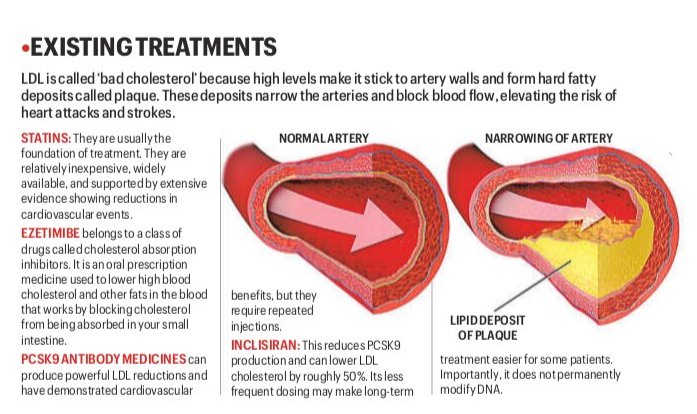
- Statins — foundation drug; reduce cholesterol production in the liver.
- Ezetimibe — a cholesterol absorption inhibitor, added when statins are insufficient.
- PCSK9 monoclonal antibodies — powerful, injectable, but need repeat doses (unlike gene editing’s permanent-change aim).
Source: Indian Express
