

The Two Balance Sheets Behind Every E-Waste Decision: Why India’s Discarded Electronics Are a Strategic Asset
Why in News
- India’s growing e-waste from discarded computers, servers and networking equipment contains valuable metals and critical minerals.
- In 2025, India generated nearly 1.5 million tonnes of e-waste, with an estimated economic value of around ₹51,000 crore.
- While about 60% is recoverable, only around 18% is currently recovered — highlighting the need to balance short-term financial gains with long-term resource security, environmental protection, public health and national competitiveness.
What is E-Waste?
- Electronic waste refers to discarded electrical and electronic equipment (EEE) — computers, servers, mobile phones, batteries, networking and storage systems — that have reached the end of their useful life.
What is Urban Mining?
- Urban mining is the recovery of valuable metals and minerals from waste (e-waste, used batteries) instead of extracting them from newly mined ore.
- Discarded electronics often contain higher concentrations of valuable metals than natural ores, making them a rich secondary resource.
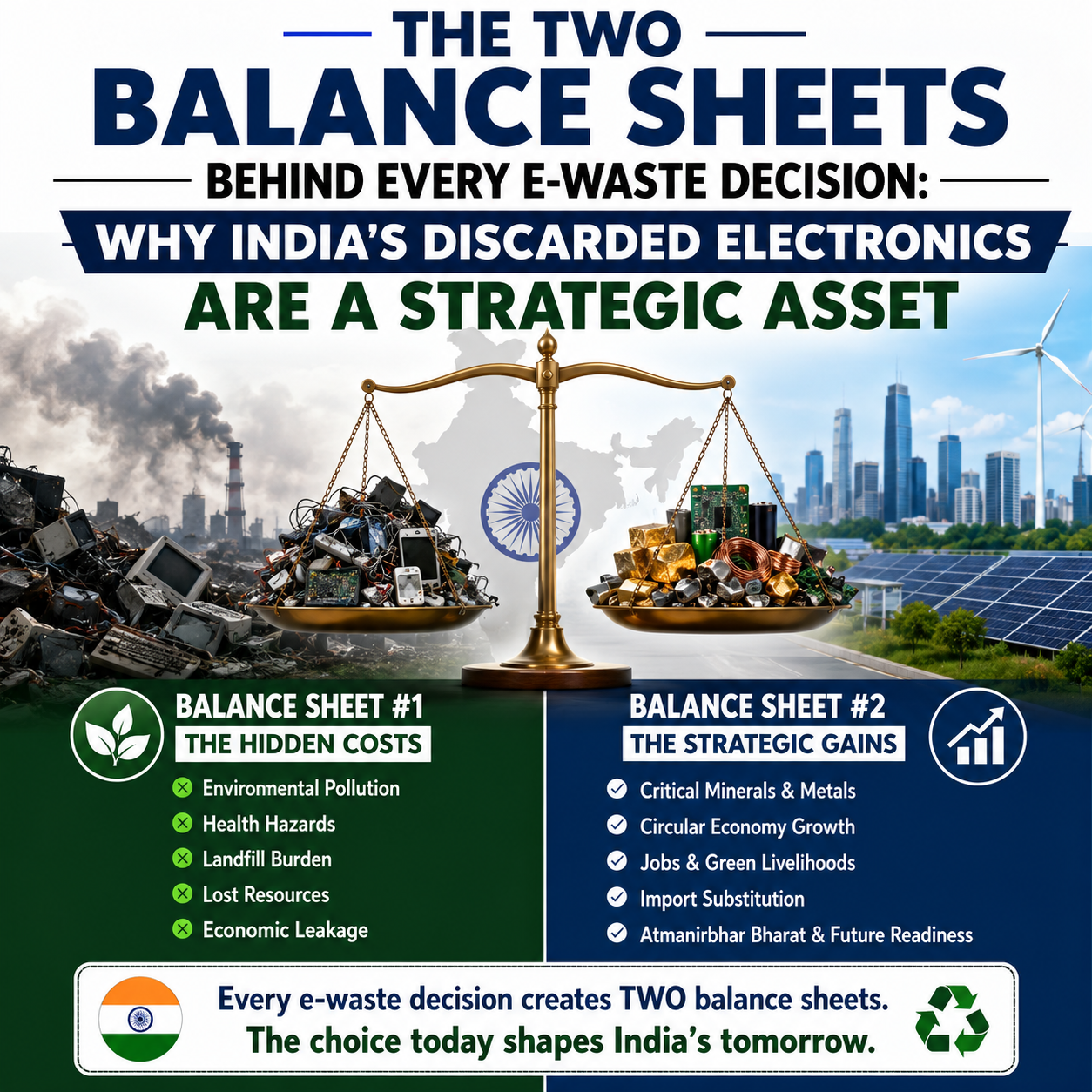
The “Two Balance Sheets” Framework
- First balance sheet (Financial/Immediate): Purchase price, resale value, savings — measurable, auditable, and closes with the transaction.
- Second balance sheet (Strategic/Long-term): Resource security, environmental sustainability, industrial capability, supply-chain resilience, public health and national competitiveness — stays “open” long after the deal is done.
Why This Matters: Significance
1. Economic Significance
- Urban mining as an economic goldmine: Could generate up to USD 6 billion annually, offering partial insulation from global supply disruptions.
- Reduced import bill: India imported about 12.47 million tonnes of critical minerals in 2024-25, led by platinum group elements, phosphorous, nickel, molybdenum and tin.
- Domestic value addition: Advanced recycling encourages downstream processing facilities and domestic manufacturing capability.
2. Strategic & National Security Significance
- Reducing dependence on China: India remains fully import-dependent for lithium, cobalt and nickel — used in EV batteries, defence electronics, telecom equipment and semiconductors.
- Urban mining as a policy instrument: Emerging as a strategic self-sufficiency tool, not merely a waste management solution.
- Short-term buffer: Viewed as a bridge while domestic mining projects (which may take a decade to mature) develop.
- Data security: Secure data destruction from discarded IT equipment is itself a cybersecurity concern.
3. Environmental & Health Significance
- E-waste contains hazardous substances — lead, mercury, cadmium, hexavalent chromium, and brominated flame retardants.
- Environmental damage creates economic costs: governments pay for cleanup, businesses face higher costs, citizens bear the burden through taxes and reduced productivity.
- Supports the circular economy and reduces the ecological damage of virgin mining.
4. Technological & Industrial Significance
- Safe recovery requires sophisticated technology, secure data destruction, environmentally compliant processing and traceable supply chains.
- Informal vs. formal recovery gap: Informal processing recovers only easily accessible metals (copper, aluminium) while losing harder-to-extract critical minerals that formal recycling can capture.
5. Governance & Procurement Reform Significance
- The L1 (lowest-price) principle promotes transparency and savings, but the cheapest purchase price may not mean the lowest overall cost long-term.
- Global shift toward life-cycle costing (LCC) and value-based procurement — asking “which option delivers the greatest long-term public value?”
India’s Policy & Institutional Framework
- E-Waste Management Rules, 2022: Introduced Extended Producer Responsibility (EPR), EPR certificates and mandatory recycling targets.
- E-Waste Collection Targets: 60% (2023-24), 70% (2024-25), 80% (2025-26).
- EPR: Producers, Importers and Brand Owners (PIBOs) meet recycling obligations directly or through Producer Responsibility Organisations (PROs).
- National Critical Mineral Mission (NCMM): ₹34,300 crore, seven-year mission (2025) for exploration, overseas asset acquisition and e-waste mineral recovery.
- Budget 2025-26: Proposed removing customs duty on critical minerals and battery waste, including cobalt and lithium-ion battery scrap.
- Recycling Infrastructure: $170 million programme to expand formal recycling infrastructure.
- Future Capacity: ~3 lakh tonnes of annual e-waste recycling capacity targeted by 2030.
Key Challenges
Informal Sector Dominance
Only a small share of e-waste is formally processed, causing loss of critical minerals and health hazards for informal workers.
Low Recovery Efficiency
Current systems recover only ~18% of the recoverable value.
Procurement Bias
Strategic value (data security, mineral recovery, environmental benefit) “rarely appears on the invoice.”
High Up-Front Cost
Advanced recycling costs deter adoption despite long-term gains.
Weak Traceability
Difficulty ensuring transparent, auditable supply chains.
Behavioural/Cognitive Gap
Decision-makers discount future costs (present bias) since benefits accrue after their tenure.
Analytical Insight
- “Unpaid Bill” Concept: Every government decision creates future costs or benefits. Good governance means choosing decisions that leave the smallest burden for future generations — inter-generational equity.
- From L1 to L-value: Procurement should move beyond lowest initial price (L1) towards lowest lifetime cost (L-value) via life-cycle costing.
- Solar Analogy: Early investment in solar manufacturing appeared expensive but built long-term industrial capacity — similarly for e-waste recycling.
- Waste-to-Wealth: E-waste should be treated as a resource, not a liability — supports Mission LiFE, SDG-12 and Atmanirbhar Bharat.
- Security–Economy–Environment Nexus: E-waste links environmental sustainability, economic self-reliance and national security.
Way Forward
Whether India’s discarded electronics become a strategic national asset or an environmental liability depends on the choices governments and businesses make today. In an economy increasingly built on renewable energy, batteries and advanced manufacturing, the wisest decision is the one that leaves behind the smallest unpaid bill.
