

Why in News: Kerala High Court released the country’s first comprehensive policy on the use of Artificial Intelligence (AI) in the district judiciary — “Policy Regarding Use of Artificial Intelligence Tools in District Judiciary.
Introduction
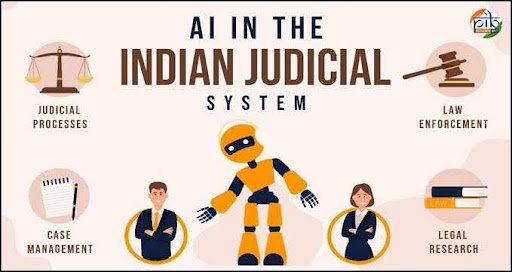
- In July 2025, the Kerala High Court issued the country’s first comprehensive guidelines on Artificial Intelligence (AI) in judicial processes through its policy titled “Policy Regarding Use of Artificial Intelligence Tools in District Judiciary.”
- This marks a timely intervention as India’s judiciary grapples with a pendency of nearly five crore cases.
- While AI promises efficiency and speed in tasks such as translation, transcription, and defect identification in filings, its deployment in a sensitive domain such as justice requires strong safeguards.
Potential Benefits of AI in Courts
- Efficiency gains – Faster translation of documents, transcription of arguments, and identification of defects in filings.
- Assistance in research – AI-enabled legal research can reduce the time spent locating precedents.
- Cost reduction – Automation of routine processes can lower administrative burdens.
- Accessibility – Translation tools could improve access for litigants across diverse linguistic backgrounds.
- Experimentation with pilots – Current use in transcription of oral arguments and witness depositions demonstrates potential.
Risks and Challenges
Errors in translation and transcription
- Example: “Leave granted” translated as “chhutti sweekar (holiday approved)”.
- In Noel Anthony Clarke vs Guardian News & Media Ltd. (2025), an AI tool transcribed “Noel” as “no.”
- OpenAI’s Whisper sometimes “hallucinates” entire phrases.
Hallucinations in Legal Research –
- Legal LLMs have been found to fabricate case laws and cite incorrect precedents, creating risks for adjudication.
Search Engine Bias –
- AI-driven search may invisibilise relevant precedents due to algorithmic bias.
Over-reliance on rule-based inference
- Risks reducing nuanced judicial reasoning to mechanical outputs, undermining contextual and human judgment.
Data privacy and security issues
- Absence of clear frameworks for storage, access, and use of sensitive judicial data in pilots.
Infrastructure gaps
- Dependence on reliable internet, robust hardware, and trained personnel, which may not be uniformly available.
Guardrails for Responsible AI Adoption
Capacity Building and AI Literacy
- Judges, lawyers, and court staff must be trained not only to use AI tools but also to understand their limitations.
- Judicial academies and bar associations can partner with AI governance experts to build critical AI literacy.
Transparency and Litigant Rights
- Litigants must be informed if AI tools are used in research, transcription, or judgment drafting.
- Right to opt-out: Parties should be allowed to object to AI use if safeguards are inadequate.
Procurement and Reliability Standards
- Adoption of standardised procurement guidelines for evaluating AI systems.
- Pre-procurement assessments to determine whether AI is the best solution for the problem.
- Evaluation criteria must include explainability, reliability, data management, and risk mitigation.
Human Oversight
- AI outputs should always be manually vetted by legal professionals such as retired judges, advocates, and translators.
- Recognizing that hallucinations are a feature of LLMs, human judgment must remain central.
Institutional Infrastructure
- Creation of technology offices within courts (as proposed in Phase III of the eCourts Project) to guide adoption.
- Specialists can oversee procurement, monitor vendor compliance, and provide technical expertise.
Conclusion
As India progresses with the eCourts project, embedding ethical, legal, and technical safeguards into AI use will ensure that efficiency does not eclipse the nuanced reasoning at the heart of justice delivery.
UPSC Relevance
GS Paper II (Polity & Governance): Judicial reforms, transparency, accountability, rights of litigants.
GS Paper III (Science & Technology): Applications of Artificial Intelligence,
Mains Practice Question
Q.AI in judiciary promises efficiency but raises serious ethical and procedural concerns. Discuss the guardrails required for responsible adoption of Artificial Intelligence in Indian courts.
