
Syllabus: Government Budgeting.
Context and Budgetary Push
- Union Budget 2026-27 announced a major financial and institutional push for AYUSH sector.
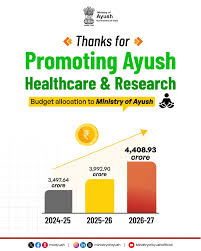
- Total allocation increased to ₹4,408 crore from ₹3,992 crore last year.
- Funding has risen sharply from ₹2,122 crore in 2020-21.
- Policy focus is on expansion, integration, and global positioning.
Institutional Expansion and Infrastructure
- Government will establish three new All-India Institutes of Ayurveda.
- Institutes will provide treatment, research, and advanced teaching facilities.
- They are modelled on AIIMS-like standards for traditional medicine.
- Funds allocated to upgrade WHO Global Traditional Medicine Centre, Jamnagar.
- Aim is to position India as global standard-setter in traditional medicine.
Strengthening Service Delivery
- National AYUSH Mission allocation increased by 66% to ₹1,300 crore.
- Funds will modernise AYUSH hospitals and dispensaries nationwide.
- AYUSH clinics will be co-located within modern healthcare facilities.
- Focus includes preventive healthcare and wellness services.
- Pharmacies and drug-testing laboratories will also be upgraded.
Technology and Supply Chain Support
- AI assistant Bharat-VISTAAR to support medicinal plant farmers.
- It will provide crop advice, price data, and export certification support.
India-EU FTA and Global Market Access
- FTA allows Indian AYUSH practitioners easier entry into Europe.
- Degree recognition barriers reduced in non-regulated EU countries.
- Indian firms can open wellness centres and Ayurvedic clinics.
- Mutual recognition of lab testing and safety certifications enabled.
- Traditional Knowledge Digital Library gains legal protection abroad.
Institutional and Regulatory Ecosystem
- Sector includes hospitals, research councils, and regulatory bodies.
- Key institutes include All-India Institute of Ayurveda and National Institute of Homoeopathy.
- Research led by bodies like Central Council for Research in Ayurvedic Sciences.
- Education regulated by National Commissions for Indian Medicine and Homoeopathy.
- Pharmacopoeia Commission sets official AYUSH drug standards.
- National Medicinal Plants Board promotes herb cultivation.
Scientific and Regulatory Concerns
- Critics highlight limited empirical clinical evidence for treatments.
- Concerns include heavy metals in some products.
- Debate persists over mixopathy and surgical training rights.
- Prescription of allopathic drugs by AYUSH doctors remains contentious.
Economic and Sectoral Implications
- AYUSH market projected at $26.5 billion by 2026.
- Startups and MSMEs form nearly 80% of the sector.
- Budget push aims to transform AYUSH into growth industry.
- Global expansion will increase scrutiny and regulatory expectations.