

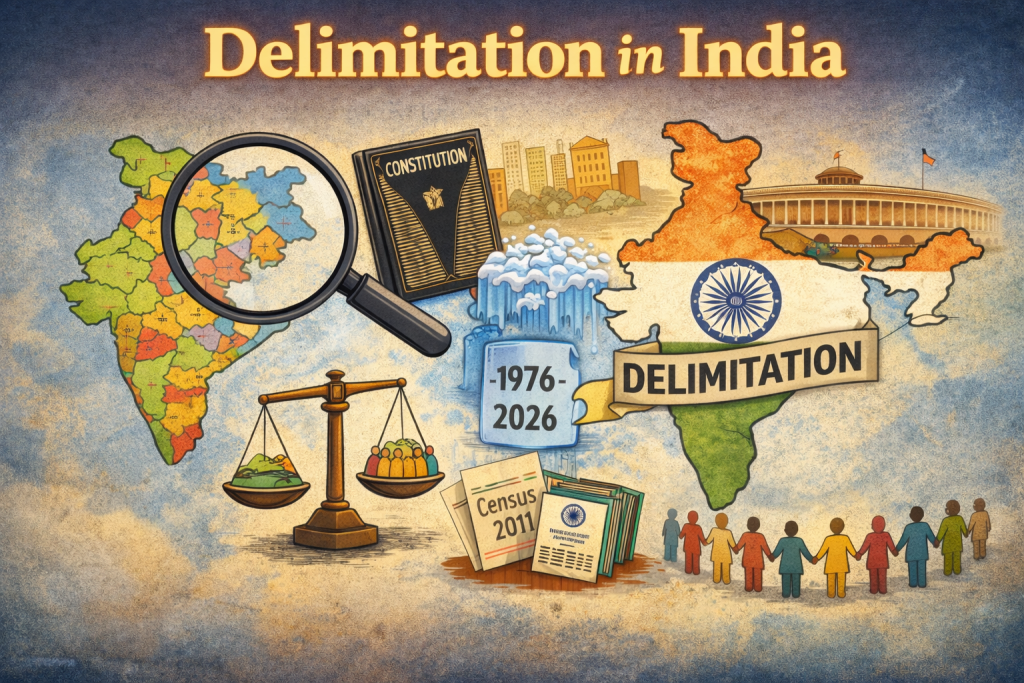
Context: The proposed Delimitation Bill, 2026, linked with constitutional amendments, has reopened a critical debate on how representation should evolve in a demographically diverse India.
What is Delimitation
- Explaining Delimitation
- Delimitation refers to the process of redrawing the number and boundaries of electoral constituencies to ensure fair representation.
- It aims to maintain the principle of equal value of each vote by aligning constituencies with population changes.
- It directly influences political power distribution and democratic voice across regions.
- Evolution of Delimitation
- The Constitution mandates delimitation after every Census under Articles 82 and 170.
- Exercises were conducted after the 1951, 1961, and 1971 Censuses.
- A major shift occurred with the 42nd Amendment (1976), which froze seat allocation to protect States implementing population control.
- This freeze was extended till 2026 through the 84th Amendment, reflecting a policy choice to balance population stabilisation and representation.
- Present Proposal
- The current proposal seeks to increase Lok Sabha seats to around 850 and redraw constituencies.
- It proposes using 2011 Census data to correct imbalances caused by migration and uneven population growth.
- The aim is to ensure intra- and inter-State population parity across constituencies.
- However, the proposal raises questions about timing, data relevance, and broader fairness.
Core Concerns
- Outdated data challenge: Using 2011 Census figures risks creating constituencies that are already misaligned with present realities.
- Migration dynamics: Continuous rural-urban migration has significantly altered population distribution, making static data unreliable.
- Federal imbalance risk: Pure population-based redistribution may disadvantage States that successfully controlled population growth.
- Representation dilemma: The debate reflects tension between numerical equality (population) and equitable federal representation.
- Timing and political sensitivity: Conducting delimitation debates alongside elections raises concerns about political intent and consensus-building.
Way Forward
- Adopt a balanced approach combining population with other indicators like development and governance performance.
- Use updated Census data to ensure accuracy and credibility of representation.
- Ensure wide political consultation and consensus, given its long-term federal implications.
- Protect the spirit of cooperative federalism, ensuring no State feels structurally disadvantaged.
- Treat delimitation as a constitutional exercise of nation-building, not merely administrative adjustment.
Conclusion
- Delimitation is fundamentally about who gets represented and how fairly democracy speaks for its people. A nuanced and balanced approach is essential to ensure that democratic equality strengthens, rather than weakens, India’s federal fabric.
