

Drone Revolution and Modern Warfare
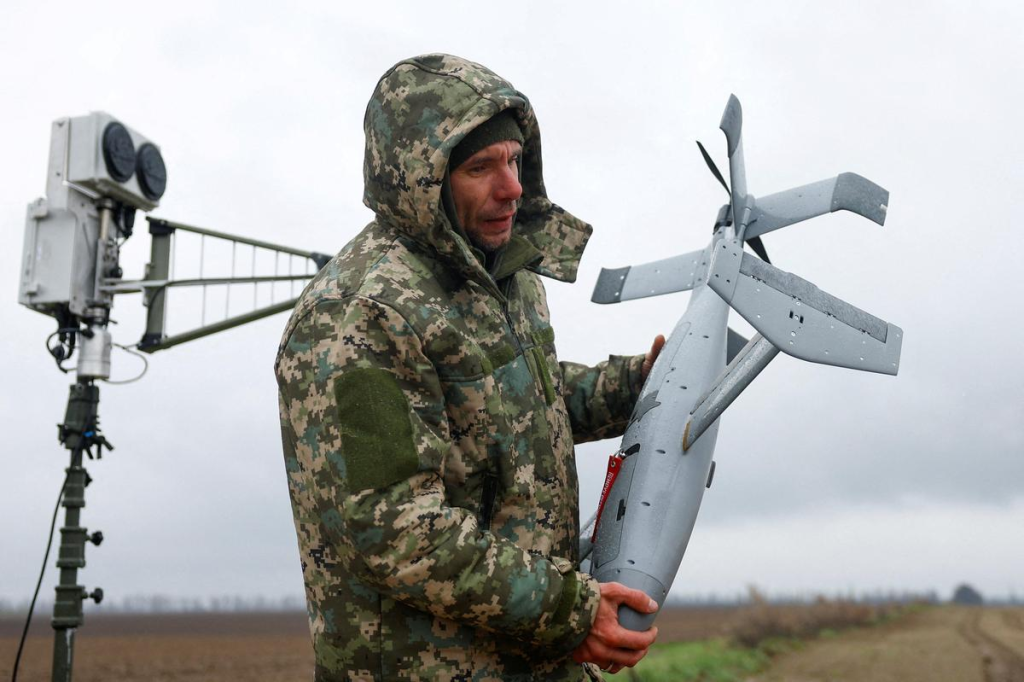
Context
- Wars in Ukraine, Lebanon and the US-Israel-Iran theatre have shattered the paradigm of conventional military superiority.
- Commercially derived drones have evolved from auxiliary assets into central instruments of military operations.
- The battlespace has transformed into an environment of persistent visibility and rapid engagement.
Types of Drones
- Surveillance Drones: Used for ISR missions. Examples include Heron and Searcher for border patrolling.
- Combat Drones (UCAVs): Armed precision strike systems. Examples include Heron TP and MQ-9 Reaper.
- Loitering Munitions: Hover before striking high-value targets. Examples include Harpy and Nagastra-1.
- FPV Drones: Inexpensive kamikaze systems costing a few hundred dollars capable of destroying million-dollar armoured vehicles.
- Swarm Drones: AI-coordinated multiple drones that saturate defences and confuse radar systems.
- Fibre-Optic Drones: Ukraine’s most significant innovation i.e. transmit commands through cables making them immune to electronic jamming.
How Drones Are Changing Warfare
- Asymmetric Superiority: Ukraine used $2,000 drones to disable Russia’s advanced S-300 air defence systems.
- Precision Strikes: MQ-9 Reaper eliminated Iranian General Soleimani with zero troop deployment.
- Real-time ISR: Heron drones in Ladakh provided live monitoring during the India-China standoff.
- Swarm Tactics: Azerbaijan’s drone swarms crippled Armenian positions in Nagorno-Karabakh (2020).
- Blurring Civil-Military Divide: Commercial drones modified with payloads now serve in hybrid and irregular warfare.
- Economic Shift: Cheap mass-produced systems are replacing expensive platforms and complex logistics structures decisively.
Challenges
- Counter-Drone Vulnerabilities: Drones can be jammed, spoofed or shot down using electromagnetic or kinetic countermeasures.
- High Attrition: Drone survivability is low when facing layered radar-guided interceptor defences.
- Civilian Misuse Risk: Drones are easily weaponised by terrorists and insurgent groups posing internal security threats.
- Regulatory Gaps: India’s drone laws lack clear mechanisms for seamless civil-military coordination.
- Slow Domestic Production: Inconsistent procurement discourages private manufacturers from scaling drone operations.
India’s Drone Landscape
- Operation Sindoor saw Pakistan deploy drone waves neutralised by India’s integrated Counter-UAS (CUAS) network.
- DRDO Aura uses radar-evading stealth design with AI for autonomous target identification.
- India’s planned “Sudarshan Chakra” nationwide air defence system must be operationalised by 2035.
Way Forward for India
- Drone Swarm Development: Accelerate indigenous swarm drone technology using AI coordination for offensive and defensive operations.
- Integrated Air Defence: Expand radar-drone integration under IACCS to pre-empt and neutralise drone threats effectively.
- Indigenous Ecosystem: Promote startups like Idea Forge and Solar Industries through fast-track defence procurement.
- Mass Production: Enable scalable drone production using modular 3D printing and dual-use industry support.
- AI Upgrades: Invest in autonomous navigation, terrain-mapping and EW resilience to bypass adversarial defences.
Conclusion: Drones are no longer just weapons, rather, they are the very infrastructure of modern warfare. As India upgrades its drone doctrine, the focus must shift from selective imports to robust, self-sustaining domestic production. Mastery over drone technology will define India’s strategic edge in all future conflicts.
| Global Drone Models: Case StudiesUkraine:Russia’s 2022 conventional war evolved into the world’s first industrial-scale drone-intensive conflict within two years.Ukraine deployed FPV kamikazes, bomber drones, loitering munitions (RAM II, UJ-31 Zozulya) and long-range strike drones.Heavy-lift hexacopter Vampire “Baba Yaga” drones became iconic symbols of Ukraine’s drone warfare.Hezbollah and Iran:Hezbollah relies on Iranian-supplied Ababil, Mohajer and Shahed series platforms for ISR and strike functions.Shahed-136 loitering munition fulfils dedicated one-way strike roles across the wider regional theatre.Iran integrates drones into deterrence, coercion and power projection through proxy forces in Iraq, Syria, Lebanon and Yemen.Israel:IDF developed AI-enabled Iron Drone Raider using net capture and direct collision rather than costly missiles.Israel operates long-endurance Heron systems alongside armed drones and loitering munitions in integrated strike complexes. |