

Context
- The ongoing Iran-US-Israel conflict has highlighted the critical vulnerability of global trade choke points. Nearly 20 million barrels of crude oil, about one-third of global supplies, pass through the Strait of Hormuz daily.
- India imports nearly 88% of its crude oil amounting to about 1.8 billion barrels annually making it severely exposed. There is an urgent need to develop alternative connectivity routes that avoid conflict zones and strategic choke points.
IMEC Framework
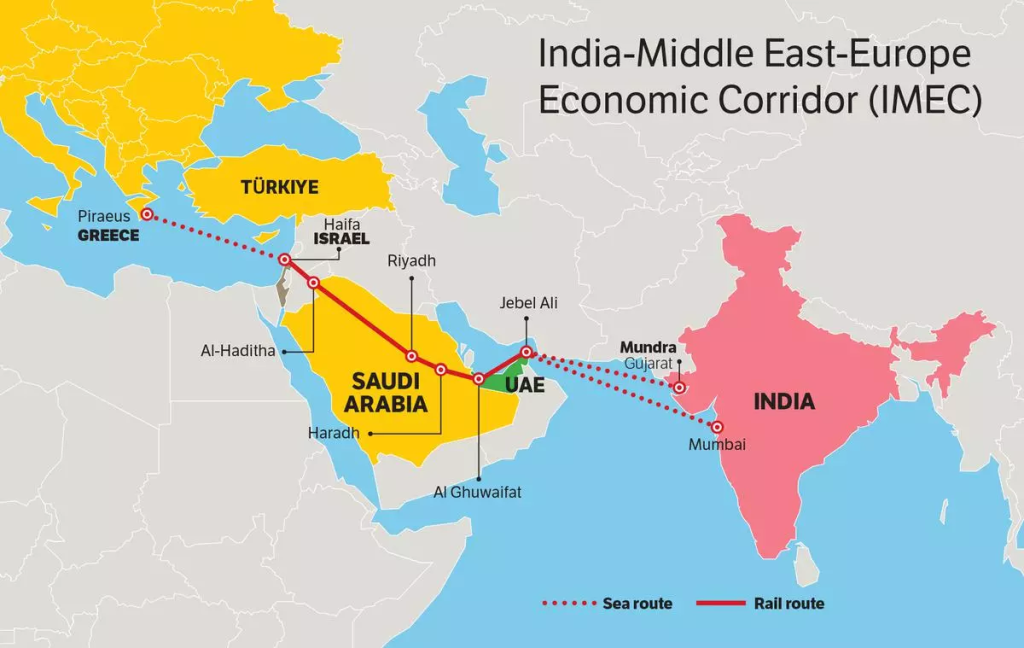
- India-Middle East-Europe Economic Corridor (IMEC) was officially announced at the G-20 Summit in New Delhi in September 2023.
- It is a multimodal economic corridor integrating railways, ports, highways, energy networks and digital infrastructure.
- It also encompasses undersea data links, green hydrogen corridors and transnational energy transmission grids.
- The corridor has three distinct sections:
- Eastern Section: Sea links connecting India with the UAE.
- Central Section: Overland route through UAE, Saudi Arabia, Jordan and Israel terminating at the port of Haifa.
- Western Section: Sea-based link from Haifa to various European ports.
- IMEC seeks to bypass the Suez Canal and reduce dependence on traditional maritime choke points.
Iran Conflict: Impact on IMEC
- IMEC was placed on the back burner soon after the Gaza war broke out on October 7, 2023.
- Key UAE ports of Jebel Ali and Fujairah have been repeatedly targeted by Iran during the ongoing conflict.
- Disruptions in the Strait of Hormuz have directly exposed the geographical vulnerabilities of these critical entry ports.
- Iran’s blockade of the Strait has demonstrated that no existing corridor is immune to regional conflict disruption.
Other Challenges Associated
- Saudi Arabia-UAE divergence over the Iran conflict represents a critical fault line threatening IMEC’s future.
- UAE’s exit from OPEC and growing strategic coordination with Israel risk widening differences with Saudi Arabia significantly.
- Deployment of Israeli Iron Beam defence systems in the UAE further complicates regional geopolitical dynamics.
- The port of Haifa which is central to IMEC’s western connectivity remains directly affected by ongoing regional conflict.
- IMEC’s success depends on smooth coordination among Saudi Arabia, UAE, Jordan and Israel — currently deeply strained.
Way Forward
- IMEC must evolve into a broader and more flexible framework while keeping the original alignment as a future option.
- Oman’s ports of Salalah, Duqm and Muscat should be developed as alternative eastern entry points away from the Strait of Hormuz.
- On the western end, a spur through Egypt terminating at a Mediterranean port offers a viable alternative to Haifa.
- Egypt already possesses the Suez Canal Economic Zone, six operational ports and four industrial zones supporting green hydrogen and LNG.
- India must play an active diplomatic role bridging Saudi Arabia and the UAE given its trusted relations with both.
- India and Italy reaffirmed IMEC commitment during PM Modi’s Europe visit in May 2026 through their Special Strategic Partnership.
- European nations especially Italy and France must actively champion IMEC to maintain its geopolitical and commercial momentum.
