Context
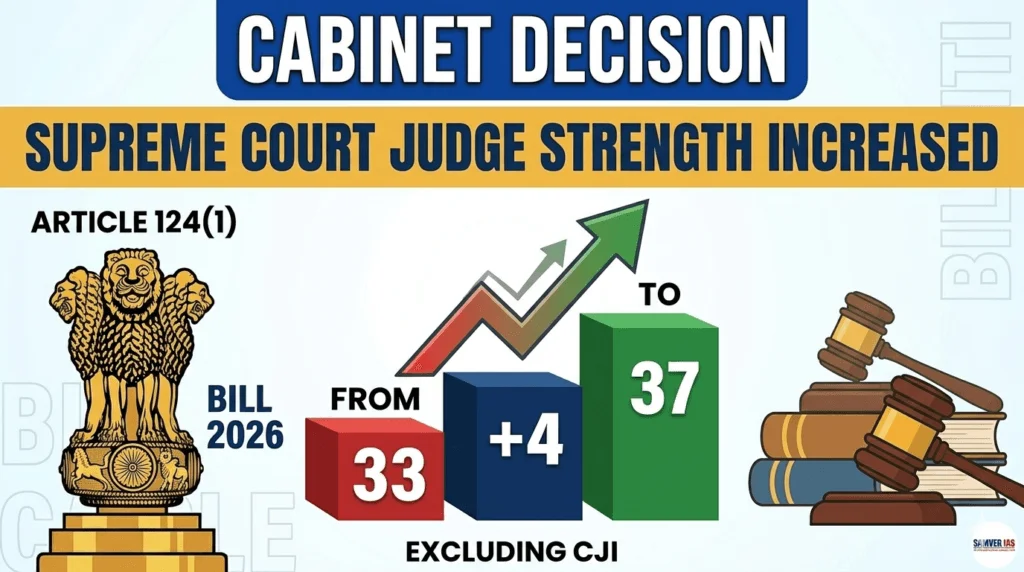
- An ordinance was promulgated increasing the Supreme Court’s sanctioned strength from 34 to 38 judges.
- The Supreme Court Collegium recommended elevation of four High Court Chief Justices and senior advocate V. Mohana.
- As per the National Judicial Data Grid, pendency before the SC currently stands at 93,966 cases.
About Judicial Pendency
- Pendency refers to the accumulation of undecided cases across courts over time.
- The Supreme Court was envisaged as both a constitutional court and final court of appeal.
- Over time, its appellate jurisdiction has increasingly overshadowed its constitutional role.
- Pendency undermines the constitutional guarantee of speedy justice under Article 21.
Causes of Pendency
- Excessive SLPs: A substantial portion of the SC docket is dominated by Special Leave Petitions under Article 136, which were meant to be exercised sparingly.
- Absence of guidelines: No clear guidelines govern the exercise of Article 136 jurisdiction leading to unpredictable outcomes.
- Government litigation: The Union, State governments and PSUs contribute overwhelmingly to judicial pendency through excessive litigation.
- Frivolous PILs: Many Public Interest Litigations are filed for personal or political interests rather than genuine public causes.
- Prolonged hearings: Excessive reliance on oral arguments consumes disproportionate judicial time unnecessarily.
Supreme Court’s Role
- In 2016, a Constitution Bench declined to narrow the scope of Article 136, further widening the SC’s already large docket.
- Unpredictable listing of cases has fuelled allegations of bench fixing and corrupt listing practices.
- Conflicting rulings by coordinate Benches further delay resolution as matters require reference to larger Benches.
- The SC must ensure intervention is reserved for cases involving substantial questions of law.
Steps Taken
- Supreme Court (Number of Judges) Amendment Bill, 2026 approved to add four new judges.
- National Judicial Data Grid established for real-time monitoring of case pendency across courts.
- Guidelines laid down in State of Uttaranchal vs Balwant Singh Chaufal (2010) to filter frivolous PILs.
- Courts have repeatedly directed the government to rationalise its litigation strategy and avoid pursuing unsustainable cases.
Persisting Issues
- The ordinance route was unnecessary as Parliament was set to convene within weeks deepening institutional scepticism.
- Increasing SC strength may lead to greater doctrinal inconsistency among more coordinate Benches.
- The promised National Litigation Policy was withdrawn leaving government litigation strategy incoherent and case-specific.
- Changes in law officers lead to contradictory legal positions in successive hearings causing further delays.
- Gender representation remains poor with the seniority convention being relaxed for men but not for women judges.
Way Forward
- The SC must develop robust filters to reduce inflow of SLPs and frivolous PILs strictly.
- Substantial questions of law must be heard by larger Benches to ensure doctrinal consistency.
- The government must introduce a National Litigation Policy to reduce its overwhelming contribution to pendency.
- Stricter time allocation for oral arguments and greater reliance on written submissions must be enforced.
- The four new positions must be used as an opportunity to improve gender representation on the Bench.
- Greater transparency in the collegium appointments process is essential to restore public confidence.