

Context
- The Union Budget 2025–26 announced an ambitious plan to increase nuclear power capacity from 8,180 MW to 100 GW by 2047. The government enacted the SHANTI Act, 2025, which replaces the Atomic Energy Act, 1962 and Civil Liability for Nuclear Damage Act (CLNDA), 2010.
- The reform opens the nuclear sector to private and foreign participation, ending the earlier monopoly of the Department of Atomic Energy. These reforms are driven by the twin national goals of achieving Viksit Bharat by 2047 and Net Zero emissions by 2070.
Current Status of India’s Energy and Nuclear Sector
- India’s total installed electricity capacity reached 476 GW in 2025, with about 50% from non-fossil sources.
- Renewable energy capacity stands at 227 GW, including solar (111 GW), wind (51 GW), and hydropower (48 GW).
- Nuclear power contributes only 8.8 GW, reflecting a very small share in the energy mix.
- In terms of generation, thermal power contributes 75%, renewables about 22%, and nuclear only 3%.
- India generated 1,824 TWh of electricity in 2024–25, with renewables contributing 403 TWh and nuclear 57 TWh.
- India’s per capita electricity generation is 1,418 kWh, significantly lower than China (7,097 kWh) and the United States (12,701 kWh).
- Renewable energy faces challenges due to intermittency, seasonal variation, and storage constraints, limiting its reliability.
Key Features of India’s Nuclear Programme
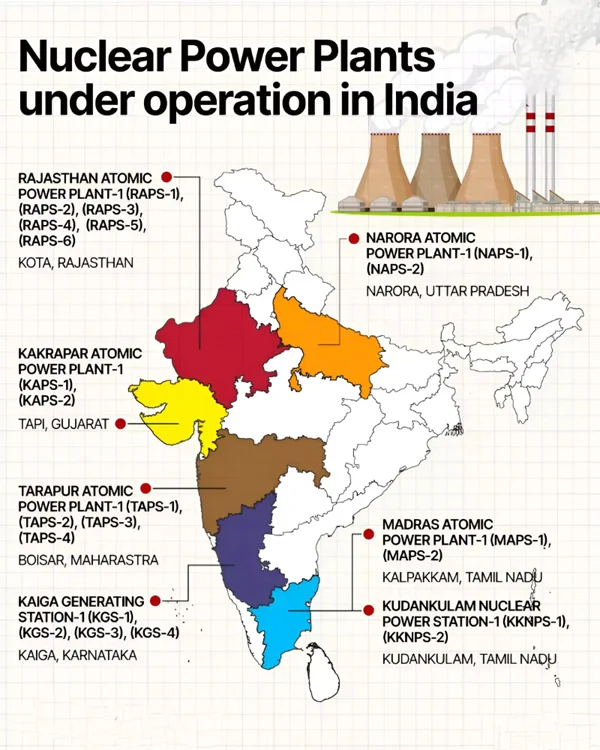
- India operates 24 nuclear reactors with an installed capacity of about 8,780 MW.
- Indigenous Pressurised Heavy Water Reactors (PHWRs) have evolved from 220 MW to 540 MW and 700 MW designs.
- India’s PHWR construction cost is about $2 million per MW, making it among the most cost-efficient globally.
- The government approved 10 PHWR reactors in fleet mode to achieve economies of scale, although progress remains slow.
- Proposed large-scale projects include Jaitapur (EDF design) and sites at Mithi Virdi and Kovvada, though these involve high costs.
- The Department of Atomic Energy has an annual budget of around ₹24,000–26,000 crore.
Challenges
- Achieving the 100 GW target requires investment of over $200 billion (₹18 lakh crore), which is difficult without private capital.
- Nuclear projects involve high upfront costs and long gestation periods, creating financial risks.
- Imported reactor technologies are expensive, with costs exceeding $5 million per MW.
- Regulatory uncertainties persist regarding liability, tariffs, waste management, and dispute resolution mechanisms.
- Renewable energy expansion is facing headwinds, with nearly 40 GW of projects lacking power purchase agreements.
- Institutional and regulatory frameworks under the new Act require detailed rules and effective implementation mechanisms.
Opportunities for India
- Nuclear power offers baseload energy, ensuring stable and continuous electricity supply.
- It provides a low-carbon alternative, supporting India’s climate commitments and energy transition.
- Development of Small Modular Reactors (SMRs) can offer flexible and scalable solutions for diverse applications.
- The government has allocated ₹20,000 crore for SMR research, targeting deployment by 2033.
- Indigenous PHWR technology can be expanded and modularised for industrial captive power generation.
- Sectors such as steel, cement, petrochemicals, and data centres are emerging as potential users of nuclear energy.
- Advanced technologies, including thorium-based reactors and HALEU fuel, provide long-term strategic advantages.
Way Forward
- The government must frame clear regulations regarding liability, tariffs, nuclear fuel ownership, and waste management.
- A strong and autonomous regulatory body must ensure safety, transparency, and public trust.
- Financing models must be developed to attract private and foreign investment, given the capital-intensive nature of nuclear energy.
- Indigenous capabilities must be strengthened through technology development, supply chains, and skilled manpower.
- Foreign reactor designs must be indigenised to reduce costs and build a domestic manufacturing ecosystem.
- Research must focus on SMRs, thorium utilisation, and advanced reactor technologies.
- Nuclear expansion must be integrated with renewable energy to ensure grid stability and sustainable energy transition.
Conclusion
- India’s nuclear power expansion represents a critical pathway towards achieving energy security, economic growth, and climate goals. Its success will depend on effective implementation, regulatory clarity, and a balanced approach that integrates technology, investment, and governance reforms.
