
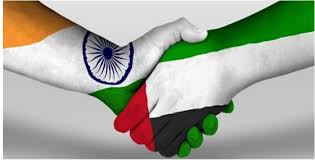
Context and Evolution of the Partnership
- India-UAE relations have transformed into a Comprehensive Strategic Partnership since 2017.
- The Comprehensive Economic Partnership Agreement (CEPA), 2022 accelerated economic integration. The bilateral trade target of $100 billion by 2030 was achieved five years early.
- Leaders have now set an ambitious $200 billion trade target by 2032.
- The UAE was invited as a Guest Country to the G-20 Summit under India’s presidency.
Economic Corridor
- Non-oil trade reached $65 billion, growing nearly 20% annually.
- UAE invested over $22 billion in India since 2000.
- Indian firms invested more than $16 billion in the UAE.
- The corridor now spans manufacturing, logistics, finance, energy, and technology.
- Over 1,200 weekly flights reflect intense commercial and human connectivity.
- Industrial and Infrastructure Partnerships
- Reliance partnered TA’ZIZ on low-carbon chemicals manufacturing in Abu Dhabi.
- Ashok Leyland relocated electric bus production to the UAE.
- ADNOC (Abu Dhabi National Oil Company) signed long-term LNG supply deals with Indian energy firms.
- Mubadala invested over $4 billion in healthcare, renewables, and technology.
- Abu Dhabi Investment Authority (ADIA) established a base in GIFT City.
Strategic, Energy and Connectivity Cooperation
- UAE is India’s 4th largest crude oil supplier.
- It is India’s 2nd largest source of LNG and LPG.
- UAE is the only country storing strategic oil reserves in India.
- Bilateral trade reached $85 billion (2022-23).
- UAE is India’s 3rd largest trading partner and 2nd export destination.
- Regional and Maritime Cooperation
- Both collaborate in the India-Middle East Economic Corridor (IMEEC).
- Naval cooperation occurs under Indian Ocean Naval Symposium (IONS).
- Joint exercises include Desert Cyclone, Gulf Star, PASSEX.
- Trilateral drills like Desert Knight (India-France-UAE) enhance interoperability.
Other Sector For Cooperation
- Technology and AI
- AI is emerging as the next frontier of corridor integration.
- Cooperation spans data centres, advanced computing, and AI innovation ecosystems.
- UAE’s early investments in AI complement India’s digital public infrastructure strengths.
- Food Security
- UAE’s agricultural constraints (0.7% arable land) make India a natural partner.
- Food corridor agreements aim to triple bilateral food trade by 2025.
- Platforms like Agriota link Indian farmers directly to UAE markets.
- New-Age Economic Platforms
- Local Currency Settlement (LCS) reduces dollar dependence in trade.
- UPI digital payments operational for Indians in the UAE.
- Civil nuclear cooperation includes support for Barakah Nuclear Power Plant operations.
- Global Corridor Dimensions
- Nearly 3.5–5 million Indians live in the UAE – the largest expatriate group.
- UAE contributed 19.2% of India’s remittances (~$11.7 billion, FY24).
- Cultural ties deepened with the BAPS Hindu Temple in Abu Dhabi.
Challenges and Strategic Constraints
- Labour concerns persist under the Kafala sponsorship system.
- India faces a trade deficit (~$16.78 billion) with the UAE.
- OPEC oil pricing policies may conflict with India’s import interests.
- Aviation disputes exist over flight expansion rights.
- Regional instability like Gaza conflict, Red Sea disruptions affects corridors.
- India-Iran ties and UAE-China engagement create geopolitical balancing pressures.