

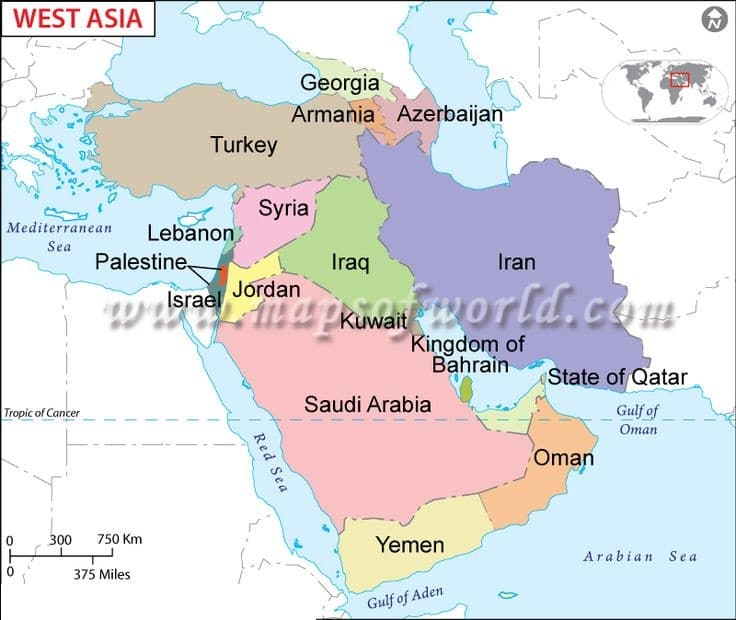
- West Asia is a subregion of Asia, bordered by Europe to the west, Central Asia to the north, South Asia to the east, and Africa and the Arabian Sea to the south.
- The region broadly includes
- Armenia, Azerbaijan, Bahrain, Cyprus, Georgia, Iraq, Israel, Jordan, Kuwait, Lebanon, Iran, Oman, Palestine, Qatar, Saudi Arabia, Syria, Turkey, the United Arab Emirates, and Yemen.
- It is marked by diverse landscapes such as deserts, mountains, and coastlines, and is associated with important rivers such as the Tigris, Euphrates, and Nile.
- For India, West Asia is not just a nearby external region; it is a space deeply connected with energy, trade, diaspora, connectivity, and strategic interests.
Significance of West Asia for India
- Energy security
- West Asia is crucial for India’s energy needs, especially in oil and natural gas.
- Saudi Arabia and Iraq are major suppliers of oil to India.
- Qatar is India’s most important supplier of natural gas, accounting for 41% of India’s total natural gas imports.
- Any instability in the region can directly affect India’s energy security and economic stability.
- Economic significance
- West Asia is an important trading partner for India.
- Indian companies have invested in sectors such as infrastructure, construction, and technology in the region.
- India’s trade with the UAE stood at $73 billion in 2021-22, recording a 68% growth over 2020-21.
- Iraq was India’s fifth largest trading partner in 2021-22 at $34.3 billion.
- Diaspora linkages
- West Asia hosts a large Indian diaspora, especially in the Gulf countries.
- The Indian diaspora is about 3.5 million in the UAE and 2.5 million in Saudi Arabia.
- In the UAE alone, the Indian expatriate community of around 3.4 million is the largest segment of India’s diaspora.
- This diaspora forms an important bridge in economic, social, and cultural relations.
- Cultural ties
- India shares a long history of cultural exchange with West Asian societies.
- India has established cultural centres in several countries of the region, deepening people-to-people ties.
- Counter-radicalisation
- Cooperation with West Asian countries is also important for countering radicalisation.
- Given the rise of extremist groups, closer engagement can support security coordination and reduce risks to Indian interests.
- Gateway to Central Asia
- West Asia can serve as a gateway to Central Asia, particularly for a country like India seeking wider continental connectivity.
- The development of Chabahar Port in Iran is important in this regard, especially for connectivity towards Afghanistan and Central Asia.
India’s Foreign Policy Towards West Asia
- India has traditionally maintained strong ties with many West Asian countries through economic, political, and cultural engagement.
- Since the 1990s, India has built trade partnerships with the region in areas such as oil and energy.
- In 2014, India adopted a more focused approach towards the region through the Look West Policy.
- Look West Policy
- The policy is aimed at advancing India’s national interest without becoming entangled in the regional politics of the Arab world.
- It reflects a balanced and interest-driven approach, rather than bloc-based alignment.
- Important policy developments
- India-UAE CEPA (2022): Expected to deepen bilateral economic ties.
- Saudi investment: Saudi Arabia has invested in the Jio platform of Reliance Industries.
- Chabahar Port: Strengthens India’s access to Iran, Afghanistan, and Central Asia.
- India-Arab Cooperation Forum (2014): Hosted by India to promote engagement and annual ministerial exchanges.
- OIC engagement (2019): India attended the OIC Foreign Ministers’ meeting as a guest of honour, marking an important diplomatic step.
Challenges in India–West Asia Relations
- Limited economic depth
- Despite progress, the text points out that India’s trade with West Asia remains relatively limited compared to other regions.
- In 2025, India’s total trade with West Asia accounted for 10-11% of its global trade.
- Geopolitical tensions
- West Asia remains a volatile region, requiring India to carefully manage ties amid regional rivalries and conflicts.
- One example is the need to balance relations between Israel and Palestine.
- Competition from major powers
- India’s engagement is influenced by the presence of other powers, particularly China.
- India has attempted to respond through stronger economic and security cooperation with countries like the UAE and Saudi Arabia.
- Political instability
- Internal instability in countries such as Syria, Iraq, and Yemen can negatively affect India’s interests in the region.
- Terrorism and radicalisation
- The rise of the Islamic State and other extremist groups poses a threat to the Indian diaspora in West Asia.
- Further, the concerns are over the radicalisation of Indian youth.
- Energy vulnerability
- Since a large part of India’s energy imports comes from West Asia, supply disruptions can have serious consequences for the economy.
- Sectarian tensions
- Tensions between Shia and Sunni groups in the region complicate India’s diplomatic balancing.
- India must maintain ties with both Iran and Saudi Arabia, despite their differing regional positions.
Way Forward
- Deepen economic engagement
- India should continue to strengthen trade and investment ties with West Asian countries.
- There is a need to complete the pending free trade agreement with the Gulf Cooperation Council.
- Strengthen counter-terror cooperation
- India can develop closer security cooperation with countries such as Israel, Saudi Arabia, Bahrain, and Turkey.
- This may include intelligence sharing, counter-terror operations, and joint exercises.
- Promote climate and sustainable development cooperation
- A regional sustainable development treaty under the I2U2 grouping, with wider participation from West Asian countries.
- Further, greater Indian investments in solar energy, electric vehicles, and clean technologies in the region.
- Expand cultural exchange
- Cultural engagement can deepen trust and mutual understanding.
- Initiatives such as the Indian Cultural Centre in Dubai are examples of this approach.
- Maintain a balanced approach
- India should preserve good relations with all countries in the region and avoid taking rigid sides in geopolitical disputes.
- A balanced and pragmatic foreign policy remains essential for safeguarding India’s long-term interests.
Conclusion
- West Asia occupies a central place in India’s foreign policy because of its links with energy, trade, diaspora, connectivity, and security. India’s approach has therefore evolved around strategic balance, economic engagement, and regional cooperation, while carefully managing the many tensions and uncertainties that continue to define the region.
