
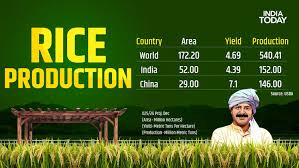
- India overtook China as the world’s largest rice producer, but this achievement comes with severe environmental costs. Rice cultivation in Punjab and Haryana is causing unsustainable groundwater depletion, forcing farmers into debt cycles while government subsidies continue to incentivize water-intensive farming.
India’s Rice Production Status
- India became the world’s largest rice producer in 2025, surpassing China.
- Rice exports crossed 20 million metric tonnes in the latest fiscal year, nearly double the exports from a decade ago.
- India grows far more rice than needed for its 1.4+ billion population.
The Groundwater Crisis
- In Punjab and Haryana, groundwater levels have dropped dramatically – from 30 feet depth a decade ago to 80-200 feet currently.
- Both states extract 35-57% more groundwater annually than their aquifers naturally replenish.
- Large parts of Punjab and Haryana are classified as ‘over-exploited’ or ‘critical’ by the Indian government (2024-2025 data).
- Farmers must drill deeper borewells (80-200 feet vs previous 30 feet), requiring expensive pumps and longer pipes, increasing debt burden.
Water Intensity of Rice Cultivation
- Producing 1 kg of rice in India consumes 3,000-4,000 litres of water (according to farm economist Ashok Gulati).
- This is 20-60% more than the global average for rice cultivation.
- Punjab and Haryana farmers depend primarily on groundwater for irrigation, unlike other regions that use mixed sources.
Role of Government Subsidies
- Minimum Support Price (MSP) for rice increased by approximately 70% over the past decade, incentivizing rice cultivation.
- Heavy power subsidies make groundwater extraction economically attractive despite environmental costs.
- These subsidies discourage crop diversification to less water-intensive alternatives like millets or pulses.
Economic and Social Impact
- Farmers borrow heavily to drill deeper borewells and install more powerful pumps.
- Increased operational costs reduce farmer profitability despite higher rice prices.
- Dependence on monsoons increases – even strong monsoons in recent years haven’t offset the extraction rate.
Policy Responses and Challenges
- Haryana launched a subsidy program (₹17,500 per hectare) to encourage farmers to switch to crops like millets.
- However, this incentive is available only for one growing season – insufficient for long-term behavioral change.
- Conflict between food security goals, export revenues, and environmental sustainability.
Expert Analysis
- Dr. Avinash Kishore (International Food Policy Research Institute): One of the world’s most water-stressed countries is paying farmers to consume vast amounts of groundwater.
- Dr. Uday Chandra (Georgetown University): Government subsidies create perverse incentives that lock farmers into unsustainable practices.
Way Forward
- Crop Diversification: Incentivize cultivation of less water-intensive crops (millets, pulses, oilseeds).
- Subsidy Reform: Restructure MSP and power subsidies to reflect environmental costs.
- Water Management: Promote micro-irrigation techniques (drip, sprinkler), rainwater harvesting, and aquifer recharge.
- Technology Adoption: Develop and promote water-efficient rice varieties and cultivation techniques (System of Rice Intensification – SRI, Alternate Wetting and Drying – AWD).