
Context
- India and the U.S. announced an Interim Trade Agreement through a joint statement on February 7. The agreement strengthened investor sentiment amid expectations of improved export market access.
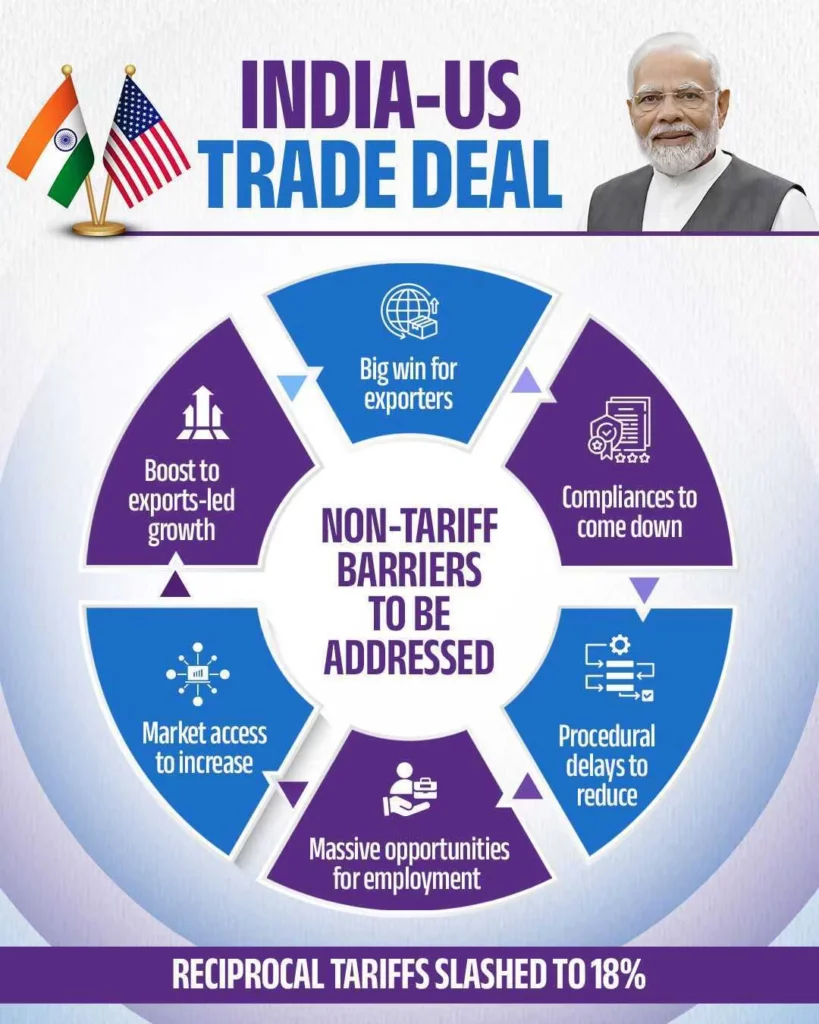
- Reciprocal tariffs on Indian exports are proposed to reduce from 25% to 18%. However, policy clarity remains limited across oil, agriculture, textiles, and procurement commitments.
- The agreement represents a transition toward deeper bilateral trade integration.
Features of the Interim India–U.S. Agreement
- Tariff Rationalisation
- India agreed to reduce tariffs on U.S. industrial and agricultural imports.
- Covered items include tree nuts, fruits, soybean oil, wine, and processed foods.
- Concessions extend to feed inputs like DDGs and red sorghum.
- These measures aim to deepen market access reciprocity in bilateral trade.
- Reciprocal Tariff Framework
- The U.S. will impose a revised reciprocal tariff rate of 18% on Indian goods.
- This represents a reduction from earlier tariff levels imposed on Indian exports.
- Relief applies to sectors like pharmaceuticals, auto components, aircraft parts, and metals.
- Export sectors employing millions may benefit through improved price competitiveness.
- Strategic Procurement Commitments
- India intends to procure $500 billion worth of U.S. goods over five years.
- Imports include energy resources, defence equipment, aircraft, and technology products.
- The provision is framed as an intent-based procurement roadmap, not binding obligation.
- Energy and defence sourcing may influence domestic price stability and security preparedness.
- Non-Tariff and Regulatory Cooperation
- Both countries agreed to ease standards in medical devices and ICT products.
- Digital trade norms will be harmonised to facilitate cross-border data flows.
- Regulatory alignment may expand technology access and digital service employment.
- Technology and Supply Chain Collaboration
- Cooperation will expand in GPUs and data-centre infrastructure development.
- The focus remains on securing resilient critical technology supply chains.
Issues with the Agreement
- Energy Sovereignty Concerns
- The U.S. claimed India agreed to halt Russian oil imports.
- India has not formally confirmed any such strategic energy commitment.
- Energy sourcing continues to depend on price viability and supply risk assessment.
- Agricultural Sensitivity Risks
- Tariff concessions raised concerns regarding farmer livelihood security.
- Government assured exclusion of sensitive sectors, including dairy and key pulses.
- Pulses references were removed from revised U.S. factsheet documentation.
- Import Dependence Debate
- The proposed $500 billion procurement raised supply-chain concentration concerns.
- Government argued imports would diversify rather than over-depend on U.S. sources.
- Textile Sector Competitiveness
- Indian textile exports will face 18% tariffs post agreement implementation.
- Bangladesh secured concessional access through U.S. cotton sourcing provisions.
- India later negotiated parity – zero tariffs using American cotton inputs.
- Agreement Ambiguity
- Differences exist between joint statements and White House factsheets.
- Several provisions remain phrased as intentions, not enforceable commitments.
Way Forward
- The formal trade agreement is expected to be signed by mid-March.
- Detailed clarity will emerge on tariff schedules and procurement commitments.
- Negotiations must balance export expansion with domestic livelihood safeguards.
- India must retain flexibility in energy security and strategic sourcing.
- Transparent policy communication will strengthen stakeholder confidence.