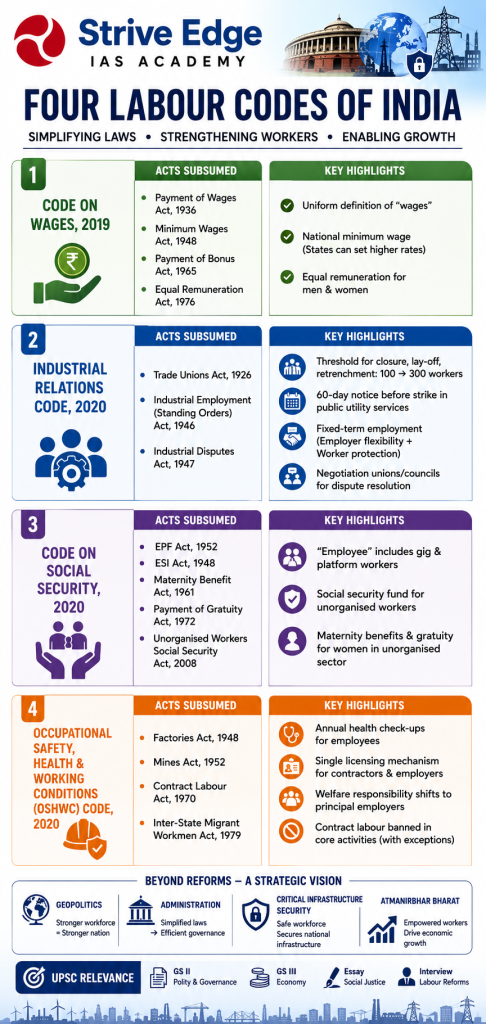
Labour Codes Implementation
Context
- The rules for all four labour codes were notified in May 2026 completing the implementation framework after nearly six years. However, the trade unions and academics argue that several provisions are regressive and detrimental to workers’ interests.
Implementation of Labour Codes
- Rules lay down standard operating procedures for implementing the codes but cannot contradict the parent legislation.
- Where the law is broad or open-ended, rules become crucial in defining worker protections in practice.
- It was expected that rules would moderate contentious provisions but those expectations appear to have been largely belied.
Issues Associated
- Fixed-Term Employment (FTE):
- The Industrial Relations Code 2020 introduced Fixed-Term Employment but does not specify a minimum tenure or limit on contract renewals.
- This creates a real risk that even regular positions become FTEs with unlimited renewals without any worker protection.
- Minimum Wage Concerns:
- Code on Wages Rules provide only a vague definition of floor wage without clearly distinguishing it from minimum wage.
- Rules fail to lay down clear principles for fixing minimum wages leaving the process open to manipulation.
- The convention of treating a four-member family as three consumption units perpetuates gender bias by assigning adult females a weight of 0.8 against 1.0 for adult males.
- Hourly wages are calculated by simply dividing daily wages by eight which is conceptually flawed and ignores international best practices.
- Gig Workers:
- Rules make no attempt to clarify the employment relationship in the gig economy leaving gig workers as self-employed.
- Rules are silent on mandatory gratuity insurance envisaged under the Code leaving an important protection mechanism undefined.
- Trade Union Recognition:
- Rules require a sole registered trade union to have at least 30% membership for recognition, a threshold not present in the Code itself.
- This makes it difficult for smaller or newly formed unions to represent workers weakening collective bargaining further.
- Occupational Safety:
- Rules omit occupation-specific welfare measures like housing and medical facilities for plantation workers.
- Rules do not distinguish between core and non-core activities leaving scope for misuse of contract labour in core operations.
Steps Required
- FTE Safeguards: Prescribe a minimum tenure of one year and limit on contract renewals to protect workers from perpetual temporary employment.
- Minimum Wage Reform: Establish clear and gender-neutral principles for fixing minimum wages eliminating the biased consumption unit framework.
- Hourly Wage Standard: Determine minimum hourly wages independently of daily wage rates as done internationally especially for domestic and gig workers.
- Gig Worker Protection: Clearly define employment relationships in the gig economy and implement mandatory gratuity insurance without further delay.
- Union Recognition: Remove the 30% recognition threshold from the rules as it finds no basis in the parent Code itself.
- Contract Labour Clarity: Define core and non-core activities clearly to prevent growing informalisation of the labour market through contract labour.