

UPSC Mains
GS Paper II
MGNREGA → VB-G RAM G
MGNREGA to VB-G RAM G: The Employment Guarantee in Limbo
Rural employment generation fell by over 40% in July 2026 and 43% during April–July 2026 — even as the new scheme’s budget rose by nearly 70%
July 2026 Employment
Fell Over 40% YoY
2026-27 Allocation
₹95,692 Crore (~70% Rise Overall)
New Wage Norm
₹300/day, Real Rise Limited
📰
Why in News
- The Union Government replaced MGNREGA with the VB-G RAM G Act from July 1, 2026. However, rural employment generation fell sharply — by over 40% in July 2026 and 43% during April–July 2026 compared to previous years.
- This has raised concerns about the strength of India’s rural employment safety net.
Background: Transition Timeline
- December 2025: Parliament passed the Bill to replace MGNREGA with the VB-G RAM G Act.
- April 1, 2026: New Act’s planned start was delayed as Rules weren’t ready; MGNREGA continued.
- May 22, 2026: Draft Rules released for public consultation.
- June 30, 2026: Final Rules and wage rates notified — minimum wage norm of ₹300/day.
- July 1, 2026: VB-G RAM G Act officially came into force, replacing MGNREGA.
Note: Although the wage was fixed at ₹300/day, it is broadly similar to the earlier MGNREGA wage of ₹100/day at 2009–10 prices after adjusting for inflation — the real increase in wages is limited.
📉
The Core Issue: The Employment Crash
1. Scale of the Decline
- July 2026: Employment fell by over 40% vis-à-vis July 2025.
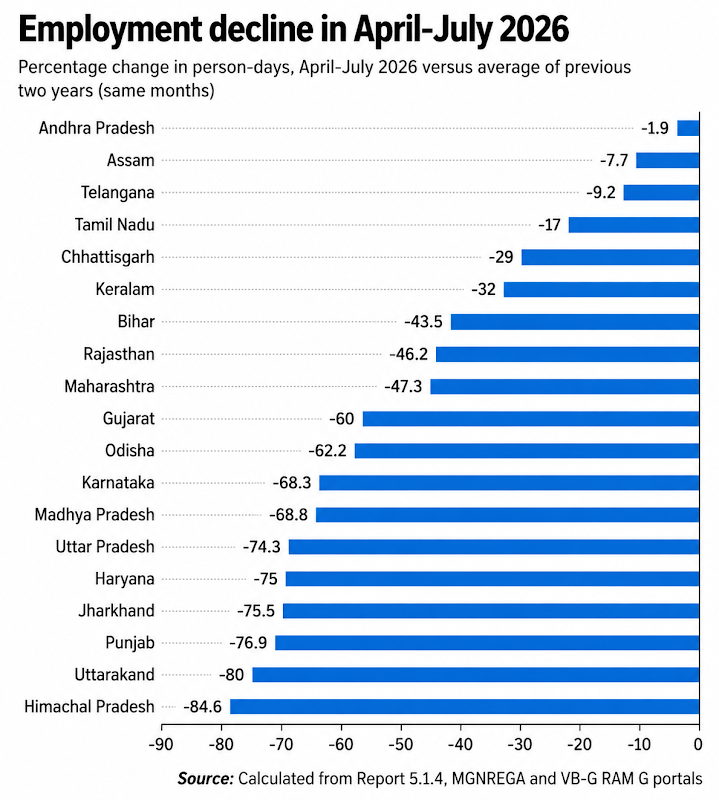
- April–July 2026: Only 70 crore person-days generated, against 128 crore (2024-25) and 119 crore (2025-26) — a 43% decline. This period normally accounts for nearly 50% of annual employment.
2. Uneven State-Wise Impact
- Small decline in states like Andhra Pradesh, Assam, and Telangana.
- In 10 of 19 major states, decline ranged between 60% and 85%.
- Virtual standstill in large, poor states like Madhya Pradesh, Uttar Pradesh, and Jharkhand.
3. The Paradox of Higher Budget, Lower Employment
Budget allocation for 2026-27 (₹95,692 crore) plus state contributions was projected at ₹1.5 lakh crore — a ~70% increase. Since real wages were unchanged, this should have increased employment. Instead, a crash occurred — a stark policy paradox.
🔍
Reasons Behind the Crash
- Transitional confusion (“Limbo”): During April–June 2026, functionaries in many districts refused to open new works, and several areas had no work at all.
- Administrative unpreparedness: Delayed rules created uncertainty at the peak demand season.
- Faltering start of VB-G RAM G in July 2026.
- Weak justification by the Ministry: Blamed the decline on a few states suspending the scheme under Section 6 — a red herring, since those states account for a small share of total employment and decline persists even excluding them.
🧾
MGNREGA vs VB-G RAM G — Key Facts
| Feature | MGNREGA (2005) | VB-G RAM G (2025) |
|---|---|---|
| Guaranteed days | 100 | Not less than 125 |
| Nature | Rights-based, demand-driven | Centrally Sponsored Scheme |
| Vision | Livelihood security | Aligned with Viksit Bharat @2047 |
| Planning | GP-identified works | Viksit Gram Panchayat Plans + PM Gati Shakti |
Emerging Concerns Going Forward
- Facial recognition at worksites: May exclude genuine workers and delay wage payments, similar to earlier NMMS/ABPS issues.
- Centre-State cost-sharing: New 40% state contribution may pressure states and reduce their incentive to generate employment.
- Feasibility of projected spending: Unlikely that the projected ₹1.5 lakh crore expenditure will be fully achieved.
🧭
Way Forward
Ensure Administrative Readiness
Prepare clear rules and systems before implementing any major programme change.
Protect the Rights-Based Approach
Keep employment demand-driven and ensure workers can claim their legal right to work.
Use Technology Carefully
Introduce facial recognition cautiously, with proper grievance redressal to prevent exclusion.
Ensure Adequate Funding
Provide timely funds and resolve Centre-State cost-sharing issues for poorer states.
Strengthen Social Audits
Improve transparency and accountability through regular social audits.
📌
Conclusion
The rural employment guarantee is an important social security and poverty-reduction tool. The transition to VB-G RAM G has raised concerns about implementation, employment generation, funding and technology-based exclusion. While it is too early to judge the new scheme fully, protecting the right to work, ensuring adequate funding, and preventing exclusion of vulnerable workers are essential.
📰
Source: The Hindu
