

Why India’s Corporate Investment Keeps Falling — Even Below GFC Levels
Why in News
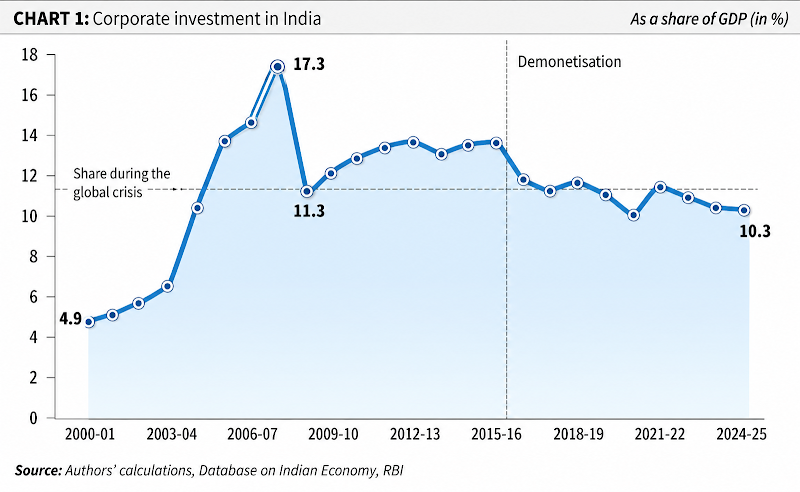
- A recent economic analysis shows corporate investment in India has been falling as a share of GDP since demonetisation in 2016, with levels now even lower than during the 2008 Global Financial Crisis (GFC).
- The decline started before the Covid-19 pandemic and continued despite the corporate tax cut from 30% to 22% in 2019 and a long period of low interest rates by the RBI — suggesting weak investment stems from deeper structural problems, not just high taxes or costly loans.
Understanding the Trend
- 2004: Corporate investment rose sharply from about 6.5% to over 10% of GDP during India’s high-growth period.
- 2008: It fell due to the Global Financial Crisis (GFC), then gradually recovered after.
- Since 2016: Corporate investment has continuously declined — unlike the GFC (an external shock), this decline followed demonetisation, a domestic policy decision, pointing to structural rather than cyclical causes.
What Determines Corporate Investment?
Investment decisions, especially for long-gestation projects like building a factory, hinge on three core factors:
- Expected Profitability: Firms invest when they expect good profits. Economies of scale can help, but investment is limited by market demand, sales potential and market share.
- Business Confidence (Animal Spirits): Firms invest more when confident about future profits. Demonetisation weakened business confidence, especially among MSMEs.
- Cost & Availability of Credit: Firms need affordable, accessible credit. Smaller firms often face higher borrowing costs and limited access to credit.
Why Monetary Policy Alone Failed
Does Firm Size Matter? — The Central Insight
Small Firms
Low own-capital, face higher credit costs which limit investment before reaching full market potential — constrained by finance: higher interest costs, lower profitability.
Large Firms
More own-capital, easier access to credit, not strongly credit-constrained — constrained by demand/market: higher profitability, lower interest costs.
Empirical panel data of listed manufacturing firms (2000–2024) confirms this asymmetry: smaller firms have lower profitability but higher interest costs, while larger firms show higher profitability and lower interest costs.
Broader Dimensions of the Problem
- Twin Balance Sheet Problem: High corporate debt and stressed bank balance sheets reduced both ability and willingness to invest.
- Capacity Utilisation: Firms avoid new investment when existing capacity is underused, indicating weak demand.
- GFCF: Gross Fixed Capital Formation as a share of GDP has remained below the ~35%+ level needed for sustained high growth.
- MSME Distress: Demonetisation and GST disproportionately affected small, informal, employment-intensive firms.
- Jobless Growth and Demand: Weak job creation reduces household demand, lowering business profits and investment — a vicious cycle.
Way Forward
Conclusion
India’s weak corporate investment is not just a temporary problem; it reflects a structural mismatch between policies and the actual problems firms face. Large firms face weak demand, while small firms face limited access to credit. To revive private investment and achieve the goals of Viksit Bharat @2047, India needs demand-led public spending, better credit support for MSMEs, and policies that create stable business confidence.
