

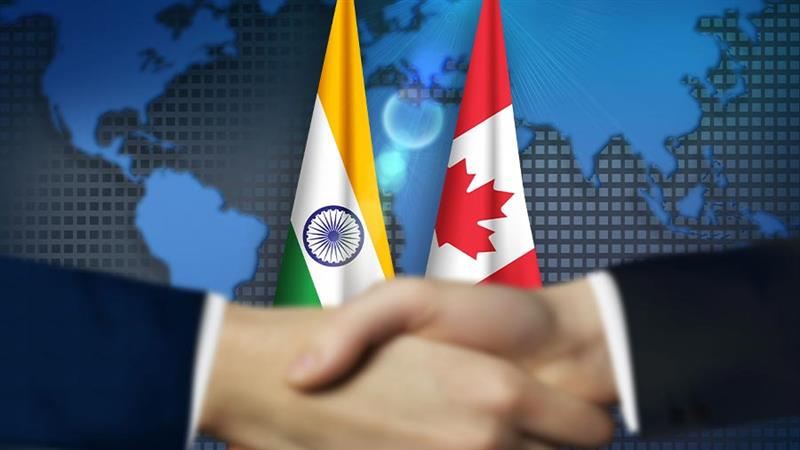
Evolution of India-Canada Relations
- Canadian PM Mark Carney visited India in February while India’s Commerce Minister Piyush Goyal visited Canada with a delegation of over 100 Indian industry leaders.
- Both nations are working toward finalising a Comprehensive Economic Partnership Agreement (CEPA) by end of 2026.
Areas of Cooperation
- Economic Dimensions
- Both nations have set an ambitious bilateral trade target of USD 50 billion by 2030.
- Indian companies have invested significantly in Canada creating thousands of jobs across technology, life sciences, manufacturing and mining.
- Canadian pension funds are investing in India’s infrastructure, logistics, clean energy, financial services and digital ventures.
- The visit aimed at deepening business-to-business linkages and enhancing investor confidence on both sides.
- Strategic Cooperation
- Canada’s Indo-Pacific Strategy places India at its heart recognising its economic potential and strategic importance.
- Both nations champion a free, open, inclusive and rules-based Indo-Pacific regional order.
- Cooperation in maritime security and resilient supply chains is being actively deepened between both countries.
- Technology
- Both countries are collaborating in artificial intelligence, advanced manufacturing and innovation ecosystems.
- India’s manufacturing expansion creates significant opportunities for Canadian technology businesses and investors.
- Cooperation in cutting-edge technologies is emerging as a core pillar of the bilateral strategic partnership.
- Energy and Indo-Pacific
- Ongoing talks on uranium, critical minerals and clean energy highlight the strategic vitality of this partnership.
- India’s surging appetite for energy and infrastructure dovetails with Canada’s expertise in natural resources and clean energy.
- Both nations are working together on climate action and clean energy transition as part of Indo-Pacific cooperation.
- Diaspora Diplomacy
- The Indian diaspora in Canada includes entrepreneurs, professionals, academics, students and community leaders.
- They serve as a living bridge driving trade, investment, innovation, talent exchange and cultural understanding.
- The diaspora must be recognised as a strategic asset and not merely a community of settled immigrants.
- Emerging Areas of Cooperation
- Agriculture is a key emerging area as Canada’s expertise complements India’s food security needs.
- Small and Medium Enterprises on both sides hold immense untapped potential to drive bilateral trade.
- Cooperation in resilient supply chains is gaining importance amid global geopolitical uncertainties.
Challenges in Cooperation
- The bilateral relationship went through a serious diplomatic rupture following the Nijjar killing controversy in 2023.
- Rebuilding institutional trust and political confidence after this episode remains a significant ongoing challenge.
- CEPA negotiations have been long-pending and translating political goodwill into a signed agreement is not simple.
- Concerns around Canadian visa policies and treatment of Indian students have periodically strained people-to-people ties.
- Some sections of the Indian diaspora’s involvement in anti-India activities remains a sensitive bilateral issue.
Way Forward
- Both governments must translate strategic intent into tangible commercial partnerships with measurable outcomes.
- CEPA must be concluded by 2026 as committed and implemented with clear sectoral roadmaps.
- The partnership must become more inclusive for SMEs which are the backbone of both economies.
- A structured diaspora engagement policy must be developed to leverage Indian-Canadians as a bilateral asset.
- Cooperation in critical minerals, uranium and clean energy must be fast-tracked to meet India’s energy security needs.
