Background and Strategic Context
- The 21st century economy increasingly depends on compute power and critical minerals.
- The U.S. launched a chip supply chain alliance to secure future AI ecosystems.
- Jacob Helberg highlighted minerals, energy, manufacturing, and AI models as strategic pillars.
Formation of Pax Silica
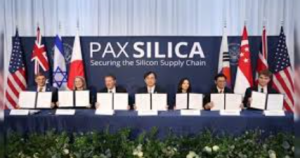
- Pax Silica was signed by nine countries in mid-December.
- Signatories include Australia, Greece, Israel, Japan, Qatar, South Korea, Singapore, UAE, and the U.K.
- Non-signatory participants include Canada, the EU, Netherlands, OECD countries, and Taiwan.
- The initiative aims to map a new global geography of computing power.
Shift in Semiconductor Strategy
- Earlier supply chains relied on competitive advantage and low-cost global production networks.
- Chips were designed in California, printed in Netherlands, fabricated in Taiwan and South Korea.
- Assembly was largely done in mainland China’s manufacturing hubs.
- Pax Silica promotes a “closed-loop” ecosystem, spanning mining, logistics, and advanced manufacturing.
- The goal is to reduce dependence on China’s growing domestic chip-making capacity.
Policy Orientation and Cooperation Framework
- The U.S. prioritises politically and technologically aligned partners over broader Indo-Pacific consensus.
- Members are expected to synchronise semiconductor design and launch joint AI research ventures.
- Countries will align investments in rare earths and economic security protocols.
- The initiative resembles the Indo-Pacific Economic Framework, but with sharper chip supply focus.
India’s Emerging Role
- The U.S. signalled a formal invitation to India as early as February.
- India offers a large engineering talent pool and software services dominance.
- Its demographic dividend and data-rich democracy strengthen a Western-led technology bloc.
- India is considering easing restrictions on Chinese investments for industrial growth.
- This reflects a re-balancing strategy, not complete economic decoupling from China.
Broader Implications
- Pax Silica tests whether alliances create secure prosperity or an exclusionary technology fortress.
- The initiative highlights tensions between global innovation exchange and geopolitical supply chain security.