

FCRA 2.0 Portal & e-OCI Card: UPSC Prelims Pinpointer Notes
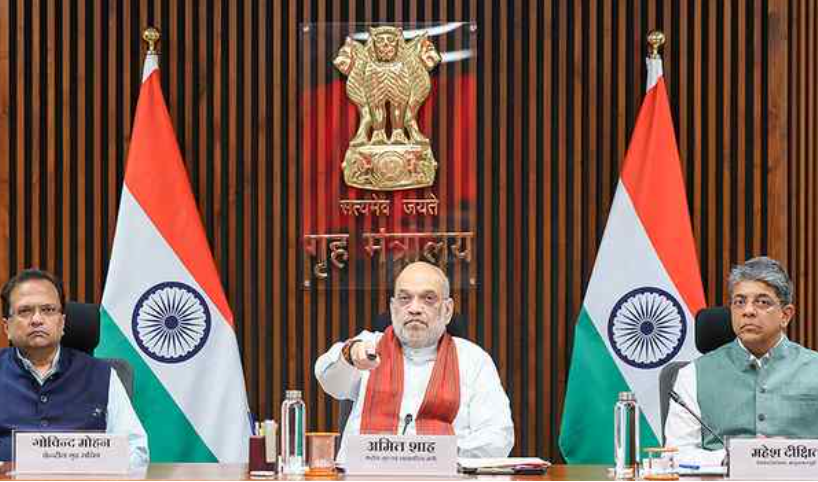
In News: Amit Shah Launches FCRA 2.0 Portal & e-OCI Card
- Union Home Minister Amit Shah launched the FCRA 2.0 Portal and the e-OCI Card initiative in New Delhi.
- The new portal aims to reduce paperwork while enabling real-time monitoring of foreign contribution inflows across the country.
About: Foreign Contribution (Regulation) Act, 2010
- FCRA registration remains mandatory for every NGO or association seeking to receive foreign contributions in India.
- Around 14,500 organisations currently hold valid FCRA registrations across the country under the Foreign Contribution Regulation Act.
- Approximately 15,000 to 20,000 FCRA applications are submitted annually under the provisions of the Act.
- Around 17,000 annual returns are filed every year by organisations registered under the Foreign Contribution Regulation Act.
Features: FCRA 2.0 Portal
- The portal is hosted on the MeghRaj Cloud, India’s National Government Cloud platform.
- It incorporates process re-engineering to improve efficiency and accelerate application processing under the FCRA framework.
- The portal provides an integrated dashboard, Aadhaar-based authentication, e-Sign facility and OCR-based document analysis.
- The platform eliminates physical submission of documents while strengthening monitoring of foreign contribution inflows.
About: e-OCI Card
- The e-OCI Card will benefit more than 50 lakh Overseas Citizen of India cardholders.
- Every cardholder will receive a unique registration number, enabling seamless identification and verification.
- The initiative enables real-time verification while reducing risks arising from loss or damage to physical documents.
Source: The Hindu
CITES Project: UPSC Prelims Pinpointer Notes

In News: EPFO Upgrades Services Under CITES Project
- EPFO is undertaking database consolidation and software upgradation under the CITES Project.
- The project aims to modernise member services through automation and rule-based processing mechanisms.
About: Centralised IT Enabled System (CITES)
- CITES stands for the Centralised IT-Enabled System developed for modernising EPFO’s service delivery mechanism.
- The project was designed by the Centre for Development of Advanced Computing.
- CITES provides a single national database replacing multiple decentralised regional databases.
- The project has implemented several EPFO reforms since becoming functional during 2023.
- It has already introduced the Centralised Pension Payment System within the EPFO framework.
Features: CITES Project
- Any PF office can process member service requests through the centralised digital platform.
- Members can access services using their existing UAN credentials without creating new accounts.
- Most KYC updates can now be completed through the online platform.
- Members can view provident fund balances, claim status and service records through one digital interface.
- EPFO offices can raise electronic queries, enabling members to respond through the online system.
Benefits: EPFO Members
- The platform links all previous Member IDs under one UAN using Aadhaar-based KYC integration.
- Members can approach any PF office across India for grievance redressal and service requests.
- The system simplifies PF transfers while maintaining accurate service history across employments.
- Faster claim settlements reduce physical visits and minimise claim rejections through electronic processing.
Source: The Hindu
India Semiconductor Mission 2.0: UPSC Prelims Pinpointer Notes

In News: Finance Ministry Clears ISM 2.0 Proposal
- The Expenditure Finance Committee cleared a ₹1.25 lakh crore proposal for India Semiconductor Mission 2.0. The approved outlay exceeds the ₹76,000 crore allocation provided under India Semiconductor Mission 1.0.
About: India Semiconductor Mission 2.0
- ISM 2.0 aims to position India as a reliable participant in the global semiconductor value chain.
- The Mission advances the goals of Aatmanirbhar Bharat and Make in India, Make for the World.
- Key Focus Areas
- Indigenous Manufacturing promotes domestic production of semiconductor equipment, chemicals, gases and materials.
- Full Stack IP encourages end to end Indian semiconductor intellectual property development.
- Research Centres will strengthen applied research and advanced semiconductor manufacturing skills.
- Supply Chains will be strengthened against geopolitical uncertainties and external disruptions.
- Market Size
- India’s semiconductor market grew from $38 billion during 2023 to $45 to 50 billion during 2024 to 2025.
- The market is projected to reach $100 to 110 billion by 2030.
- India targets 70 to 75 percent domestic chip self sufficiency by 2029.
Source: The Hindu
Climate Tipping Points: UPSC Prelims Pinpointer Notes
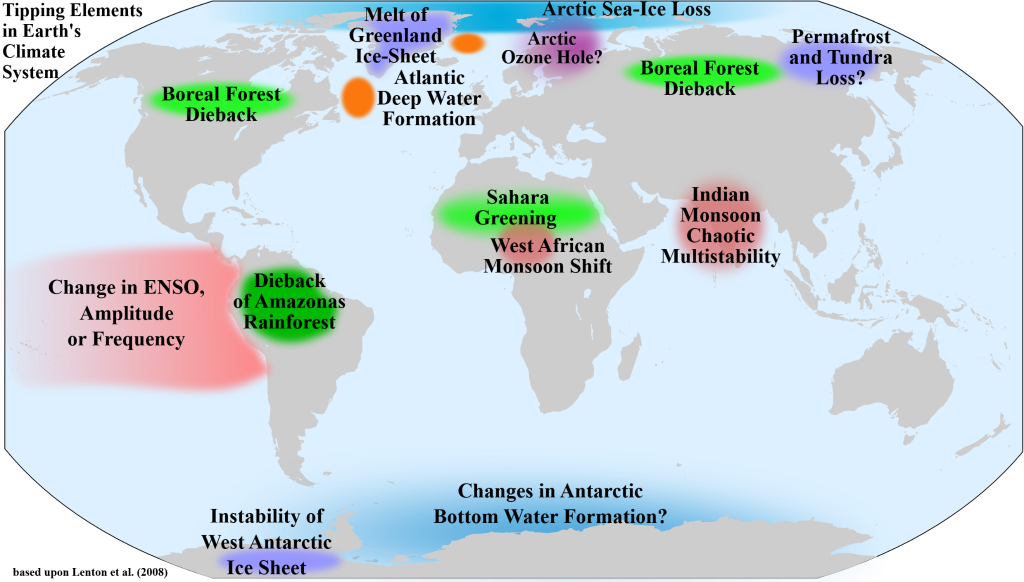
About: Climate Tipping Point
- A climate tipping point is a threshold beyond which Earth’s climate system shifts into a new state.
- Once crossed, climate changes become faster and difficult to reverse on human timescales.
- Small temperature increases can trigger large self-amplifying feedback mechanisms beyond critical thresholds.
Key Characteristics
- Self-amplifying feedback allows climate changes to continue even after the original triggering factor disappears.
- Scientific uncertainties make precise prediction of climate tipping points extremely difficult.
- Complex climate systems and uncertain input data limit accurate long-term projections.
Major Climate Tipping Points
- Arctic sea ice melting increases ocean heat absorption, accelerating further warming and ice loss.
- Amazon rainforest may gradually transform into a savannah ecosystem under sustained climatic stress.
- Atlantic Meridional Overturning Circulation (AMOC) may experience significant slowdown or eventual collapse under changing climatic conditions.
- Coral reefs face large-scale bleaching under rising ocean temperatures.
- Greenland ice sheet may undergo irreversible long-term disintegration under continued warming.
- Indian monsoon patterns may experience substantial long-term climatic changes.
- Positive Social Tipping Points: Renewable energy adoption may accelerate rapidly after achieving a critical level of societal acceptance.
Source: The Hindu
Anti-Dumping Duty: UPSC Prelims Pinpointer Notes

In News: DGTR Initiates Anti-Dumping Probe on CRGO Steel
- DGTR initiated an anti-dumping investigation on Cold Rolled Grain Oriented steel imports. The investigation follows an application submitted by JSW JFE Electrical Steel Private Limited.
About: Anti-Dumping Duty
- An anti-dumping duty is a protectionist tariff imposed on unfairly priced imported goods.
- Dumping occurs when exports are sold below their normal domestic market prices.
- The duty equals the price difference between normal value and dumped import price. It aims to restore fair competition by correcting trade distortions caused by dumping.
- The World Trade Organization permits anti-dumping measures as legitimate trade remedies.
Objectives
- Domestic industry receives protection against unfair competition from below-market-priced imported products.
- The duty seeks to re-establish fair trade conditions within the domestic market.
Administration in India
- Directorate General of Trade Remedies (DGTR) administers anti-dumping and anti-subsidy investigations under the Ministry of Commerce and Industry.
- The investigations are headed by the Designated Authority under the Directorate General of Trade Remedies.
- The Department of Commerce recommends anti-dumping duties after completing the investigation process.
- The Ministry of Finance imposes anti-dumping duties based on departmental recommendations.
Source: Indian Express
UMEED Portal: UPSC Prelims Pinpointer Notes

In News: UMEED Portal Completes One Year
- The UMEED Portal completed one year after launching for nationwide Waqf property registration. Around 7.95 lakh applications were received through the portal during the first year. Nearly 88,571 applications were rejected, representing about eleven percent of total applications.
About: UMEED Portal
- UMEED Portal is a centralised digital platform for registering and regulating Waqf properties across India.
- The portal was launched under the Unified Waqf Management, Empowerment, Efficiency and Development initiative.
- Every property includes geolocation data and precise measurements during digital registration.
- The portal provides legal awareness tools explaining beneficiaries’ rights under the amended Waqf law.
- The platform enables nationwide digital registration of Waqf properties within a fixed timeline.
- Key Features
- Unregistered properties after the prescribed deadline will be flagged as disputed for further proceedings.
- Such disputed properties will be referred to the Waqf Tribunal for adjudication.
- Properties registered in women’s names cannot subsequently be designated as Waqf properties.
- Women, children and EWS beneficiaries remain eligible beneficiaries under the amended provisions.
- About: WAMSI
- WAMSI was the previous digital system used for Waqf property registration and management.
- The system contained duplicate entries, errors and inconsistent property records.
- WAMSI was formally disabled on 8 May 2025.
About: Waqf
- Waqf is a permanent charitable endowment created under Islamic law for religious or public welfare purposes.
- Waqf property cannot be sold, inherited or transferred after its valid dedication.
Source: Indian Express
