

Startup India Initiative
About the Initiative
- Startup India was launched on 16th January 2016, celebrated annually as National Startup Day.
- It is a flagship initiative to build a robust startup ecosystem and transform India into a nation of job creators.
- Nodal agency is the Department for Promotion of Industry and Internal Trade (DPIIT), Ministry of Commerce and Industry.
Three Pillars
- Simplification and handholding cover easier compliance, regulatory support, and market access.
- Funding Support includes tax exemptions, Seed Fund, Fund of Funds, and Credit Guarantee Scheme.
- Incubation and Industry-Academia Partnership is supported through platforms like the MAARG Portal.
Key Initiatives
- Fund of Funds for Startups (FFS) provides scale capital to startups.
- Startup India Seed Fund Scheme (SISFS) supports early-stage funding.
- Credit Guarantee Scheme for Startups (CGSS) provides risk mitigation.
- MAARG Portal (Mentorship, Advisory, Assistance, Resilience, and Growth) supports startup mentorship.
- States’ Startup Ranking Framework (SRF) promotes competitive federalism among states.
- SIPP Scheme facilitates fast-tracking of patent applications for startups.
Key Achievements (2016-2025)
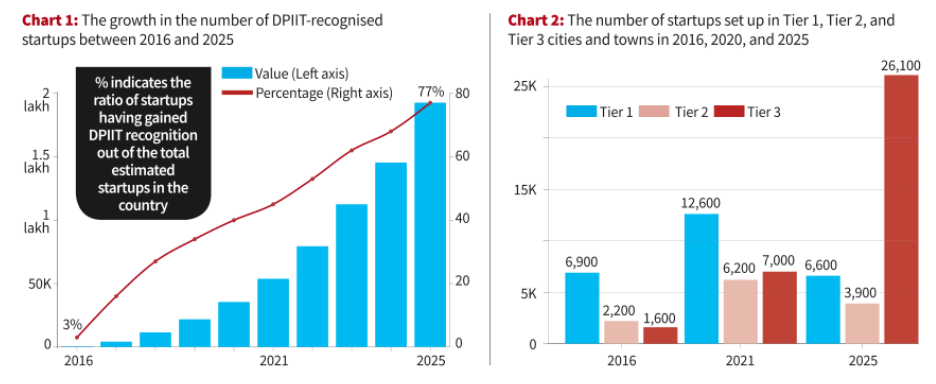
- Total startups grew from 10,000 (2016) to 2,50,000 (2025), a 25-fold increase.
- Funded startups grew from 2,000 to 75,000, a 38-fold increase.
- India is now among the top four startup nations globally.
- Tier 3 towns accounted for 71% of new startups in 2025, up from 15% in 2016.
- CAGR of women founders stood at 20%, compared to 14% for men.
S-400 Air Defence System

Context: India received the fourth squadron of the S-400 air defence system from Russia in May 2026.
More in News
- The delivery is part of a $5.43 billion agreement signed between India and Russia in 2018 for five S-400 regimental systems.
- Three squadrons are already inducted into service; delays occurred due to the Russia-Ukraine conflict.
- The fifth and final squadron is expected to be delivered in 2027.
- The system will be integrated with AI-enabled decision-support capabilities for threat prioritisation, though the final engagement decision remains with the operator.
About S-400
- S-400 is a long-range surface-to-air missile system developed by Almaz Central Design Bureau of Russia.
- It is built as an upgrade over the earlier S-200 and S-300 Russian air defence systems.
- NATO designation for the S-400 is SA-21 Growler.
- Key Features
- It can simultaneously engage aircraft, drones, cruise missiles, and ballistic missiles.
- Long-range missiles can engage targets up to 400 km while radar detection extends up to 600 km.
- It provides 360-degree coverage and can track hundreds of targets simultaneously.
- It can track stealth aircraft using specialised detection methods.
- It performs effectively even in electronic warfare environments.
- It is mounted on mobile platforms, enabling rapid deployment and relocation after launch.
- It supports multiple guidance systems including active, passive, and satellite-based guidance.
Comparison with Other Systems
- Patriot System has a shorter range and fewer missile options than the S-400.
- THAAD specialises only in ballistic missile interception, making it less versatile.
- HQ-9 (Chinese system) has a lower detection range and flexibility compared to S-400.
Aviation Turbine Fuel

Context: The Union Cabinet approved a ₹10,000 crore one-time budgetary support to OMCs for an ATF Price Stabilisation Fund.
More in News
- The fund will be provided as interest-free advances to OMCs and will function as a self-sustaining revolving fund.
- International ATF prices surged nearly 2.5 times from ₹60.5 per litre (March) to ₹142 per litre (May).
- ATF accounts for nearly 40% of airline operating costs, rising up to 60% during extreme fuel volatility.
About Aviation Turbine Fuel (ATF)
- ATF is a petroleum-based fuel used to power aircraft with gas-turbine engines.
- It is a refined kerosene or a blend of kerosene and gasoline meeting stringent quality standards.
- The two primary types are Jet A and Jet A-1, with Jet A-1 being the global standard due to superior cold-weather performance.
- ATF is tested against standards set by ASTM and DEF STAN (UK Ministry of Defence Standard).
- It is produced through crude oil refining, where kerosene is hydrotreated to remove sulphur and then blended.
Southwest Monsoon
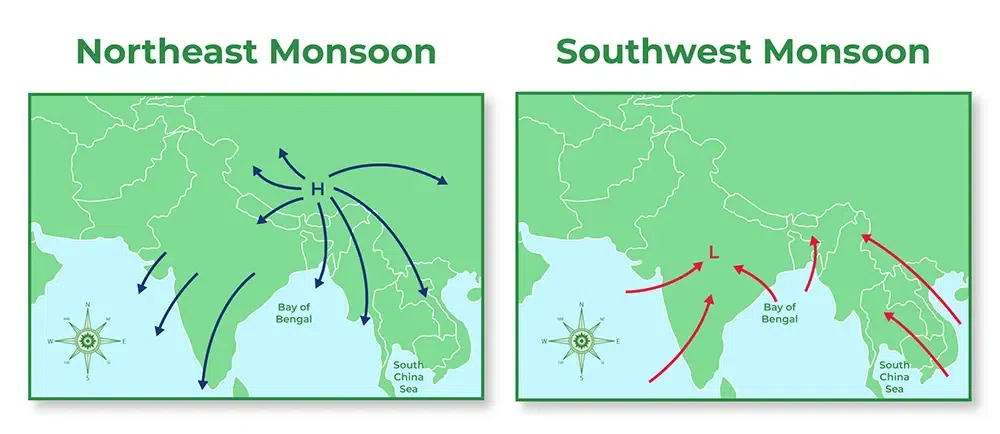
Context: IMD revised the southwest monsoon onset over Kerala to “around June 4”, after an earlier forecast of May 26 proved inaccurate.
More in News
- This is the first failed Kerala onset forecast since 2015, when a May 30 prediction gave way to a June 5 onset.
- IMD’s operational onset forecasts had been accurate every year from 2005 to 2025, except 2015.
- An upper-air cyclonic circulation off the south Kerala coast is expected to aid the monsoon’s final push.
- IMD forecast isolated heavy to very heavy rainfall over Kerala over the next six to seven days.
About Southwest Monsoon
- Southwest Monsoon typically arrives over Kerala on June 1 and reaches most of India by mid-July.
- It lasts from June to September and accounts for three-fourths of India’s total annual rainfall.
- The monsoon first arrives over the Andaman and Nicobar Islands around May 20.
- It divides into two branches upon hitting the peninsula i.e. the Arabian Sea branch and the Bay of Bengal branch.
- Arrival of the monsoon causes a sudden temperature drop of 3°C to 6°C, known as the burst of monsoons.
- The ITCZ (monsoon trough) lies along the Ganga plain during the monsoon season, creating low pressure over northwest India.
- Southwest Monsoon typically begins retreating by end of September, sometimes extending to October.
RudraM-II Missile
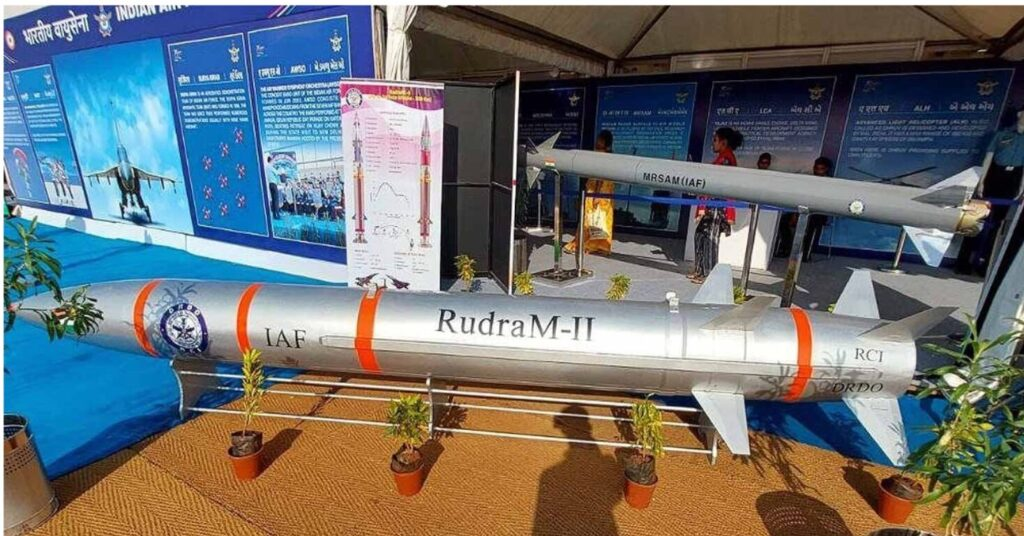
Context: DRDO and IAF successfully conducted flight tests of the indigenous RudraM-II air-to-surface missile from Integrated Test Range (ITR), Chandipur.
About RudraM-II
- RudraM is a series of indigenous air-to-surface anti-radiation missiles developed for the Indian Air Force.
- Anti-radiation missiles target enemy radar, communication systems, and radio-frequency sources forming hostile air-defence networks.
- Three variants have been developed: RudraM-I, RudraM-II, and RudraM-III.
- It is designed to enhance India’s Suppression of Enemy Air Defence (SEAD) capability.
- In SEAD operations, the missile strikes enemy air-defence assets from stand-off ranges, improving the survivability of friendly aircraft.
- RudraM-II was developed by DRDO with Research Centre Imarat (RCI), Hyderabad as the nodal laboratory.
Similipal National Park

About Similipal
- Similipal is located in Mayurbhanj district of Odisha and covers an area of 2,750 sq. km.
- It is named after the Simul (silk cotton) tree, which grows abundantly in the region.
- It holds multiple designations: National Park, Tiger Reserve, Wildlife Sanctuary, Biosphere Reserve, and part of the Mayurbhanj Elephant Reserve.
- It is situated in the Deccan Peninsular Bio-geographic Zone, harboring biodiversity from the Western Ghats, Eastern Ghats, and Eastern Himalayas.
Physical Features
- The highest peaks are the twin peaks of Khairiburu and Meghashini at 1,515 metres above mean sea level.
- Notable waterfalls include Joranda and Barehipani.
Flora
- The dominant vegetation is moist mixed deciduous forest with patches of tropical semi-evergreen and dry deciduous forests.
- Sal is the dominant tree species.
- The park houses 7% of India’s flowering plants and 8% of India’s orchids.
Fauna
- Similipal holds the highest tiger population in Odisha.
- It is the only tiger reserve in India known for melanistic (black) tigers.
- Other key species include leopard, elephant, gaur, sambar, four-horned antelope, and hill mynah.
Producer Price Index (PPI)

Context: The Government will introduce a new Producer Price Index (PPI) from June 15, while phasing out the WPI over five years.
About PPI
- PPI will have three indices: Output PPI, Trial Input PPI, and Services PPI.
- Services PPI will initially cover seven services: Banking, Securities Transaction, Insurance, Management of Pension Funds, Railways, Air (Passenger), and Telecom.
- The new WPI revised series will carry a base year of 2022-23, replacing the earlier 2011-12 base year.
- WPI will continue to be released alongside PPI for five years to allow users sufficient time to transition.
- Both WPI and Output PPI will be compiled on a monthly basis by DPIIT under the Ministry of Commerce and Industry.
- The transition aligns with global best practices and recommendations of the International Monetary Fund (IMF).
Advantages of PPI over WPI
- PPI covers output, input, and services prices, offering a more comprehensive assessment of inflationary trends.
- Availability of both Output PPI and Input PPI provides better understanding of price movements across production stages.
- It explains how inflation experienced by input producers is passed through to the final output price.
- PPI aligns India with advanced economies globally, making price data more internationally comparable.
