
Urban Challenge Fund (UCF)
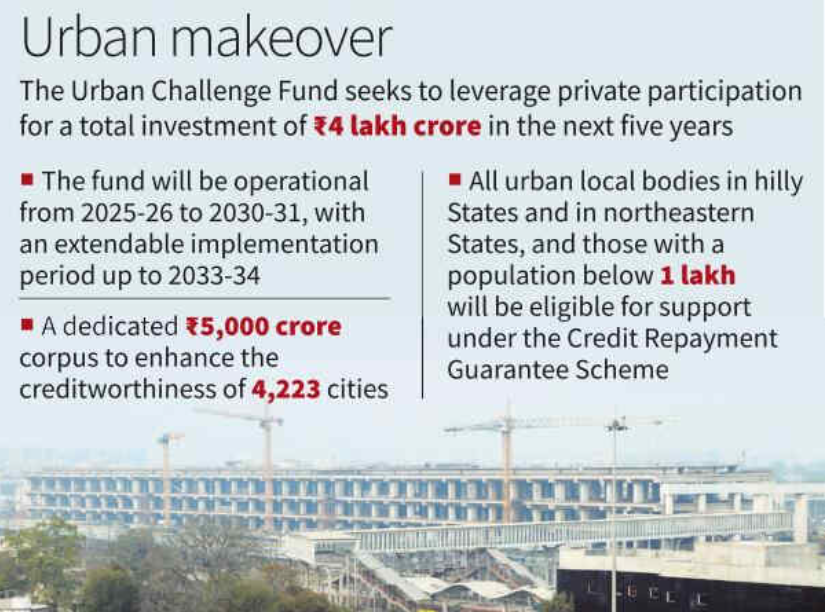
Context: The Union Cabinet approved the launch of the Urban Challenge Fund (UCF) under the Ministry of Housing and Urban Affairs. The fund will support high-impact urban infrastructure projects with Central assistance of ₹1 lakh crore, aiming to catalyse nearly ₹4 lakh crore investment over five years.
About Urban Challenge Fund
- A Centrally Sponsored Scheme focused on financing transformative and bankable urban projects.
- It is designed to accelerate planned urbanisation and strengthen city infrastructure.
- The initiative emphasises on market-linked financing instead of pure grant-based funding.
- Financing Pattern
- 25% of project cost provided as Central assistance under UCF.
- Minimum 50% funding to be mobilised from market sources.
- Remaining share funded by States, UTs or Urban Local Bodies (ULBs).
- Market sources include bank loans, municipal bonds and PPP investments.
- Credit Repayment Guarantee
- A dedicated ₹5,000 crore Credit Guarantee Scheme created.
- Supports first-time access to market finance for cities and ULBs.
- Special focus on North-Eastern and Hilly States/UTs.
- Provides guarantee support up to a defined portion of loans.
- Duration
- Operational from FY 2025–26 to FY 2030–31.
- Implementation period extendable up to FY 2033–34.
- Project Selection
- Projects chosen through a transparent and competitive challenge mode.
- Focus on high-impact and reform-linked proposals.
Urban Development Areas Supported
- Creative Redevelopment of Cities
- Revitalisation of congested CBDs and historic cores.
- Upgradation of legacy infrastructure and public spaces.
- Focus on mobility and flood resilience.
- Cities as Growth Hubs
- Strengthening urban regions as economic engines.
- Connectivity of industrial and economic nodes.
- Water and Sanitation
- Bridging service gaps in vulnerable urban areas.
- Promoting sustainability, reuse and circular systems.
Eligibility of Cities
- Cities with population greater than 10 lakh (2025 estimates).
- All State and UT capitals.
- Major industrial cities with population greater than 1 lakh.
- ULBs in Hilly and North-Eastern States eligible for credit guarantee support.
- The funding has been tied to reforms in:
- Municipal finance and creditworthiness.
- Urban governance and digital services.
- Operational capacity and sustainability.
- Project monitoring and performance metrics.
Significance for Urban India
- Shifts urban financing toward market-driven, outcome-based funding.
- Reduces overdependence on public budgetary resources.
- Encourages creation of bankable urban infrastructure projects.
Bioethanol Fuel
About Bioethanol
- Bioethanol is a renewable, alcohol-based biofuel derived from plant biomass.
- It is produced through fermentation of sugar and starch-rich organic material.
- Considered a cleaner alternative to conventional fossil fuels.
- Raw Materials Used
- Produced from sugar crops like sugarcane and sugar beet.
- Also derived from food grains such as corn.
- Alternative feedstock includes agricultural residues and forestry waste.
- Major Global Producers
- Brazil and the United States are the largest producers and consumers.
- France is a leading producer and exporter within Europe.
- Key Uses
- Transport Fuel: Blended with petrol or used in flex-fuel vehicles.
- Electricity Generation: Burned to produce steam for power turbines.
- Heating: Used in fireplaces and room-heating systems.
Advantages of Bioethanol Fuel
- Cleaner Emissions
- Plants absorb CO₂ during growth, lowering lifecycle emissions.
- Emission reduction ranges roughly from 19% to 86% depending on feedstock.
- Low Residue Combustion
- Burning bioethanol produces minimal waste and fewer pollutants.
- Rural Economic Support
- Creates income opportunities in agriculture and biofuel industries.
Key Challenges
- High Production Cost: Feedstock and processing technology make production expensive.
- Lower Energy Content: Provides less energy than petrol, reducing fuel efficiency.
- Food Security Concerns: Use of edible crops may affect food availability and prices.
- Environmental Pressure: Large-scale cultivation may cause deforestation and water stress.
- Infrastructure Constraints: Requires specialised storage, transport and compatible engines.
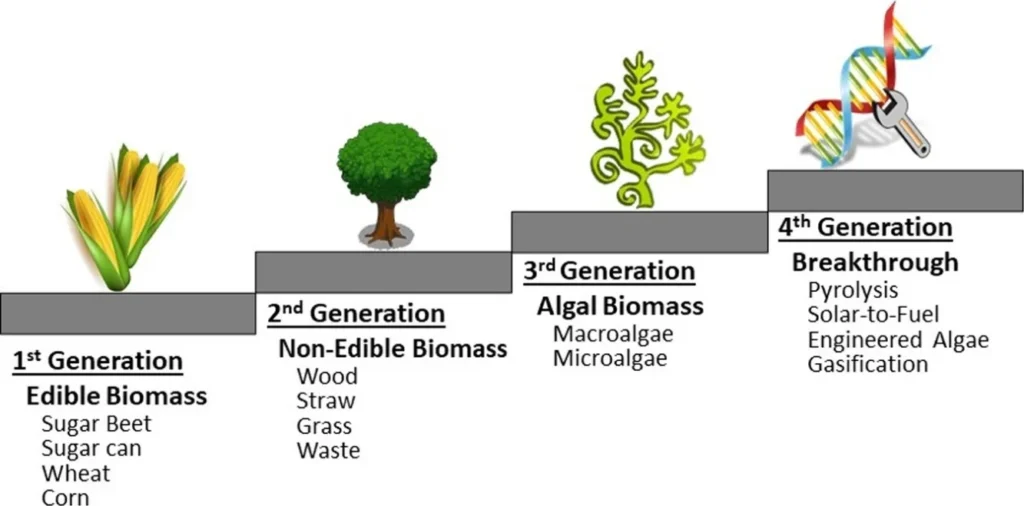
| Generations of Biofuels 1st Generation Biofuels (Conventional Biofuels)
3rd Generation Biofuels (Algae-Based Biofuels)
|
AI Labelling

Context
- The Ministry of Electronics and Information Technology (MeitY) amended the IT Rules, 2021 in 2026.
- Amendments mandate labelling of AI-generated content across digital platforms.
- Takedown timelines for unlawful online content have been significantly reduced.
- Rules will come into force from 20 February 2026.
- The reform responds to rising risks of deepfakes, misinformation, and synthetic media misuse.
About the Framework
- Amendment falls under the Information Technology (Intermediary Guidelines and Digital Media Ethics Code) Rules.
- Introduces regulation of Synthetically Generated Information (SGI). It applies to social media intermediaries, especially platforms with over 5 million users.
- Framework places due diligence obligations on platforms and users.
- Objective is to ensure transparency, traceability, and user awareness in digital content ecosystems.
What Changes Have Been Made
- AI Content Labelling
- Platforms must prominently label AI-generated images and videos.
- Large platforms must obtain user declaration before publishing SGI.
- Mandatory technical verification mechanisms introduced.
- Detection & Provenance Measures
- Platforms must deploy reasonable technical tools to detect unlawful SGI.
- Required to ensure content provenance and identifier tagging.
- Aims to strengthen authenticity tracking across digital platforms.
- Rules prohibit SGI involving:
- Deepfakes impersonating real persons.
- Forged documents and fraud content.
- Child sexual abuse material.
- Explosives-related instructional content.
- Exemptions
- Routine camera retouching edits excluded.
- Film industry visual effects exempted from labelling norms.
- Revised Takedown Timelines
- Government or court-ordered takedowns: 2–3 hours.
- Sensitive user complaints: Reduced to 36 hours.
- General grievances: Resolution within one week.
- User Compliance & Platform Accountability
- Platforms must notify users of rules every three months.
- Must warn about legal consequences of harmful AI content.
- Non-compliance may lead to content removal, account suspension, or legal action.
APEDA (Agricultural and Processed Food Products Export Development Authority)
APEDA (Agricultural and Processed Food Products Export Development Authority)
- APEDA is a statutory export promotion authority created to strengthen India’s agricultural export ecosystem.
- It works to help Indian farmers, processors, and exporters reach global markets with quality products.
- Established under the APEDA Act, 1985.
- Replaced the earlier Processed Food Export Promotion Council (PFEPC).
- Promotes export of agricultural and processed food products from India.
Establishment & Administrative Details
- Act passed: December 1985.
- Came into force: 13 February 1986.
- Functions under the Ministry of Commerce & Industry, Government of India.
Core Mandate
- APEDA’s role is to make Indian agri-products globally competitive while ensuring quality and compliance.
Key Functions of APEDA
- Export Promotion & Market Development: Provides financial assistance, branding support, and market intelligence to expand India’s agri-exports.
- Registration of Exporters (RCMC): Registers exporters of scheduled products and ensures adherence to export regulations.
- Quality Standards & Certification: Fixes export standards and monitors product quality, including inspection of meat and processed items.
- Packaging & Value Addition Support: Encourages better packaging, labeling, and processing to enhance international acceptance.
- National Programme for Organic Production (NPOP): Acts as the secretariat for certification and regulation of organic product exports.
- Trade Data & Statistics: Collects and publishes export data for policy planning and trade analysis.
- Monitoring of Sugar Imports: Entrusted with oversight functions related to sugar import regulation.
Product Coverage (Scheduled Products)
- APEDA covers a wide basket of agri-exports, including:
- Fruits and vegetables
- Basmati rice
- Meat and dairy products
- Cereals
- Honey
- Guar gum
- Floriculture products
- Herbal and medicinal plants
- Cashew and beverages
Sangtam Community

Context: The apex body of the Sangtam community recently passed a resolution to protect pangolins within its jurisdiction. This highlights the growing role of indigenous tribes in wildlife conservation.
Who are the Sangtam?
- Sangtam Naga are a recognized Naga tribe of Nagaland.
- They form part of the larger Naga ethnic group of Northeast India.
- Known for strong customary laws and community governance traditions.
Geographical Distribution
- Primarily inhabit Kiphire and Tuensang districts.
- Located in eastern Nagaland, near the India–Myanmar border.
Origin & Ethnographic Roots
- Oral traditions trace migration through regions of present-day Myanmar.
- Later settled in eastern parts of present Nagaland.
- Name “Sangtam” derived from ancestral village “Sangdang.”
- Mentioned in late 19th-century British administrative records.
Social & Cultural Characteristics
- Governed through village councils and apex tribal bodies.
- Community organised into six major clan groupings (Shuh).
- Clan system reflects strong lineage and kinship structures.
Ecological Setting & Livelihood
- Inhabit dense forested and biodiverse landscapes.
- Practice shifting cultivation and forest-linked livelihoods.
- Regions fall within important biodiversity hotspots of Northeast India.
Governance & Community Decision-Making
- Collective resolutions regulate social customs and resource use.
- Tribal bodies exercise strong authority in local governance.
Contemporary Significance
- Region lies along a major wildlife trafficking corridor near Myanmar.
- Community institutions act as key partners in biodiversity protection.
- Recent pangolin protection move reflects community-led conservation.
Tetrataenium Paikadae (New Plant Species)

Context: A new plant species Tetrataenium paikadae was discovered in the Western Ghats in Idukki district, Kerala.
About the Species
- Taxonomic Identity
- It is a newly discovered flowering plant species.
- Belongs to the Apiaceae family.
- Apiaceae includes plants like carrot and coriander.
- Location
- Discovered in Idukki district, Kerala.
- Identified within Eravikulam National Park (Falls in the Western Ghats biodiversity hotspot)
- Habitat
- Found in high-altitude grasslands.
- Occurs in moist, marshy ecosystems.
- Elevation range: 1,000–2,500 metres.
- Key Identification Feature
- Distinguished from related species through fruit structure.
- Based on number and arrangement of oil tubes.
