

PM SHRI Scheme: UPSC Prelims Notes

In News: Kerala Political Row Over PM SHRI
- The Kerala Assembly witnessed heated debate between the LDF and UDF over implementing the PM SHRI scheme.
- The previous LDF government signed an MoU with the Centre for PM SHRI in October 2025 but withdrew within 20 days.
- The current UDF government has appointed a Cabinet sub-committee to study the scheme.
About: PM Schools for Rising India (PM SHRI)
- PM SHRI stands for Pradhan Mantri Schools for Rising India.
- It is a Centrally Sponsored Scheme launched under the Ministry of Education.
- It aims to develop model schools reflecting the spirit of National Education Policy (NEP) 2020.
- Schools will be managed by Central Government, State and UT Governments, local bodies, KVS, and NVS.
Aim: 14,500 Model Schools Under NEP 2020
- PM SHRI aims to transform over 14,500 schools across India into model institutions.
- The scheme runs for 5 years from 2022-23 to 2026-27.
Features: SQAF, Smart Classrooms and Holistic Learning
- PM SHRI schools will have enhanced infrastructure including labs, libraries, and art rooms.
- They will integrate smart classrooms and digital learning tools for technology-enabled education.
- The scheme promotes a holistic learning approach with play-based learning in the early years and flexible teaching methods.
- A School Quality Assessment Framework (SQAF) will conduct regular evaluations to maintain high standards.
Funding: Centrally Sponsored Scheme (60:40)
| Category | Centre : State Ratio |
| General States and UTs with Legislature | 60 : 40 |
| Northeastern and Himalayan States, including J&K | 90 : 10 |
| UTs without Legislature | 100% Central |
Source: The Hindu
BHIM, UPI and NPCI: UPSC Prelims Notes
In News: BHIM Transaction Volumes Triple in a Year
- BHIM app transaction volumes more than tripled between June 2025 and May 2026.
- Monthly volumes rose from 79.64 million (June 2025) to 244 million (May 2026), according to NPCI BHIM Services Limited.
About: UPI as an Advanced IMPS
- UPI (Unified Payments Interface) is an advanced version of IMPS (Immediate Payment Service), enabling round-the-clock cashless fund transfers.
- UPI powers multiple bank accounts into a single mobile application of any participating bank.
- It merges banking features, seamless fund routing, and merchant payments into one platform.
- NPCI launched UPI with 21 member banks in 2016.
- UPI is currently the biggest among all NPCI-operated payment systems.
BHIM-UPI: Government’s Interoperable Payment App
- BHIM stands for Bharat Interface for Money – Unified Payments Interface.
- It was developed by NPCI as a government initiative for fast, secure, and reliable cashless payments through mobile phones.
- BHIM is based on UPI and facilitates e-payments directly through banks.
- It is interoperable with other UPI applications and bank accounts.
- Top UPI apps include PhonePe, Paytm, Google Pay, Amazon Pay, and BHIM (the government offering).
Body: National Payments Corporation of India (NPCI)
- NPCI is an umbrella organisation for operating retail payments and settlement systems in India.
- It is an initiative of the Reserve Bank of India (RBI) and the Indian Banks’ Association (IBA) under the Payment and Settlement Systems Act, 2007.
- NPCI is a “Not for Profit” company under Section 8 of the Companies Act, 2013 (earlier Section 25 of Companies Act 1956).
- It provides payment and settlement infrastructure for the entire banking system in India.
NPCI Systems: IMPS, AePS, BBPS, NACH and RuPay
- NACH: National Automated Clearing House.
- IMPS: Immediate Payment Service.
- AePS: Aadhaar Enabled Payment System.
- BBPS: Bharat Bill Payment System.
- RuPay: India’s indigenous card payment network.
Source: The Hindu
Indian Passport and Citizenship: UPSC Prelims Notes
In News: Passport Is a Travel Document, Not Citizenship Proof
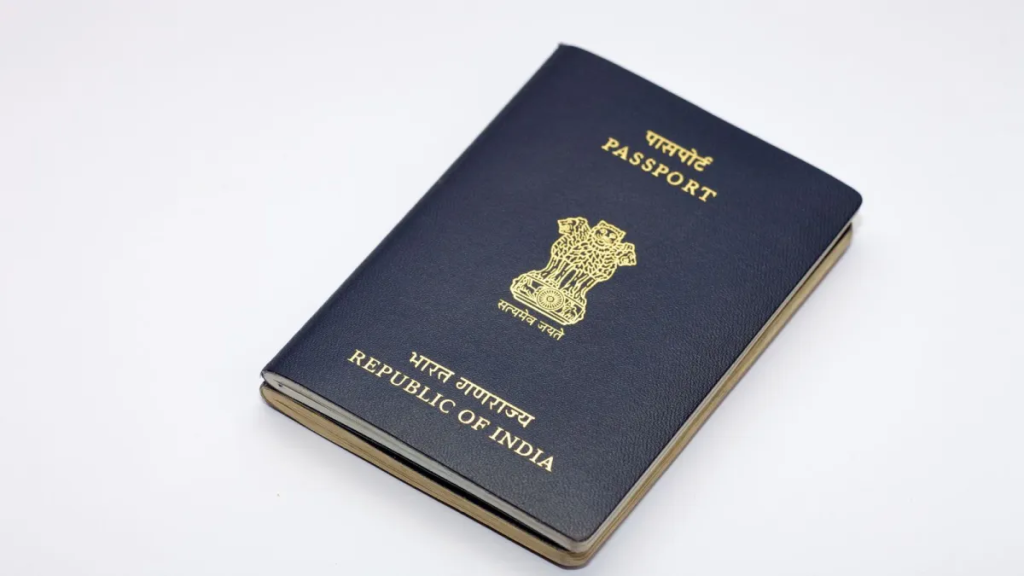
- A senior MEA official clarified that the Indian passport is a “travel document” and not a “citizenship document.”
- The passport attests to nationality while travelling abroad but does not establish citizenship rights.
- The clarification came in the context of voter list exclusions under the Special Intensive Revision (SIR) of electoral rolls in 16 states.
About: Indian Passport and the Passports Act, 1967
- The Indian passport is issued to help Indians transit and travel through foreign ports and territories.
- Passports are issued after due diligence, verifying entitlement through documents like Aadhaar and PAN card.
- There are 545 Passport Seva Kendras across India, covering almost every Lok Sabha constituency.
Distinction: Travel Document vs Citizenship Proof
- A passport establishes nationality for international travel purposes.
- A citizenship document establishes citizenship rights including voting rights and related entitlements.
- The two must not be compared or used interchangeably for legal purposes.
e-Passport: Chip-Based Document and Passport Seva Kendras
- Around 10% of Indian passport holders currently possess an e-passport, which is a chip-based document.
- Chip-enabled e-passports have contributed to ease of travel and global job opportunities for Indians.
- One-stop centres for distressed women in the Indian diaspora have been opened in Gulf countries and Singapore.
Mobility: Visa-Free, Visa-on-Arrival and e-Visa Access
- 27 countries have given visa-free entry status to Indian passport holders.
- 47 countries offer visa on arrival to Indian passport holders.
- 66 countries provide e-visas (electronic visas) to Indian passport holders.
Source: India Today
Index of Services Production (ISP): UPSC Prelims Notes
In News: First-Ever ISP to Launch in July 2026
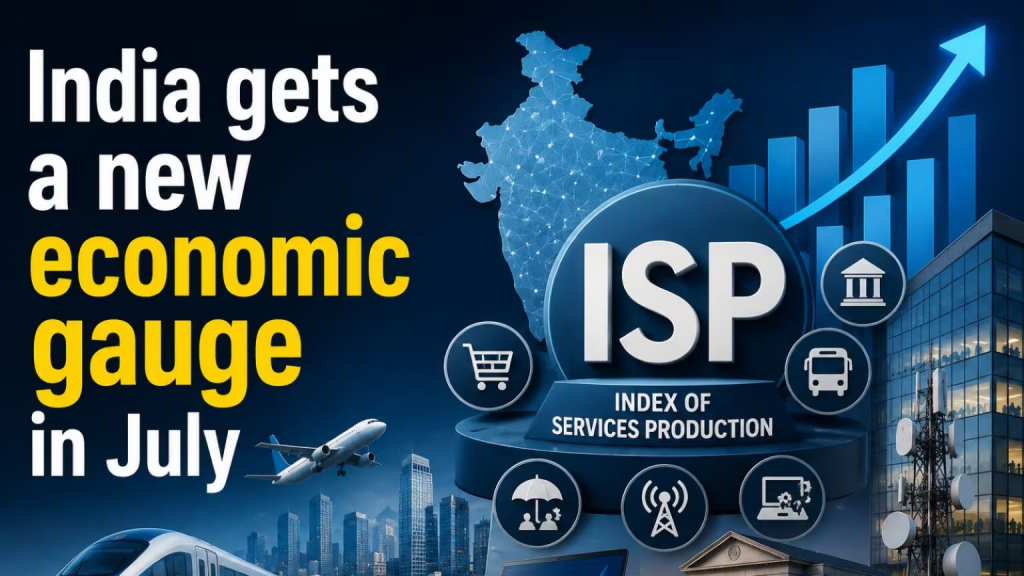
- The first-ever Index of Services Production (ISP) for April 2026 will be announced on July 14, 2026.
- Subsequent numbers will be released on the 29th day of every month (or next working day if a holiday).
About: Index of Services Production (ISP)
- ISP is a high-frequency economic indicator to measure the real output of India’s services sector.
- It is being developed by the Ministry of Statistics and Programme Implementation (MoSPI).
- It is the services counterpart of the Index of Industrial Production (IIP).
- MoSPI released an approach paper on ISP in April 2026 and invited stakeholder comments.
- Services contribute more than half of India’s GDP and GVA and generate large-scale employment.
- Without ISP, policymakers rely on indirect indicators such as GST collections, PMI surveys, bank credit, air traffic, railway freight, and telecom data.
Base Year and Lag: 2024-25 Base, 60-Day Release Lag
- The base year for ISP is 2024-25.
- The index will be released each month with a 60-day lag.
Design: GST Data and Formal Services Coverage
- ISP will initially focus on the formal services sector.
- GST data will be used as a key input as it provides regular information on formal-sector service activity.
- The index will cover trade, transport, storage, communication, financial services, real estate, professional services, hospitality, health, and education services where measurable data is available.
ISP vs IIP: Services Output vs Industrial Output
| Feature | ISP | IIP |
| Measures | Services sector output | Mining, manufacturing, electricity |
| Data Source | GST and administrative data | Physical production data |
| Developer | MoSPI | MoSPI |
| Frequency | Monthly | Monthly |
- IIP is based on physical production data (tonnes, units, megawatts).
- ISP will depend more on administrative and transaction data such as GST records.
Source: The Hindu
Crimea and the Black Sea: UPSC Prelims Notes
In News: Ukrainian Strikes Hit Power in Sevastopol, Crimea
- Ukrainian drones knocked out power in Sevastopol, the biggest city in Russian-held Crimea.
- Drones hit the main substation at the Sevastopol power plant in Crimea.
- Ukraine has intensified strikes on Russian oil refineries, depots, and supply routes this year.
About: Crimea and Its Strategic Location
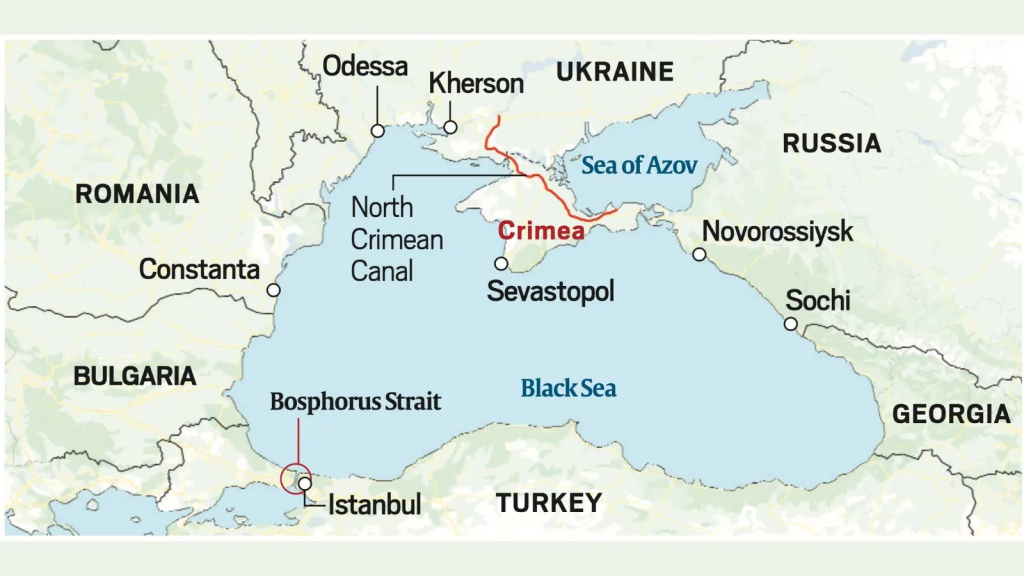
- Crimea is an autonomous republic located in southern Ukraine.
- Historically known as the Tauric Peninsula, Crimea has been ruled by Greeks, Romans, Byzantines, Ottomans, and Russians.
- Its location has historically made it a prized geopolitical asset in the Black Sea region.
Maritime Links: Black Sea, Sea of Azov and Kerch Strait
- Crimea is bordered by the Black Sea to the west and south and the Sea of Azov to the northeast.
- The Kerch Strait links Crimea to Russia, connected via the strategically significant Crimean Bridge.
- Crimea is separated from the Sea of Azov by the Arabat Spit.
Geography: Crimean Mountains, Perekop Isthmus and Kerch Peninsula
- Crimea is connected to mainland Ukraine by the narrow Perekop Isthmus (8 km wide).
- The southern coastline is dominated by the Crimean Mountains, with Ai-Petri as a prominent peak.
- Rivers like Salhir and Alma traverse the interior regions of Crimea.
- The Kerch Peninsula in eastern Crimea is rich in iron ore, mud volcanoes, and mineral springs, supporting mining and spa industries.
Strategic Centres: Simferopol and Sevastopol (Black Sea Fleet)
- Simferopol is the administrative capital of Crimea.
- Sevastopol is a deep-water port and serves as the headquarters of Russia’s Black Sea Fleet.
Source: Reuters
Kirthai-II Hydel Project and Chenab: UPSC Prelims Notes
In News: Panel Clears Kirthai-II Hydel Project
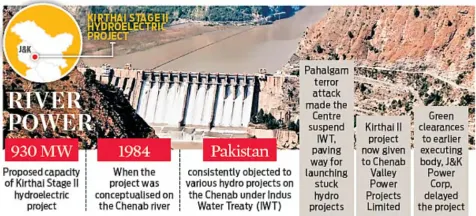
- The Forest Advisory Committee (FAC) of the Environment Ministry recommended in-principle approval for diversion of 197 hectares of forest land for the 820 MW Kirthai-II Hydroelectric Project on the Chenab River.
- Kirthai-II becomes the third hydroelectric project on the Chenab to receive approvals since the suspension of the Indus Waters Treaty (IWT) following the Pahalgam terror attack in 2025.
- A total of 8,723 trees are to be felled, comprising pine species, silver fir, oak, and other broadleaf trees.
- The project area has the presence of Himalayan tahr, Asiatic Black bear, Himalayan brown bear, and Asiatic ibex.
About: Kirthai-II Project on the Chenab
- Kirthai-II is a run-of-river project with an original proposed capacity of 930 MW, now reduced to 820 MW.
- A 121-metre-high concrete gravity dam will be built in Padder Tehsil of Kishtwar district.
- The Kirthai-I project is located upstream and the Kiru project is located downstream of Kirthai-II.
- The project site is a natural habitat of chilgoza pine trees.
Location: Kishtwar, J&K (Indus Basin)
- The project is located on the Chenab River in Kishtwar district, Jammu and Kashmir.
- It is being developed in the Chenab River Basin, a major tributary of the Indus River system.
- The project site is located in moderate to dense, high-mountainous forest area.
Treaty Link: Indus Waters Treaty and Western Rivers
- Under the Indus Waters Treaty (IWT), Pakistan controlled the waters of Indus, Jhelum, and Chenab (Western Rivers).
- India controlled the waters of Ravi, Beas, and Sutlej (Eastern Rivers) under the IWT.
- The Jammu and Kashmir government has dispensed with cumulative impact assessment for the Indus, Chenab, and Jhelum rivers following IWT suspension.
- Other projects stalled or proposed in the Indus basin include Sawalkote, Dulhasti-II, Ratle, Pakal Dul, Kwar, Kiru, and Kirthai Stage-I and II.
Source: Indian Express
Grid India and Gas-Based Power: UPSC Prelims Notes
In News: Grid India Turns to Gas-Based Power
- Grid Controller of India (Grid India) advised gas-based power stations to plan fuel procurement for 7 days in June.
- The move anticipates the need for additional gas-fired generation during the June to September monsoon season.
- Forecasts of below-normal monsoon rainfall have prompted hydroelectric stations to conserve water in their reservoirs.
- The West Asia conflict has cast a shadow over fuel availability for gas-based power plants.
About: Grid Controller of India (Grid-India)
- Grid India is the Grid Controller of India, responsible for resource adequacy assessment and power grid management.
- Its assessment is based on projected demand, planned and forced outages of generating units, hydro, renewable generation profiles, and present weather information from the India Meteorological Department (IMD).
- Grid India cited three key factors for resource adequacy assessment: historical data, planned upcoming capacity, and prevailing forced outages and uncertainty in renewable energy generation.
Role: Rebalancing and Evening Peak Demand
- Gas-based power accounts for only a small share of India’s overall generation mix but plays a crucial rebalancing role during evening peak hours.
- Typically, around 10 GW of gas-fired capacity is relied upon during peak summer.
- Gas-based power plants are expected to shoulder a larger share of the balancing requirement during evening peak hours.
- Until the monsoon gains momentum in July, the priority is to pre-serve water levels, making gas-based generation more important.
Market: Indian Energy Exchange (IEX) and Spot Gas Prices
- Power sector entities purchased 45,07,850 MMBtu of natural gas from the spot market between June 1 and May 31, which is 340.4% higher than the corresponding period last year.
- The average spot gas price stood at ₹1,846 per MMBtu in June.
- Gas prices stood at ₹1,606 per MMBtu in April, up 43.5% from ₹1,119 per MMBtu a year earlier.
- The Indian Energy Exchange (IEX) is the country’s leading gas-trading bourse, providing data on power sector gas purchases.
Context: West Asia Crisis and Gas Supply Concerns
- The conflict in West Asia has disrupted long-term import contracts and clouds fuel availability for gas-based power plants.
- Only about 5 GW of gas-based generation capacity is currently available due to supply disruptions.
- The government has moved to prioritise gas allocation to certain sectors during periods of shortage.
Source: Indian Express
