

Weak Monsoon & India’s Resilience: UPSC Mains Notes
In News: India Better Placed to Withstand a Weak Monsoon
- IMD has forecast 2026 monsoon rainfall at around 90% of the long-period average.
- This would make it the weakest monsoon in more than a decade.
- India may be better prepared than before but risks remain real and widespread.
Importance: Monsoon as the Backbone of India’s Economy
- Southwest monsoon provides 70 to 75% of India’s annual rainfall during June to September.
- It is essential for kharif crop sowing, groundwater recharge, reservoir storage and drinking water supply.
- Nearly half of India’s farmland is still not irrigated making monsoon critical for agriculture.
- IMD defines normal monsoon as 96% to 104% of the long-period average of 87 cm.
- A weak monsoon can reduce crop yields, lower farm incomes and weaken rural demand.
Concern: 43% Déficit, El Niño & the MJO Factor
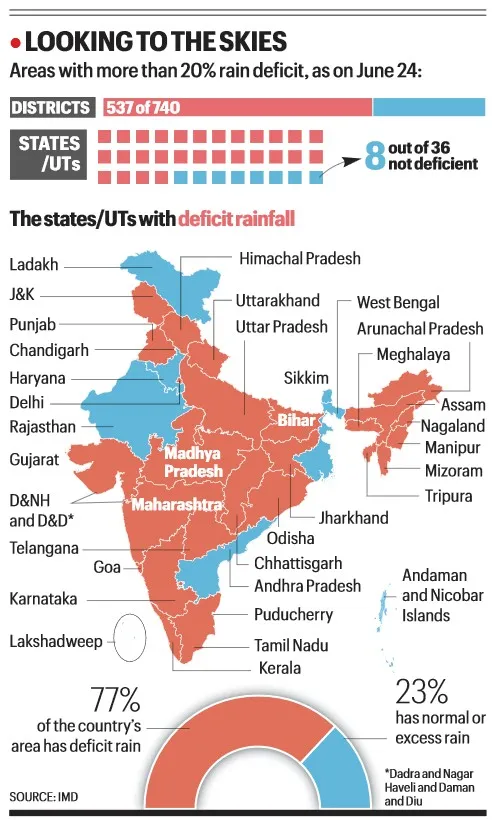
- Monsoon rainfall has been about 43% below average so far this season.
- June saw a rainfall deficit of more than 40% despite being expected to perform better.
- The monsoon has covered only around half of India’s landmass instead of almost the entire country.
- Patchy spatial distribution and delayed advance can be damaging even if seasonal rainfall later improves.
- El Niño has emerged in the equatorial Pacific but its impact on India comes with a lag.
- Bigger near-term factors include weak low-pressure systems, weak monsoon currents and an unfavourable Madden-Julian Oscillation (MJO) phase.
- The MJO is a moving system of winds and clouds influencing tropical rainfall patterns.
- Around 75% of India’s area currently has more than 20% rainfall deficiency.
Preparedness: Reservoirs, Groundwater & Contingency Plans
- The past two good monsoon years have left major reservoirs at healthier storage levels.
- Official reports suggest groundwater conditions have improved in several areas reducing vulnerability somewhat.
- Rapid rise of solar and wind power has reduced India’s dependence on hydropower conserving reservoir water.
- Rural employment guarantee programme has invested heavily in rainwater harvesting, water storage and soil moisture conservation.
- Government has prepared contingency plans for more than 300 districts to reduce weak rainfall impact.
- 111 districts are classified as high priority where less than one-fourth of farmland is irrigated.
- States have been advised to encourage farmers to shift from water-intensive crops to pulses, millets and oilseeds.
- Governments are pushing early kharif sowing using pre-monsoon showers as an adaptive farming measure.
Way Forward: Crop Diversification & Climate Resilience
- Under climate change, even normal monsoons may come with greater regional and local variation.
- The challenge is no longer just rainfall quantity but when, where and how intensely it falls.
- Long-term solutions require crop diversification, better irrigation efficiency and water harvesting.
- Drought-resistant crops and improved local forecasting must become central to agricultural planning.
- India’s resilience has improved but timely planning, intervention and support remain essential to limit damage.
Source: Indian Express
