

India’s Low-Fertility Future: UPSC Mains Notes
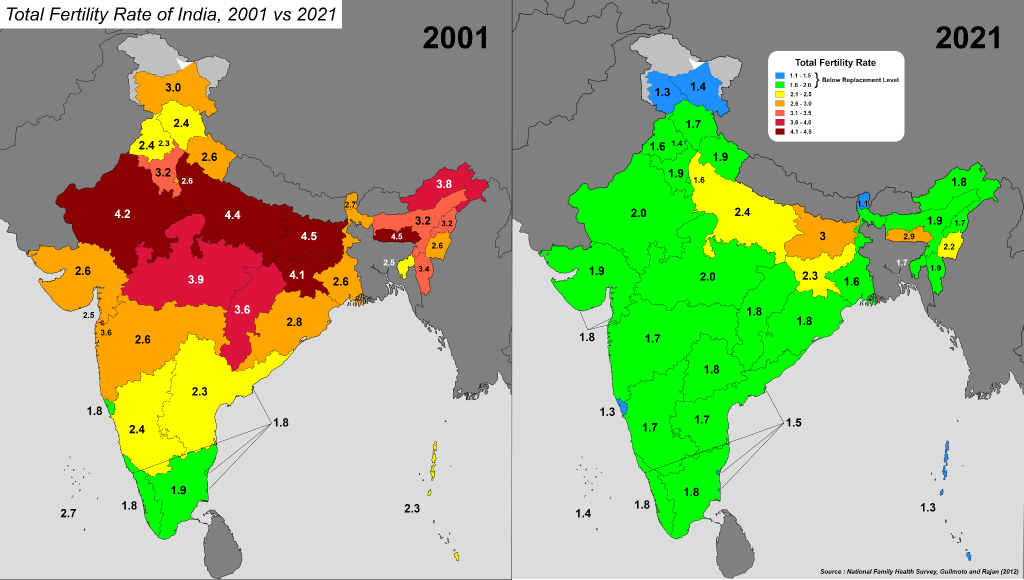
In News: India’s Fertility Falls Below Replacement Level
- India’s Total Fertility Rate (TFR) has fallen to 1.9 children per woman as per the latest Sample Registration System data. This is below both the global average of 2.2 and the replacement level of 2.1.
- India has crossed into low fertility as a nation but not as one uniform demographic economy.
Data: TFR at 1.9 & Regional Demographic Divide
- Urban fertility has fallen to 1.5 while rural fertility remains around replacement level.
- Delhi’s fertility rate stands at 1.2 lower than the United States (1.6), Finland (1.4) and Japan (1.3).
- Kerala, Tamil Nadu and West Bengal are at 1.3 — among the lowest globally.
- Bihar remains at 2.9 followed by Uttar Pradesh (2.6), Madhya Pradesh (2.4) and Rajasthan (2.3).
- Some states are rapidly moving towards ageing while others still have large young labour cohorts ahead.
- India must create productive opportunities for young workers in poorer states while strengthening systems for older populations.
Challenge: Ageing Before Industrialising
- Premature Ageing: India enters demographic ageing on a weaker institutional and fiscal base entirely.
- Low Per-Capita Income: India’s per-capita income is only $2,800 making fiscal headroom extremely limited.
- Narrow Tax Base: Net direct taxpayers account for only 6% of the total population.
- Weakening Joint Family: The joint family system is weakening under urbanisation, migration and nuclear household pressures.
- Migration Paradox: Children’s migration improves monetary resources but worsens elderly loneliness and health vulnerability.
- Japan Warning: Even a wealthy Japan saw public debt cross 200% of GDP due to ageing strain.
Concerns: Weak Pensions, Care Gaps & Informal Workforce
- No Pension Cover: NITI Aayog reports 78% of the elderly have no pension coverage at all.
- Elderly Dependence: 70% of the elderly depend on others for their basic daily needs and support.
- Inadequate NSAP: Old-age pension remains only Rs 200 per month for those aged 60 to 79.
- APY Limitation: Atal Pension Yojana assumes sustained contributions which informal workers with volatile incomes cannot maintain.
- Informal Workforce: Most workers spend their lives in informal work keeping old-age security outside formal contracts.
- Healthcare Burden: Ageing will increase demand for long-term management of hypertension, diabetes, dementia and palliative care.
- Scale of Crisis: 150 million elderly today are projected to rise to 347 million by 2050.
Way Forward: Pension Floor, Geriatric Care & Welfare Portability
- Inflation-Indexed Pension Floor: India needs a minimum pension floor as a basic layer of public risk-pooling for old age.
- Geriatric Care Integration: Geriatric care must be embedded into nursing practice, district health planning and primary care systems.
- Mission-Mode Action: The same mission-mode approach used for fertility and child survival must now be applied to elderly care.
- Welfare Portability: If workers move across state borders their entitlements must move with them as a foundational principle.
- Investment in Younger States: Younger states must invest aggressively in education, health and skills to avoid low-wage informality.
- Migrant Recognition: Older richer states must treat migrants as citizens who deserve portable protection not temporary labour.
Source: The Hindu
