


Police Custody vs Judicial Custody

Understanding Custody
- The word ‘custody’ means apprehending someone for protective care.
- The fundamental principle behind arresting a suspect is to protect society from further harm by the accused.
Police Custody
- When police receive a complaint or FIR and arrest a suspect, the accused is brought to the police station lock-up — this is referred to as police custody.
- During this detention, the police officer in charge may interrogate the suspect.
- Under Section 57 of CrPC, police must produce the accused before a Magistrate within 24 hours of arrest.
- The maximum period of police custody is 24 hours, which may be extended to a total of 15 days by the Magistrate.
Judicial Custody
- When the accused is placed under the supervision of the concerned Magistrate and lodged in jail (not a police lock-up), it is called judicial custody.
- Governed by Section 167 of CrPC, the Magistrate holds the power to extend this custody from time to time.
- Judicial custody begins when the public prosecutor satisfies the court that custody is necessary for the purpose of investigation.
- The accused remains in jail until the court grants bail.
- Once the 60 or 90-day period ends without filing of a chargesheet, the accused becomes entitled to default bail.
| Aspect | Police Custody | Judicial Custody |
| Custody with | Police | Magistrate |
| Lodged in | Police lock-up | Jail |
| Maximum period | 24 hrs (up to 15 days total) | 60 or 90 days |
| Governed by | Section 57, CrPC | Section 167, CrPC |
| Begins when | Police arrests on complaint/FIR | Prosecutor satisfies court of necessity |
Shift to BNSS, 2023
- The Bharatiya Nagarik Suraksha Sanhita (BNSS), 2023, which came into effect from July 2024, brought significant changes to the custody framework.
- Section 187 of BNSS replaces Section 167 of CrPC, while retaining the overall structure but introducing greater flexibility for investigators.
- Key Change: Staggered Police Custody
- Under the old CrPC, police custody had to be taken within the first 15 days of the total detention period.
- Under BNSS, the 15-day police custody can now be taken in parts – spread across:
- First 40 days for lesser offences (total detention period: 60 days)
- First 60 days for serious offences (total detention period: 90 days)
- This means police can seek custodial interrogation at different stages of the investigation, rather than being restricted to the initial period.
- Bail Threshold under BNSS
- After 60 or 90 days of total detention, the accused is entitled to bail if they can furnish it, under Section 187 of BNSS
Green Bonds

Context: The Brihanmumbai Municipal Corporation (BMC) plans to issue municipal green bonds to finance sustainable infrastructure initiatives. The green bonds aim to raise ₹500 crore for projects including wastewater treatment and desalination plants.
More in News
- Aligns with Union Budget announcement: FM Nirmala Sitharaman’s ₹100-crore incentive for single municipal bond issuance of ₹1,000 crore.
- Carbon credits possibility: BMC can claim future carbon credits from environment-friendly projects financed through green bonds mechanism.
What are Green Bonds?
- According to SEBI, a green debt security is one issued with the intention of raising money for causes like sustainable development or increased energy efficiency.
- Green bonds are debt instruments similar to normal bonds, but the capital raised must be earmarked exclusively for green projects.
- Green projects typically include those linked to renewable energy, pollution reduction, and similar environmental initiatives.
Key Features
- Green bonds can be issued by both governments and private companies such as multinational corporations.
- They generally carry lower interest rates than loans provided by commercial banks.
- They are considered less risky since they are linked to the issuer rather than the successful completion of the projects.
- When issuing green bonds, issuers must provide information about the project needing green financing and the overall environmental benefits arising from it.
Green Bonds vs Normal Bonds
| Aspect | Normal Bonds | Green Bonds |
| 1. Use of funds | Any project | Green projects only |
| 2. Interest rate | Market rate | Generally lower |
| 3. Disclosure requirement | Standard | Must disclose environmental benefits |
Risk of Greenwashing
- Due to lower interest rates, businesses sometimes attempt to raise money under the guise of green bonds without genuine environmental intent and this practice is called greenwashing
Kaziranga National Park
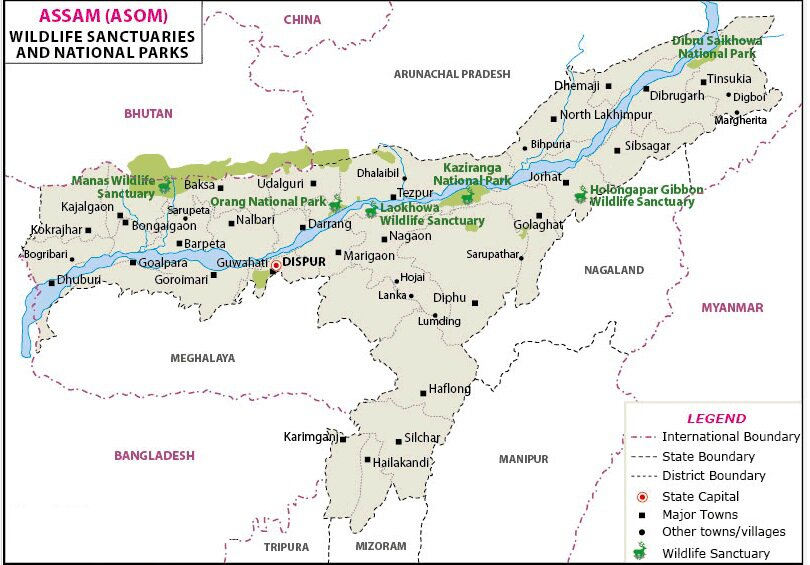
Context: The seventh waterbird census at Kaziranga National Park recorded the first-ever sighting of smew, a rare Eurasian diving duck, raising concerns about climate-driven range shifts. The ornithologists warn it signals disrupted migration patterns and underscores the urgent need to protect critical refueling habitats amid mounting threats.
Basic Facts About Kaziranga National Park
- Located between the Brahmaputra River and the Karbi (Mikir) Hills in Assam
- It is the single largest undisturbed and representative area in the Brahmaputra Valley floodplain
- Declared a UNESCO World Heritage Site in 1985
- Rivers
- The River Diffalu, a tributary of the Brahmaputra flows through the National Park
- Another tributary, Moradifalu, flows along its southern boundary
Flora and Fauna
- Primarily famous for its dense and tall elephant grasses intermixed with small swamplands
- Also has abundant cover of water lilies, water hyacinths, and lotus
- Home to the world’s largest population of one-horned rhinoceroses
- Other key species include Tiger, Eastern Swamp Deer, Elephant, Buffalo, Hoolock Gibbon, and Capped Langur
- The Gangetic River Dolphin is also commonly found in its habitat
VB G RAM G Act, 2025

Basic Overview
- Full name: Viksit Bharat – Guarantee for Rozgar and Ajeevika Mission (Gramin) Act, 2025.
- It strengthens and reforms the rural employment guarantee framework in India
Key Provisions
- Enhanced Employment Guarantee
- Provides a statutory guarantee of not less than 125 days of wage employment per rural household per financial year
- The right to demand employment remains legally enforceable
- Pause Period
- States can notify an aggregated pause of up to 60 days during peak sowing and harvesting seasons
- This prevents labour shortages in agriculture while the full 125-day guarantee remains intact during the remaining period
- Timely Wage Payments
- Wages must be paid weekly or within 15 days of work completion
- Delays attract mandatory compensation, directly addressing one of the most persistent criticisms of MGNREGA
- Employment Linked to Productive Assets
- Wage employment is explicitly aligned with creation of durable, productive, and climate-resilient assets across four priority domains:
- Water security and conservation
- Core rural infrastructure
- Livelihood-supporting infrastructure
- Works to mitigate extreme weather and climate risks
- All assets are integrated into the Viksit Bharat National Rural Infrastructure Stack to ensure convergence and avoid duplication
- Wage employment is explicitly aligned with creation of durable, productive, and climate-resilient assets across four priority domains:
- Decentralised Planning
- Planning originates from Viksit Gram Panchayat Plans (VGPPs), prepared through participatory processes and approved by Gram Sabhas
- Panchayats retain control over identification of works, prioritisation, and social audits
- Digital integration with PM Gati Shakti ensures national-level convergence without undermining local autonomy
- Financial Architecture
- Implemented as a Centrally Sponsored Scheme with the following cost-sharing pattern:
- General States: 60 : 40
- North-East and Himalayan States: 90 : 10
- UTs without legislatures: 100% Central funding
- Implemented as a Centrally Sponsored Scheme with the following cost-sharing pattern:
- Strengthened Administration
- Administrative expenditure ceiling raised from 6% to 9%
- Enables better staffing, training, and field-level supervision at Panchayat and block levels
- Technology with Social Oversight
- Use of biometric authentication, geo-tagging, and real-time dashboards for transparency
- Technology is framed as an enabler, not a gatekeeper
- Social audits by Gram Sabhas are strengthened for community oversight
- Unemployment Allowance Restored
- Earlier dis-entitlement provisions have been removed
- If employment is not provided within the stipulated period, unemployment allowance becomes payable after 15 days
Corporate Average Fuel Efficiency (CAFE) Norms

Context: The Prime Minister’s Office (PMO) held a high-level meeting to review the proposed Corporate Average Fuel Efficiency (CAFE)-3 norms for passenger vehicles.
What are CAFE Norms?
- CAFE norms were first notified in 2017 under the Energy Conservation Act, 2001
- The core objective is to mitigate fuel consumption by lowering CO₂ emissions, thereby reducing oil dependency and air pollution
- Fuel efficiency is estimated by averaging the standard fuel consumption of all vehicles sold each year
- Applicability
- Applicable to the following categories of passenger vehicles with a Gross Vehicle Weight (GVW) of less than 3500 kg: Petrol, Diesel, LPG, CNG, Hybrid, and Electric vehicles
- CAFE – III Norms
- CAFE-III norms have been notified for the 5-year period from 2027 to 2032
About Bureau of Energy Efficiency (BEE)
- Established in 2002 under the provisions of the Energy Conservation Act, 2001
- Nodal Ministry: Ministry of Power
- Primary objective is to reduce energy intensity in the Indian economy
- Functions and Duties
- Coordinates with designated consumers, designated agencies, and other organisations
- Recognises, identifies, and utilises existing resources and infrastructure to perform functions assigned under the Energy Conservation Act
- The EC Act provides for both regulatory and promotional functions assigned to BEE
- Regulatory Functions
- Develop minimum energy performance standards for equipment and appliances under the Standards and Labelling programme
- Develop minimum energy performance standards for commercial buildings
- Develop energy consumption norms for designated consumers
Chagos Islands
Location
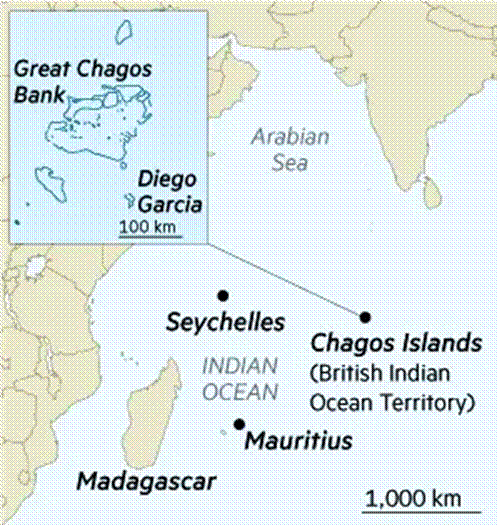
- The Chagos Archipelago consists of over 60 small islands located in the central Indian Ocean, south of the Maldives and east of Seychelles
- The largest island, Diego Garcia, hosts a key US-UK military base
Historical Background
- The islands were under British rule since 1814, originally ceded by France
- In 1965, the UK separated Chagos from Mauritius, forming the British Indian Ocean Territory (BIOT) — this happened before Mauritius gained independence in 1968
Strategic Significance
- Diego Garcia has served as a critical logistics and intelligence base for US military operations in West Asia, South Asia, and East Africa
- It has hosted over 2,500 personnel, nuclear-capable aircraft, and surveillance systems
UK–Mauritius Chagos Sovereignty Deal (2025)
- Following a UK High Court ruling, the English Prime Minister signed a treaty handing sovereignty of the Chagos Islands to Mauritius
- The deal includes a 99-year lease of Diego Garcia to the UK and US for continued military use
- The UK will pay Mauritius approximately £101 million per year, totalling billions over the lease period
- Significance of the Deal
- Marks the completion of Mauritius’s decolonisation process
- Balances sovereignty claims with the strategic military requirements of Western allies
- Seen as a “win-win” — recognising Mauritian control while maintaining UK-US security presence
- India’s Stance
- India has consistently supported Mauritius’s claim over Chagos, in line with its principles of territorial integrity, sovereignty, and international law
