

New GDP Series
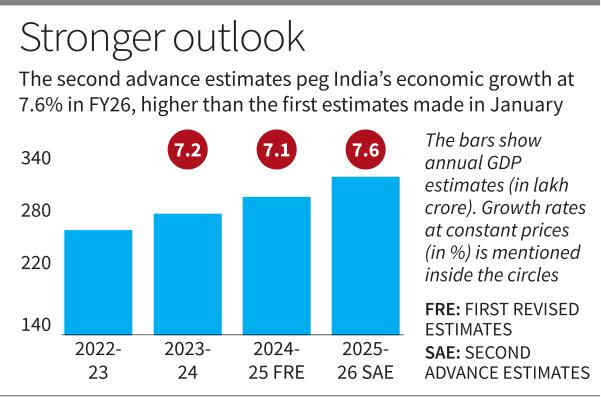
Context: India’s economic growth for FY26 upgraded to 7.6% in the second advance estimates based on the new GDP series.
Old vs New GDP Series
| Sector | Earlier | Now |
| Non-Financial Private Corporate Sector | GVA allocated to sector with bulk of activity | Activity-wise revenue share used |
| General Government — Housing | Housing services to employees not included | Housing services included |
| General Government — Coverage | Limited coverage of autonomous institutes & local bodies | Coverage enhanced |
| Household Sector | Data extrapolated from older surveys | ASUSE + PLFS used annually |
| Private Final Consumption | Less granular measurement | Enhanced Household Expenditure Surveys used |
New Data Sources Introduced in New Series
| Area | Earlier | Now |
| GST Data | Only in quarterly accounts & some sectors | Regional output, private company contribution & active company identification |
| Private NBFCs | Proxy-based approach | Actual NBFC financial data from MCA |
| Banking (RBI) | Limited RBI data usage | STRBI used for public & private banks |
| Local Bodies | Data largely imputed | Direct estimation via enhanced state reporting |
NABARD

Basic Facts
| Particulars | Details |
| Full Form | National Bank for Agriculture and Rural Development |
| Nature | Apex Development Financial Institution |
| Established | 12 July 1982 (National Bank for Agriculture and Rural Development Act, 1981) |
| Headquarters | Mumbai, Maharashtra |
| Ownership | 100% Government of India |
Genesis
- Origins traced to the CRAFICARD Committee (1979), chaired by Shri B. Sivaraman
- Parliament passed the NABARD Act (National Bank for Agriculture and Rural Development Act, 1981)
- NABARD took over:
- Agricultural credit functions of the RBI
- Refinance and development functions of ARDC (Agricultural Refinance and Development Corporation)
Key Functions
- Credit: Refinance to Cooperative Banks, RRBs, and Commercial Banks
- Supervisory: On-site inspections of Cooperative Banks and RRBs
- Policy: Advises RBI and Government of India on agricultural credit policy
Major Initiatives
- SHG-Bank Linkage Programme (SHG-BLP): Launched in 1992; world’s largest microfinance initiative; covers over 12 million women’s groups
- Kisan Credit Card (KCC): Flexible working capital for farmers with simplified documentation
- Rural Infrastructure Development Fund (RIDF): Set up in 1995; finances roads, irrigation canals, bridges, and storage facilities through state governments
- E-Shakti: Digitalises SHG records
Meningococcal Disease
What is it?
- A rare but serious bacterial infection
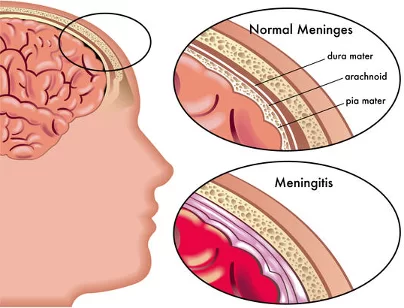
- Causes inflammation of the membranes covering the brain and spinal cord
- The two most common types are meningitis and septicemia — both can be deadly within hours
Cause
- Caused by the bacteria Neisseria meningitidis
- About 1 in 10 people carry these bacteria in the back of their nose and throat without falling ill known as being ‘a carrier’
- Sometimes the bacteria invade the body and cause meningococcal disease
Transmission
- Spreads through sharing of respiratory and throat secretions (saliva or spit)
- Requires close or lengthy contact to spread
- Less contagious than common cold or flu
Key Symptoms
- Fever, headache, and stiff neck (most characteristic symptom)
- Photophobia (sensitivity to bright light)
- Nausea, vomiting, and/or diarrhoea
- A dark red or purple pinpoint rash or bruise-like patches
Treatment
- Primarily treated with antibiotics
- Supportive care may include oxygen therapy, drugs for low blood pressure, and skin repair surgeries
Meningococcal Disease vs Meningitis
- Meningitis is an inflammation of the meninges (protective membranes of the brain and spinal cord).
- Meningitis can occur in meningococcal disease, but not all meningitis cases are caused by the meningococcal bacteria.
INS Anjadip
Basic Facts
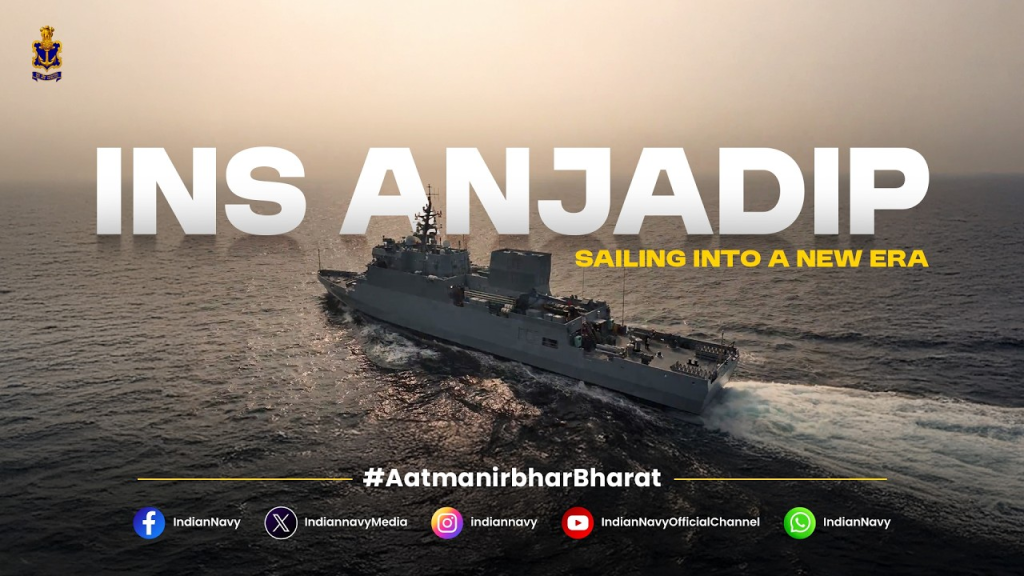
- INS Anjadip is an indigenously designed and built Anti-Submarine Warfare Shallow Water Craft (ASW-SWC).
- It is the 4th ship commissioned under the ASW-SWC project (series of eight ships).
- Commissioned by Admiral Dinesh K. Tripathi (Chief of Naval Staff) at Chennai Port.
- Commissioned at the Eastern Naval Command.
- Built by Garden Reach Shipbuilders & Engineers (GRSE), Kolkata at Kattupalli.
- Length: 77 metres.
Primary Role
- Nicknamed the ‘Dolphin Hunter’
- Engineered to detect, track, and neutralise enemy submarines in coastal (littoral) waters
Key Weapons & Systems
- Hull Mounted Sonar ‘Abhay’: indigenous sonar system
- Lightweight Torpedoes
- ASW Rockets
- Combat Management System
- Water-Jet Propulsion system with a top speed of 25 knots
Additional Capabilities
- Coastal Surveillance
- Low-Intensity Maritime Operations (LIMO)
- Search and Rescue (SAR) operations
Significance
- Represents a major step towards Aatmanirbhar Bharat in defence
- Marks India’s transition into a formidable ‘Builder’s Navy’
- Named after Anjadip Island (near Karwar, off Goa coast) — strategically located in the Arabian Sea
- Vasco da Gama claimed the island as Portuguese crown territory on 24th September 1498 during his first voyage to India
Asian Development Bank (ADB)
Context: IIFL Home Finance signed a $300 million loan with ADB to strengthen affordable housing finance for women in low-income communities in peri-urban and urban areas.
About Asian Development Bank (ADB)
- Basic Facts
| Particulars | Details |
| Established | 19th December 1966 |
| Headquarters | Manila, Philippines |
| Nature | Multilateral Development Bank |
| Members | 69 members — 49 regional + 20 non-regional |
| Largest Shareholders | Japan & USA (15.6% each), China (6.4%), India (6.3%), Australia (5.8%) |
Key Functions of ADB
- Provides grants, loans, technical assistance, and equity investments to developing member countries
- Facilitates policy dialogues and mobilises financial resources through cofinancing operations
- Focuses on six key areas aligned with UN SDGs: Education, Health, Transport, Energy, Finance, and Climate Change
- Works with NGOs and private companies to improve capital markets
Governance of ADB
- Operated by a Board of Governors: one representative per member state
- Board elects 12 Directors: 8 from regional + 4 from non-regional members
- President serves a five-year term
- Every ADB president has been from Japan (as its founder and largest shareholder)
Membership
- Open to members of the UN Economic Commission for Asia and the Far East
- Grown from 31 members (1966) to 69 members today.
Green Bonds

Context: Bank of Baroda plans to raise up to ₹10,000 crore through green infrastructure bonds.
What are Green Bonds?
- According to SEBI, a green debt security is one issued with the intention of raising money for causes like sustainable development or increased energy efficiency.
- Green bonds are debt instruments similar to normal bonds, but the capital raised must be earmarked exclusively for green projects.
- Green projects typically include those linked to renewable energy, pollution reduction, and similar environmental initiatives.
Key Features
- Green bonds can be issued by both governments and private companies such as multinational corporations.
- They generally carry lower interest rates than loans provided by commercial banks.
- They are considered less risky since they are linked to the issuer rather than the successful completion of the projects.
- When issuing green bonds, issuers must provide information about the project needing green financing and the overall environmental benefits arising from it.
Green Bonds vs Normal Bonds
| Aspect | Normal Bonds | Green Bonds |
| 1. Use of funds | Any project | Green projects only |
| 2. Interest rate | Market rate | Generally lower |
| 3. Disclosure requirement | Standard | Must disclose environmental benefits |
Risk of Greenwashing
- Due to lower interest rates, businesses sometimes attempt to raise money under the guise of green bonds without genuine environmental intent and this practice is called greenwashing
Durand Line
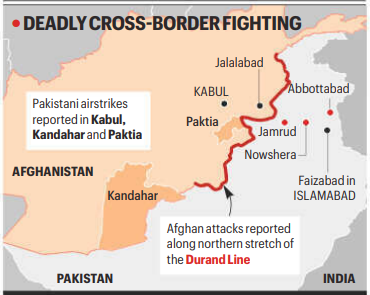
What is the Durand Line?
- A 2,600 km border running from the Iran border in the west to the China border in the east
- Cuts across the Karakoram range and the Registan desert
- Drawn between British India and Afghanistan by Sir Henry Mortimer Durand (Foreign Secretary) and Emir Abdur Rahman Khan of Afghanistan in 1893
Historical Background About Anglo-Afghan Wars
| War | Year | Outcome |
| First Anglo-Afghan War | 1839 | British invaded but were pushed back |
| Second Anglo-Afghan War | 1878 | British won → Treaty of Gandamak (1879) → gave Britain control over Afghanistan’s foreign policy |
| Third Anglo-Afghan War | 1919 | Ended with Treaty of Rawalpindi → restored Afghanistan’s control over foreign affairs → reaffirmed the Durand Line |
Significance of the Durand Line (1893)
- Split Pashtun tribal areas between British India and Afghanistan
- Placed Balochistan under British India
- Established the Wakhan Corridor as a buffer zone between Russia and Britain
Post-1947 Scenario
- Pakistan inherited the border after Partition
- Afghanistan refused to recognise it, calling it a colonial creation
- Pashtun groups on both sides demanded a separate Pashtunistan, deepening bilateral tensions
- All Afghan governments, including the Taliban, reject the Durand Line’s legitimacy and press claims over Pashtun regions
Bail, Parole & Furlough

Context: The Supreme Court ordered the release of Nitish Katara murder convict Vikas Yadav on furlough for temporary release to spend family time on Holi.
Definitions
- Bail: Pre-trial release granted to an accused while their case is pending in court as does not imply innocence
- Parole: Conditional release given to a convict who has served part of their sentence, intended as a reward for good behaviour and to facilitate reintegration into society
- Furlough: Temporary release granted to a convict for a specific personal purpose (e.g., family funeral, visiting a seriously ill family member), inmate must return after the period ends
Comparative Table
| Aspect | Bail | Parole | Furlough |
| Stage | Before conviction (trial pending) | After partial serving of sentence | During serving of sentence |
| Purpose | Ensure court appearance | Rehabilitation & reintegration | Maintain family ties |
| Eligibility | Most accused (except serious crimes/flight risk) | Long-term prisoners with good conduct | Convicts with good conduct & long sentences |
| Duration | Until trial concludes | Longer term, extendable | Short-term (days to weeks) |
| Granted by | Court | Prison authorities or Court | Prison authorities |
| Legal Nature | Judicial process & fundamental legal right | Mix of administrative & legal oversight | Administrative measure under prison rules |
| Conditions | Court appearances, no criminal activity | Regular reporting, restricted movement | Reporting to police, return to prison on time |
